Axios Hill Leaders

January 09, 2026
Newsy edition, wild day. 944 words, 3.5 minutes.
- ☘️ Thune's lucky break
- 🗳️ Dems stick to Venezuela
- ⏎ Shades of "Abolish ICE"
1 big thing: ☘️ Thune's lucky break
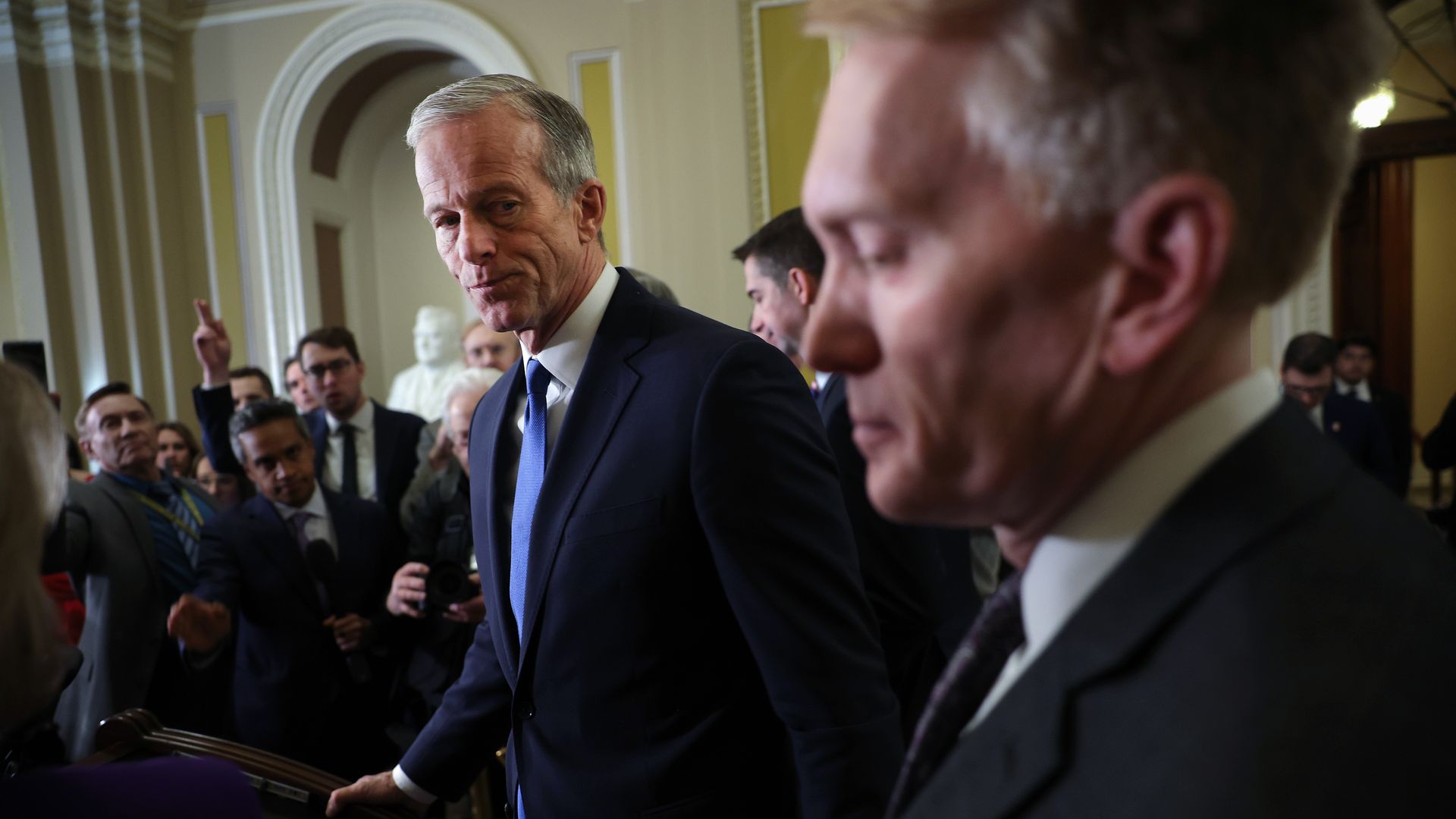
House Speaker Mike Johnson solved a problem for Senate Majority Leader John Thune today, sparing the Senate from burning precious floor time on veto votes when they're on the clock for government funding.
Why it matters: The Senate embarrassed President Trump, with five Republicans voting to advance a War Powers Act vote on Venezuela.
- But the House prevented one Trump defeat from turning into three, blocking a pair of veto overrides.
Between the lines: There was some concern in the Senate that the two veto overrides, plus next week's votes on the war powers resolution that advanced today, would prevent them from passing a three-bill spending package before leaving for a week-long recess.
- Now it's possible for the Senate to move on the spending minibus next week, as leaders work in rare harmony to try and prevent another government shutdown on Jan. 31.
Trump's frustration surfaced in a Truth Social Post. He name-checked all five GOP senators and said they "should never be elected to office again."


Zoom in: The House voting to sustain Trump's vetoes was quite a surprise.
- Last week, Trump used the first vetoes of this term on a Colorado water measure and a Florida flood control project. Both bills passed unanimously in the House.
- But rank-and-file Republicans rallied to Trump's defense. In the end, he lost 35 Republicans on the Colorado vote and 24 on the Florida one.
The intrigue: A rump brigade of 17 House Republicans voted to pass a three-year extension of the ACA tax credits that were brought to the floor via a discharge petition.
- Yes, they defied the GOP leadership in siding with the Democrats.
- But they also increased pressure on the Senate to act on rising health care costs, giving Senate negotiators a small window to find common ground to solve a political problem on rising health care costs and affordability.
The bottom line: House Republicans might not have been acting entirely out of magnanimity towards Trump. Fear was also a motivating factor.
- "This had nothing to do with a policy disagreement. Folks are afraid of getting a mean tweet or attack," Rep. Lauren Boebert (R-Colo.), who represents the district for the water project, said after the failed veto overrides.
— Hans Nichols and Kate Santaliz
2. 🗳️ Dems stick to Venezuela
Sen. Tim Kaine (D-Va.) wants to keep the war powers resolution that he advanced in the Senate today squarely focused on Venezuela — and not have it drift towards Greenland.
Why it matters: Democrats want to turn their surprising procedural victory into clear military restrictions on Trump in Venezuela.
- But the amendment process on war power resolutions is fairly open and Democrats might be tempted to turn next week's debate on Kaine's resolution into around-the-world critique of Trump's foreign policy.
"It's not a good idea to put other countries in," Kaine told reporters, insisting he didn't want to include anything on Trump's efforts to subsume Greenland.
- "My strategy on amendments is likely to be: Do I think this amendment will hurt the final passage vote? And if it is — even if I kind of like it — if it would hurt the final passage, I would probably be against it."
- "I think we should just pass it," Sen. Richard Blumenthal (D-Conn.) told us. "There's no need to burden it with extraneous stuff. It speaks volumes powerfully on its own."
The other side: Republicans didn't reveal their amendment strategy but made it clear they thought the underlying resolution was flawed.
- "The resolution is irrelevant because it speaks to removing troops from the country that don't exist," said Sen. Jim Risch (R-Idaho), the chair of the Senate Foreign Relations Committee.
The bottom line: If Kaine's resolution passes the Senate, it will head to the House, where it faces longer odds.
- And if Congress does somehow pass a joint resolution, Trump will almost certainly veto it.
— Hans Nichols
3. ⏎ Shades of "Abolish ICE"
Democrats are pushing the most confrontational changes for federal law enforcement since the days of "Abolish ICE."
Why it matters: We're only two years removed from the 2024 election losses that Democrats blamed — in part — on the immigration issue. But a majority of Americans said last year that President Trump is doing "too much" on deportations, according to Pew.
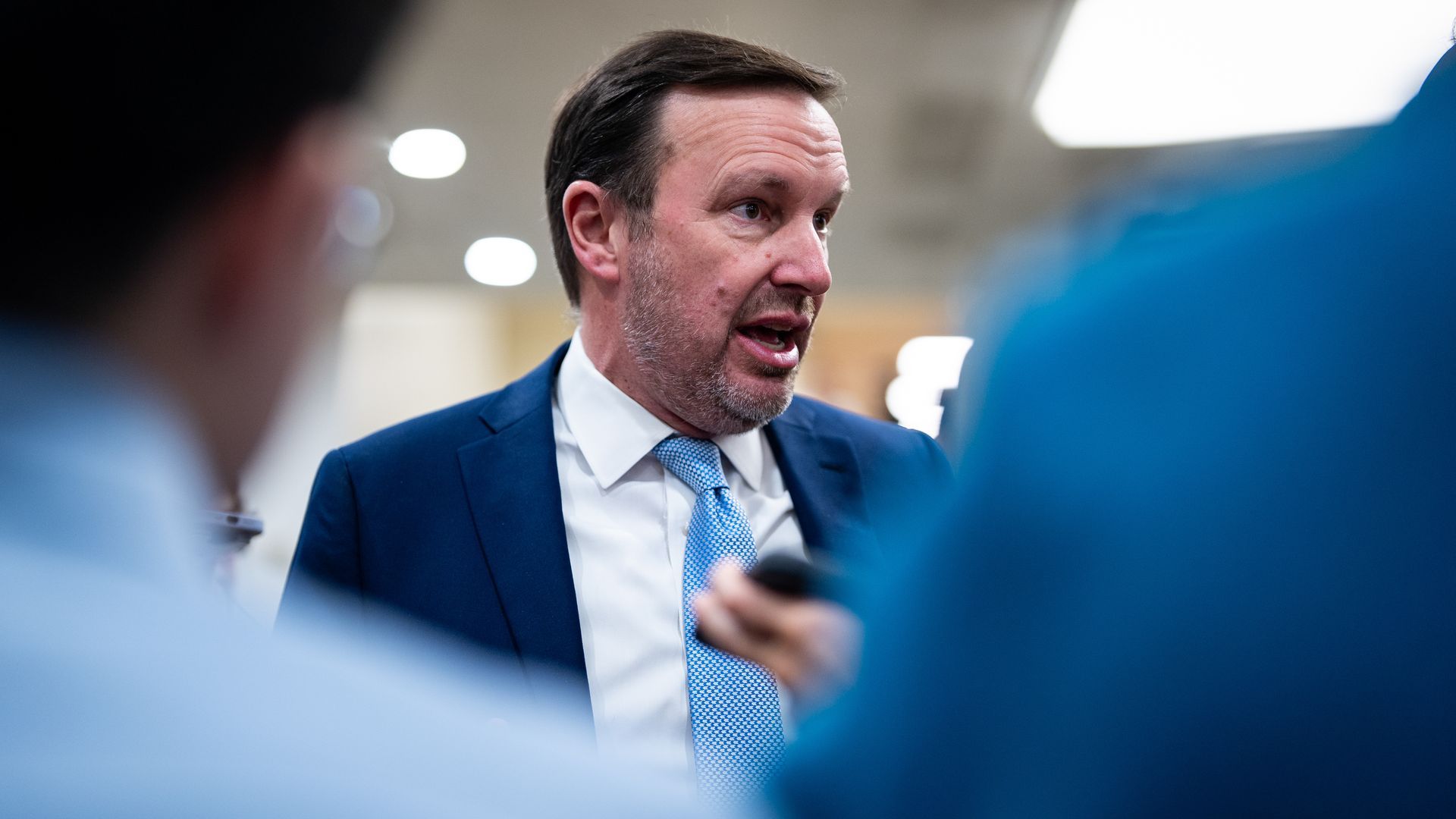
- After the fatal ICE shooting in Minneapolis, Sen. Chris Murphy (D-Conn.) will propose sweeping reforms to DHS, including requiring a warrant for arrests, banning masks during enforcement operations and requiring Border Patrol to remain at the border, we reported earlier today.
- Murphy's proposal also would limit the use of firearms by ICE when conducting civil matters and require agents to wear identification.
Zoom in: Murphy is also trying to build a coalition of Democrats to insist on some restraints on DHS' authority as a condition of their support for a spending bill for the department — with funding set to lapse Jan. 30.
- Murphy and his staff are in conversations about his new bill with lawmakers from Minnesota, California and Illinois, where DHS has deployed large numbers of agents, a source familiar with the talks told us.
- "It's hard to imagine how Democrats are going to vote for a DHS bill that funds this level of illegality and violence without constraints," Murphy told us today. "There's gotta be some reasonable constraints."
The bottom line: It's hard to see Republicans agreeing to Democratic demands for constraints.
- Absent a bipartisan agreement, Democrats' other option would be to try to block, or at least vote against, a DHS funding bill or a stopgap measure for the department.
— Stephen Neukam
This newsletter was edited by Justin Green and copy edited by Arthur MacMillan
Sign up for Axios Hill Leaders