
Axios Generate

May 15, 2023
🥞 Good morning! Today's newsletter has a Smart Brevity count of 1,233 words, 5 minutes.
‼️ New U.S. pipeline giant: ONEOK is acquiring Magellan Midstream Partners in a nearly $19 billion cash-and-stock deal announced last night.
- The deal marries ONEOK's natural gas liquids pipelines with Magellan's crude oil and refined products network. Go deeper.
🎶 Exactly 45 years ago, Yvonne Elliman was #1 on Billboard's Hot 100 with this week's first intro tune...
1 big thing: Tropical Cyclone Mocha fits a climate-driven pattern

A man looks from a window in Myanmar's Rakhine State during Tropical Cyclone Mocha on May 14. Photo: Sai Aung Main/AFP via Getty Images
Tropical Cyclone Mocha, which struck Myanmar and Bangladesh as a high-end Category 4 storm on Sunday, is a catastrophic example of a rapidly strengthening storm — one that leaps multiple intensity categories, Andrew writes.
Why it matters: Rapid intensification, along with higher rainfall rates, are key ways that climate change is influencing nature's strongest storms.
- Studies show such storms are becoming increasingly common and the magnitude of the rapid intensification is rising.
Threat level: Aid organizations are scrambling to respond to Cyclone Mocha, which struck just north of Sittwe, Myanmar, packing maximum sustained winds of 155 mph, making it a high-end Category 4 storm.
- At its peak intensity about 8 hours before landfall, it had maximum sustained winds of 175 mph. That put it tied for first place on the list of the most intense tropical cyclones on record for the North Indian Ocean Basin, per meteorologist Jeff Masters.
Zoom in: Cyclone Mocha went through at least two major bursts of rapid intensification, with sustained winds climbing by at least 90 mph in 48 hours.
- When examining its strengthening over a shorter period, when the storm's winds climbed by 60 mph, Cyclone Mocha ranks among the top 1% of all rapidly intensifying storms in the Bay of Bengal, according to meteorologist Kieran Bhatia.
- Conditions were ideal for rapid intensification, with light winds aloft and warm ocean waters from the surface to deeper depths.
Between the lines: Several recent studies have pointed to climate change as a key suspect behind shifts in the frequency and magnitude of rapidly intensifying storms.
- For example, a 2020 study published in the Proceedings of the National Academy of Sciences found that tropical cyclones are now more likely to reach higher categories across much of the globe.
- In addition, a 2019 paper in the journal Nature Communications found a trend in Atlantic hurricanes toward more rapid intensifiers during the 1982-2009 period that was unlikely to be from natural climate fluctuations alone.
- Another paper, published last year, found that "extreme rapid intensification events," with sustained winds that increased by at least 57 mph in 24-hours, have become more common worldwide.
What they're saying: "If you increase the available energy that a cyclone can convert into wind, you increase the likelihood of more rapid intensification events that result in more category 4 and 5 storms," said Jim Kossin, a meteorologist at The Climate Service, a sustainability intelligence company.
- "Climate change is increasing this available energy."
- Karthik Balaguru, a climate scientist at Pacific Northwest National Laboratory, urged caution about directly attributing Cyclone Mocha's intensification to climate change, but said the storm's behavior is consistent with research findings.
2. 2023 is currently in 4th place in race to warmest year: NOAA
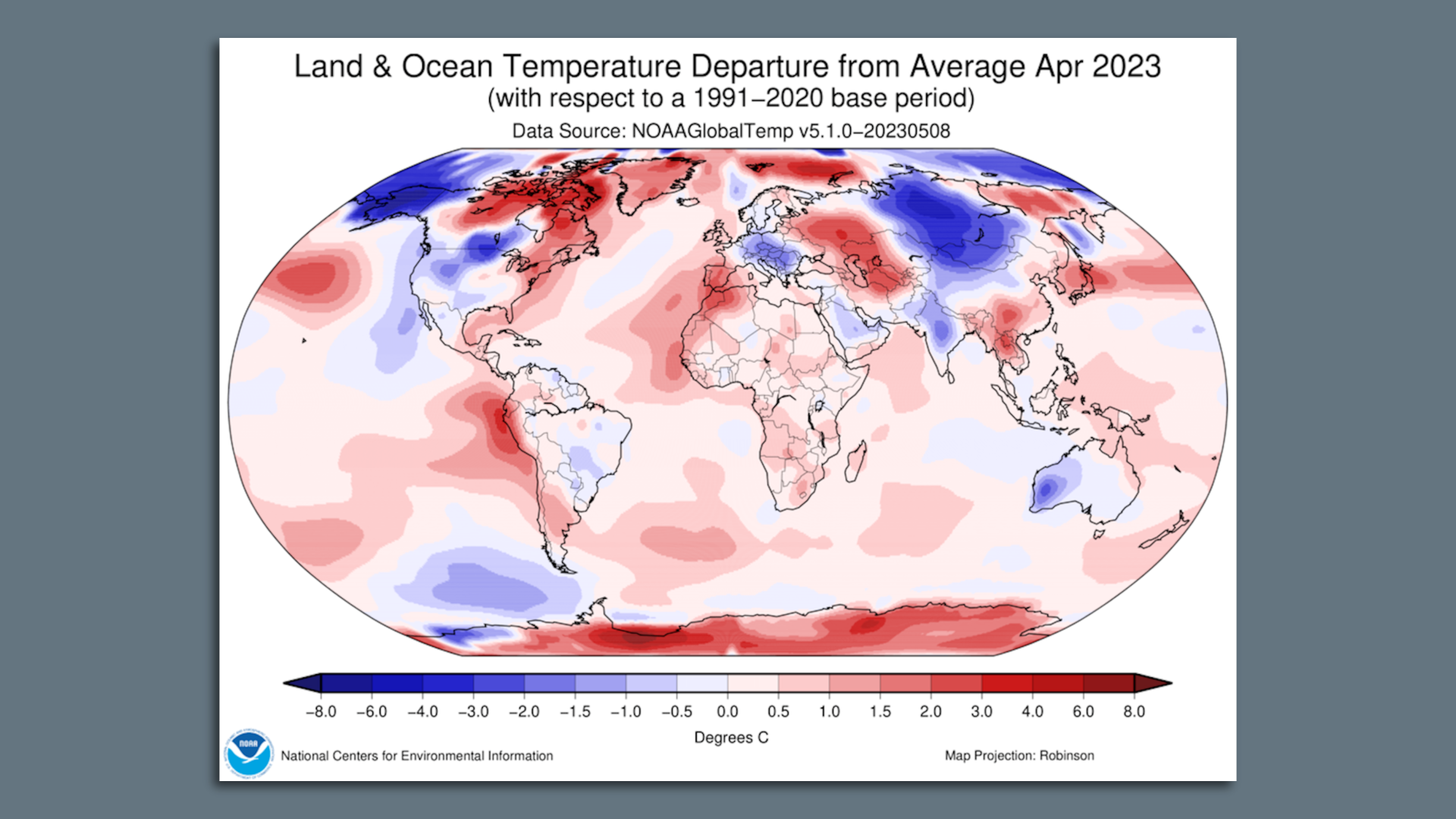
Map of global average surface temperature departures from average during April 2023. Image: NOAA
April's global climate statistics are in, and three of the main temperature-tracking groups found that the month was the fourth-warmest April on record, Andrew writes.
Driving the news: The most recent agency to weigh in is NOAA, whose findings echo Europe's Copernicus Climate Change Service and NASA.
- NOAA also found the January-April period stands as the fourth-warmest on record.
Zoom in: In addition, the Southern Hemisphere had its warmest month of any month on record, NOAA found, and related to the rapidly developing El Niño, global oceans were the second-warmest of any month.
Between the lines: NOAA pegs 2023's likelihood of setting a warmest year milestone at 27.6%, along with a 92.9% probability of landing in the top-5 warmest range, and a greater than 99.5% chance of a top-10 year.
- NOAA also stated with 95% confidence that the year will be between the 1st and 7th-warmest year on record.
- The agency provides a helpful chart of how this year is trending compared to previous hottest years.
3. Charted: Carbon capture's slow launch at power plants
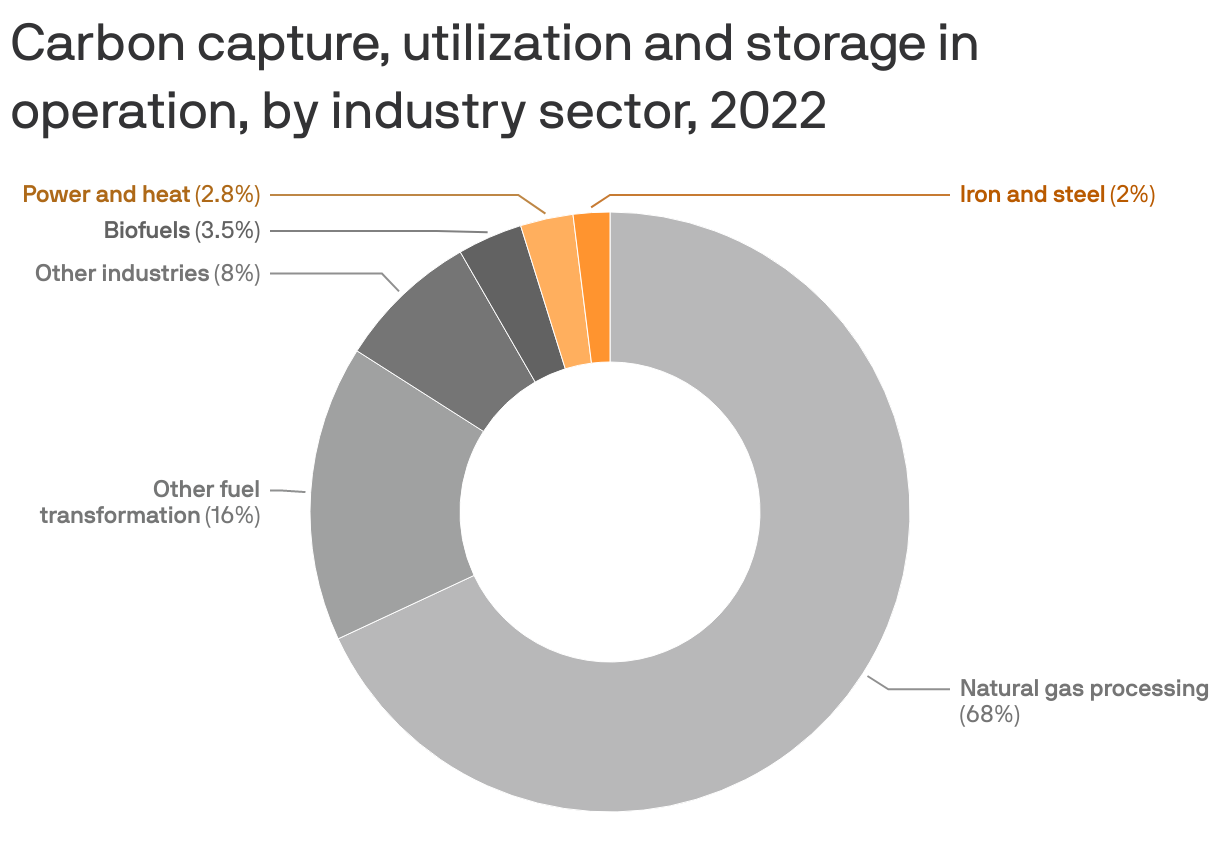
Deployment of carbon capture tech in the U.S. and worldwide is slated to grow, but as you can see above, most global action to date has not been at power plants, Ben writes.
Why it matters: EPA's new draft carbon emissions rules for U.S. power plants promote use of the tech to comply with the standards.
The big picture: No power plants with carbon capture are currently operating in the U.S.
- The most recent effort — the Petra Nova project in Texas — halted operations in 2020.
What we're watching: That project's owners plan to restart the facility this year.
- And Reuters reports that over a half dozen other U.S. carbon capture projects are planned in the power sector.
- More broadly, while carbon capture has been slower to catch on than backers have hoped, the International Energy Agency also sees momentum and growth in power and other industry sectors this decade.
What we don't know: How many U.S. carbon capture projects will be enabled by climate law incentives, along with EPA rules — if they survive legal and political challenges.
👀Big this week: G7 energy diplomacy
We'll be keeping close watch on the G7 heads-of-state summit in Hiroshima, Japan that begins Friday, Ben writes.
What we're watching: How the joint declaration addresses natural gas amid the competing pressures of decarbonization and energy security.
Catch up fast: In mid-April, G7 energy and climate ministers issued a very nuanced statement that cautiously endorsed some gas investment.
The big picture: It's connected to how states will continue trying to isolate Russia while ensuring adequate oil and natural gas supplies.
- The Financial Times reported Sunday that their may be agreement to "prevent the resumption of Russian pipeline gas exports on routes to countries such as Poland and Germany."
- The idea is to ensure that Russia "does not receive a boost to its energy revenues" as the G7 looks to raise economic pressure on Moscow.
🏃🏽♀️Catch up fast on policy: Finance, Treasury, Congress

Illustration: Sarah Grillo/Axios
💰The Energy Department plans to stake a Texas manufacturing plant that will produce wiring systems used in electric vehicles, Ben writes.
- Driving the news: DOE's loan office on Friday announced a preliminary $362 million commitment for CelLink's "flexible circuit wiring harnesses" plant.
- Why it matters: Their tech is "lighter, smaller, faster to produce, and can be less expensive than conventional wiring harnesses," DOE said.
- The big picture: The Georgetown, Texas plant is expected to produce enough harnesses for roughly 2.7 million EVs annually, the department said.
📈 The share price of U.S. solar manufacturer First Solar soared 26% Friday after the Treasury Department announced how it will implement a key climate law incentive.
- Why it matters: It was among several solar companies to see immediate market gains. "Investors viewed the news as a boon to companies with existing or future plans for U.S. factories," Reuters reports.
- The intrigue: Treasury is allowing developers to use Chinese-made solar materials and still receive the domestic content "bonus" — provided 40% of the overall project materials by cost are from the U.S. That irked some domestic manufacturers.
👀 A GOP-led House Oversight Committee panel will gather Wednesday to air criticisms of EPA's draft carbon emissions rules for vehicles, which mandate a steep increase in EV sales.
- Why it matters: The hearing is an early sign of the intense political and legal battles ahead over the recently proposed rules, which aim to have EVs hit 60% of U.S. light-duty vehicle sales in 2030.
👋 Ana Unruh Cohen is joining the White House Council on Environmental Quality as senior director for clean energy, infrastructure, and NEPA, officials said this morning.
- Why it matters: She's a well-known and connected figure in climate circles.
- Catch up fast: Past gigs include Democratic staff director for the House Select Committee on the Climate Crisis, which ceased operations following the change in House control.
📬 Did a friend send you this newsletter? Welcome, please sign up.
🙏 Thanks to Nick Aspinwall and Chuck McCutcheon for edits to today's edition.
Sign up for Axios Generate

Untangle the energy industry’s biggest news stories


