Axios Generate

January 15, 2021
Welcome back! Today's Smart Brevity count: 1,390 words, 5 minutes.
🛢️ A Trump-appointed regulator finalized a rule Thursday that — if left intact — would thwart big banks’ policies that avoid lending for projects like Arctic oil drilling and new coal plants. CNN has more, and check out our earlier coverage here.
🗓️ Generate will be off Monday in recognition of Martin Luther King Jr. Day.
🎶 And this month marks 40 years since Elvis Costello and the Attractions released the album "Trust," which provides this week's final intro tune...
1 big thing: Unlocking the ways to meet China's carbon goal

Illustration: Annelise Capossela/Axios
China has a workable path toward making a huge head start on its long-term climate pledges by ensuring that essentially all new power generating capacity added going forward is zero-carbon, a new analysis argues.
Driving the news: The report out today offers what authors call a technically and economically feasible roadmap for transforming China's power sector over the next 10 years.
It's from the Rocky Mountain Institute, which is a clean energy think tank, and the Energy Transitions Commission, a coalition that brings together corporate heavyweights and NGOs.
By the numbers: China has recently pledged to achieve economy-wide carbon neutrality by 2060 and have its emissions peak before 2030.
The report says the roadmap on electricity in particular between now and 2030 would involve...
- Electricity generation growing by 54% as demand grows and China works to electrify more of the economy to help curb emissions.
- No new coal-fired capacity is added, while combined onshore wind and solar capacity would rise from 408 gigawatts in 2019 to roughly 1,650 GW in 2030.
- There are smaller increases in hydro, nuclear, gas and offshore wind capacity additions.
- Total non-fossil generation is 53% of the country's total by then in the roadmap aligned with fully decarbonized power by 2050.
Why it matters: China is by far the world's largest greenhouse gas emitter. So there's lots of interest in whether the country will translate its broad pledges into sweeping on-the-ground changes to its energy systems — and how that can happen.
The intrigue: One key finding is the technical challenges of having immensely larger amounts of variable renewables on China's grids are real but solvable.
- It lays out ideas around improvements in forecasting and data management, voltage control and more.
- I'm out of space and time, but there's a lot there — including market reform proposals — and I encourage wonks and wonk-adjacent readers to check it out.
Bonus: The geopolitics of China's climate plan
One more China thing: a piece this week in Foreign Policy by analysts with the Breakthrough Institute looks at the geopolitical and economic motivations behind China's big climate pledge late last year.
Here's part of the geopolitical side of the wide-ranging analysis...
- "China’s net-zero commitment allowed it to neuter American criticism of China well before any potential change in U.S. political leadership while preempting efforts by the EU to apply pressure via carbon border taxes."
- "Just as importantly, it was also calculated to counterbalance rising Western concerns about China’s belligerent posture in the South China Sea, its saber-rattling toward Taiwan, its human-rights crackdown in Hong Kong, its genocidal assault on the Uighur minority in northwestern China, and much more."
2. Breaking: Oil major Total leaves API
Oil-and-gas giant Total said this morning that it's leaving the American Petroleum Institute, which is the industry's most powerful U.S. lobbying group.
Why it matters: It's the biggest rupture yet between European-headquartered multinational oil majors and U.S.-based trade groups over climate policy.
Total, Shell, BP and Equinor have previously left some other trade associations.
What they're saying: France-based Total cited several differences with API.
They noted API is part of a group that opposes electric vehicle subsidies.
They also cited differences on carbon pricing and that "API gave its support during the recent elections to candidates who argued against the United States’ participation in the Paris Agreement."
3. Biden nears legislative push on energy spending
Joe Biden plans to seek big energy- and climate-related infrastructure investments in the economic recovery bill he'll propose after trying to push a more immediate COVID-19 relief package through Congress.
Driving the news: Biden offered the outlines of his strategy in remarks yesterday about the proposed $1.9 trillion COVID-19 relief plan that's focused on vaccines and immediate economic aid.
The big picture: Biden said he would lay out the recovery package in his first address before a joint session of Congress next month (it's not technically a State of the Union but it's the same type of thing).
- "It will make historic investments in infrastructure and manufacturing, innovation, research and development, and clean energy," Biden said.
- Staying on infrastructure, he said touted rebuilding roads, bridges and ports "to make them more climate-resilient, to make it faster, cheaper, and cleaner to transport American-made goods across our country and around the world."
- He also said the proposal would include "historic" R&D investments in areas including battery tech and clean energy.
* * *
Speaking of Biden, his team announced this morning that it's nominating Janet McCabe to be deputy administrator of EPA, the number two slot at the agency.
She was the agency's top air quality official during the Obama administration.
4. Democrats will face tricky puzzles
Illustration: Aïda Amer/Axios
Put a pin in this one: The Washington Examiner reports that Sen. Joe Manchin, the incoming energy committee chair, is "signaling that he’ll be a check on liberal climate change policies such as a mandate for carbon-free electricity."
Why it matters: The piece is an early glimpse at the positioning of the man who will have lots of influence as a conservative Democrat in the almost evenly split Senate.
It's a reminder that Democrats will be challenged to balance competing interests in their caucus.
The big picture: One of Joe Biden's big goals is a standard requiring 100% carbon-free U.S. electric power by 2035, though details are scarce.
- The Examiner reports Manchin "would not rule out" supporting specific policies to reach the 2035 goal.
- But he "appeared skeptical of an idea championed by progressives to impose a clean electricity standard that would mandate utilities to use only electricity that emits no carbon...within 15 years."
What's next: Keep an eye on Manchin as his detailed positions emerge and bills for turning Biden's platform into specifics surface. And that brings me to this interesting report in Bloomberg.
- It previews an upcoming analysis on ways to advance a clean electricity standard that work within the Senate's tricky budget reconciliation process.
- That's important because reconciliation measures are immune from filibuster.
How it works: The analysis is from the University of California at Santa Barbara analyst Leah Stokes and co-authors with groups including Evergreen Action, they report.
Among the five ideas are...
- "Clean electricity credits" that "assign each utility a target for an 80% or so emissions drop by 2030 and 100% by 2035."
- Block grants under which states would "qualify for federal funding by enacting 100% clean-energy standards."
5. UN's former climate head joins Impossible Foods
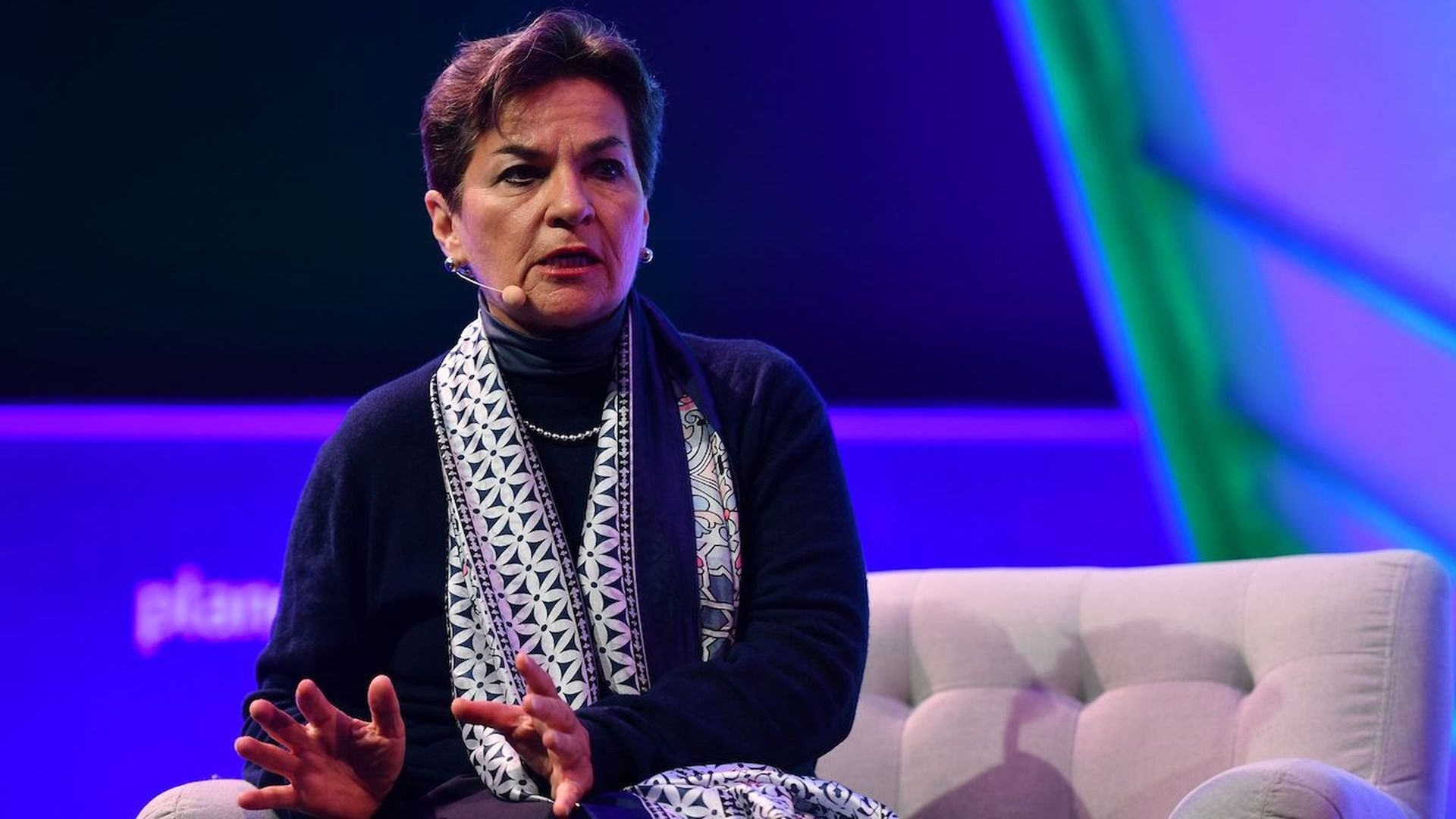
Former UNFCCC executive secretary Christiana Figueres at the Collision 2019 conference. Photo: Sam Barnes/Sportsfile via Getty Images
Axios' Bryan Walsh scoops...Christiana Figueres, an architect of the Paris climate agreement, will be joining the board of alternative protein startup Impossible Foods.
Why it matters: Figueres' move signals the growing importance of the alt-protein sector, and it's an acknowledgment that solving climate change must include addressing food and agriculture, as well as energy.
What they're saying: "[Figueres'] experience and insights into working with the global community on climate change solutions will be invaluable in our fight to save the planet," says Impossible Foods CEO Patrick O. Brown.
Catch up fast: Figueres, a former Costa Rican diplomat, oversaw the UN's main climate change body, the United Nations Framework Convention on Climate Change (UNFCCC), from 2010 to 2016, including the negotiations that led to the Paris Agreement.
- Since leaving the UN, she's served on the board of the Spanish energy and infrastructure company Acciona and founded the environmental advocacy group Global Optimism.
The big picture: Figueres tells Axios she sees Impossible Foods — which makes plant-based protein products, including the Impossible Burger — and the food industry overall as "one of the main levers of change" on global warming.
"The consumption of animal products — and especially the consumption of beef — is detrimental to personal health as well as planetary health, because of embedded deforestation," she says.
What to watch: Whether Impossible Foods can continue to bring its price down to help compete with conventional meat.
6. Sizing up 2020's place in a warming world
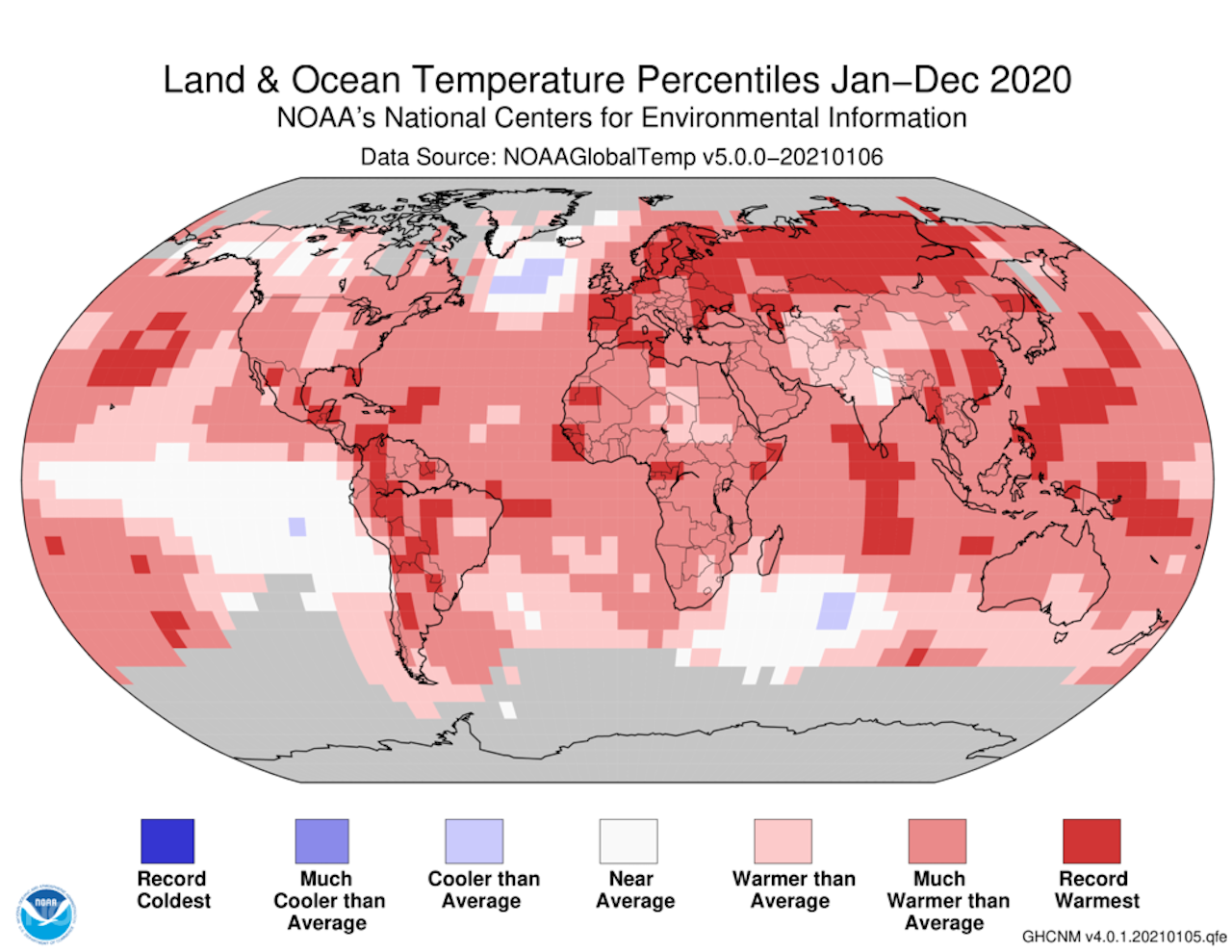
Via The Washington Post..."The year 2020, which witnessed terrifying blazes from California to Siberia and a record number of tropical cyclones in the Atlantic, rivaled and possibly even equaled the hottest year on record, according to multiple scientific announcements Thursday."
Driving the news: Analyses from the National Oceanic and Atmospheric Administration, NASA and others put 2020 on par with or just below 2016, though it's essentially a statistical dead heat.
Why it matters: The data signifies the ongoing march of global warming. "The world’s seven-warmest years have all occurred since 2014, with 10 of the warmest years occurring since 2005," NOAA's analysis states.
The analysis shows 2020 was just 0.02°C cooler than the record-breaking 2016, while NASA showed a tie.
What they're saying: "Whether one year is a record or not is not really that important," Gavin Schmidt, a top NASA scientist, said in a statement.
"[T]he important things are long-term trends. With these trends, and as the human impact on the climate increases, we have to expect that records will continue to be broken," he said.
7. Catch up fast: Shale, Chevron, employment
Fracking: "Halliburton Co. is swapping diesel-powered engines for grid-supplied electricity in the Permian Basin, the latest example of how the U.S. shale industry is looking for ways to reduce emissions amid heightened scrutiny from investors." (Bloomberg)
Venture capital: "Chevron Corporation on Jan. 14 said it made an investment in Blue Planet Systems, a start-up company that uses its proprietary carbon capture process to repurpose flue gas from refineries and other industrial operations into building materials." (S&P Global Platts)
Jobs: "While clean energy job growth accelerated somewhat following an especially slow November, the sector ended 2020 with a deficit of 429,258 jobs." (Morning Consult)
Sign up for Axios Generate

Untangle the energy industry’s biggest news stories