
Axios Generate

October 15, 2024

🥞 Welcome back! This week's first edition is a quick 1,105 words, 4 minutes.
🛢️ Situational awareness: Oil prices are dropping sharply this week on multiple reports that Israel doesn't plan to strike Iranian energy sites.
- Brent crude is in the mid-$74 range this morning, down from the $79 range late last week.
📻 This week in 1985, INXS released their breakthrough album "Listen Like Thieves," which provides today's intro tune...
1 big thing: Making sense of Google's nuclear-powered AI ambitions
Let's spend more time with Google's move to support small modular nuclear reactors to help power the AI-fueled data center build-out.
🏃 Catch up quick: Google inked a deal with Kairos Power for deployment of 500 megawatts' worth of SMRs by 2035, with the first targeted to arrive by 2030.
- The planned 75MW size of their reactors suggests a half-dozen projects, though some could be next to each other.
Why it matters: It's Google's first nuclear foray as the tech giant — and its peers — hunt for zero-carbon power to fuel energy-thirsty AI data centers.
A few takeaways...
❤️ Big tech is spreading the love. So far Microsoft is staking revival of a Three Mile Island reactor. It's also exploring fusion.
- Amazon plans to co-locate a data center campus with a separate large, existing reactor.
- And now Google is supporting SMRs, while Oracle is also exploring small reactors.
- Look for more kinds of deals as different tech giants find different ways to back nuclear. And Michael Terrell, Google's senior director for energy and climate, signaled to reporters that the company could explore multiple nuclear strategies.
🤷 Google's plan is rather vague right now. The company and Kairos offered no specifics on the costs, financial timelines, or other money matters. Nor are there location details.
- But that said, they emphasized that it's a structure called an "order book" that, per DOE, aims to support repeated deployments of one design.
- "The learnings that come from building the same reactor technology multiple times over, will lead to lower costs and greater scale," Terrell said.
🔗 It could have effects beyond Google. Power researcher Jesse Jenkins said Google is using its purchasing power to "create early market pull to help commercialize advanced clean firm power technologies."
- Jenkins, posting on X, cites Google's separate work with geothermal startup Fervo Energy (and noted that Google supports his Princeton research lab).
- Another big tech player going nuclear could help explain why the share prices of SMR startups Oklo and NuScale jumped yesterday.
Reality check: SMRs face big regulatory, financial and other hurdles. And for now, the wider data center expansion looks bullish for fossil fuels.
- "Natural gas will be critical to meeting surging power demand for data centers amid a boom in demand for new computing capacity through the rest of this decade," Moody's Ratings said in a new report, noting its role complementing intermittent renewables.
The bottom line: Tech giants have deep pockets and face pressure to fuel AI without lots of emissions, and that could help knock those SMR barriers down.
2. 🎉 Bonus: new AI advice for Harris and Trump
Analysts with high-level government experience have ideas to ensure the U.S. has the energy needed to maintain AI leadership — without bailing on climate goals.
Why it matters: These days our antenna's up for policy ideas on all kinds of things as a new White House looms.
🗞️ Driving the news: A new Foreign Policy piece by the scholars with Columbia University's energy think tank offers five buckets of advice, urging:
- Federal purchasing programs that support efficient systems, noting "the fastest way to meet AI's energy needs is to reduce them in the first place."
- Making it easier to build new energy infrastructure, calling the bipartisan Manchin-Barrasso permitting plan a "good start."
- Utility business model reforms that help improve existing systems, like transmission retrofits that boost capacity on existing lines.
- Stronger federal efforts to support advanced nuclear, including changes in how the Nuclear Regulatory Commission does business.
- Diplomacy that creates opportunities abroad for U.S. firms in AI and reduces China's influence.
State of play: It's authored by Jason Bordoff, an Obama-era White House energy and climate aide, and Jared Dunnmon, a former senior AI official in the Defense Innovation Unit under Biden and Trump.
What we're watching: Whether these ideas gain any traction.
3. How climate change supercharged Helene, Milton
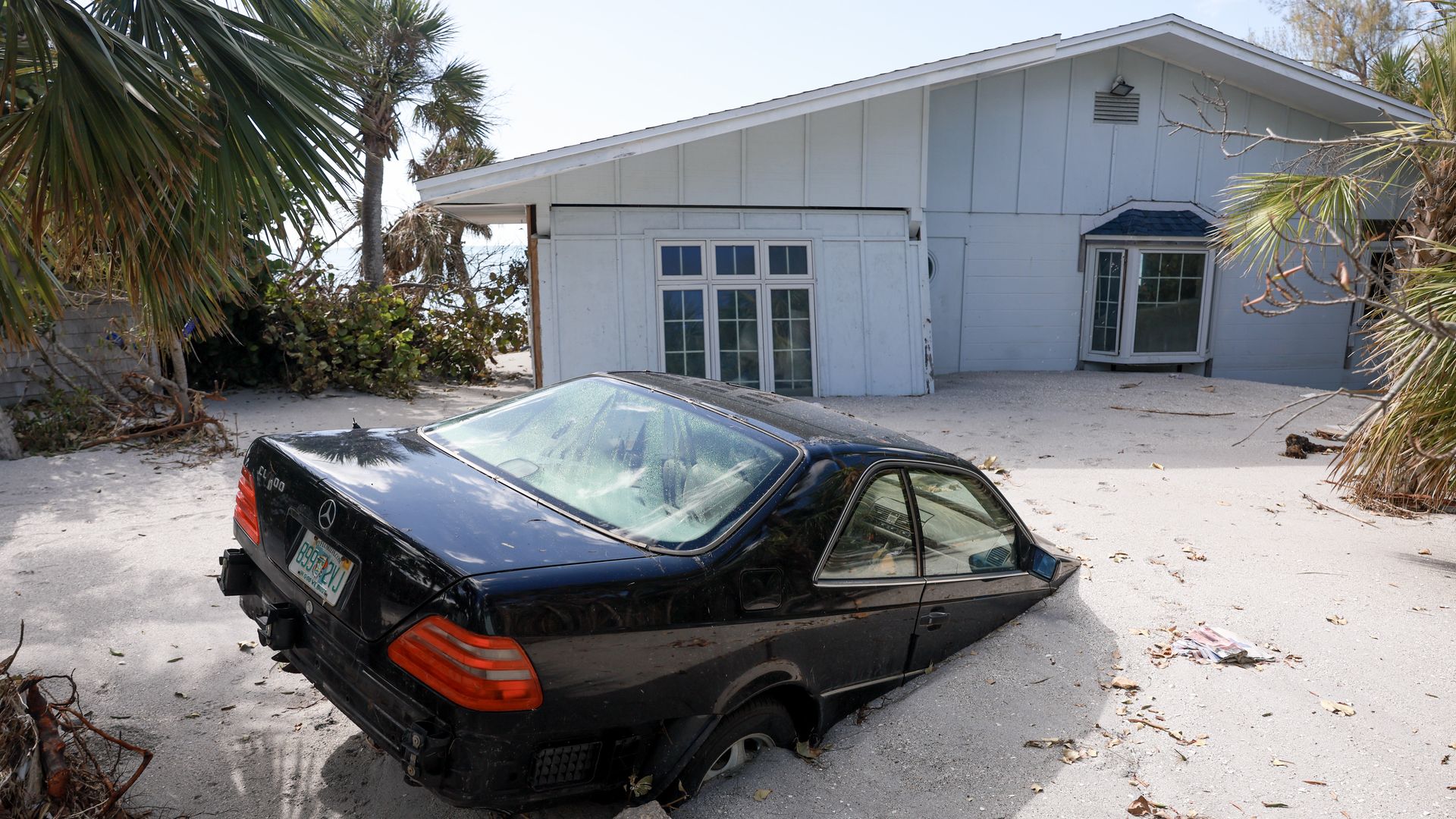
Multiple studies are clearly showing how human-caused climate change made Hurricanes Helene and Milton more potent and destructive.
Why it matters: Helene and Milton are a painful reminder that climate change is clearly affecting Earth's most powerful storms, primarily by amplifying their rainfall and helping them to rapidly intensify and reach greater peaks.
The intrigue: The physics behind this is relatively straightforward: Record-warm oceans provide more energy for hurricanes to tap into, and warmer air temperatures allow the atmosphere to hold more moisture.
- This enables such storms to get stronger and deliver more rainfall.
Between the lines: A study published by World Weather Attribution looked at shifts in the storms' environment, particularly the bathtub-like ocean temperatures that Helene encountered (Milton also went over record-warm waters in a different part of the Gulf of Mexico).
- Researchers found that climate change has increased hurricanes' potential intensity, an upper speed limit for storms that take Helene's path in the Gulf during the month of September.
- "Together, these findings show that climate change is enhancing conditions conducive to the most powerful hurricanes like Helene," the study found.
What they found: The same group conducted a limited, lightning-fast analysis of Milton.
- It found that climate change is leading to a 40% increase in the number of storms of its intensity and that such storms' maximum wind speeds are stronger now than in a world without climate change.
- A separate rapid attribution analysis from the nonprofit Climate Central found that human-driven climate change made the record-warm ocean temperatures that Milton drew its energy from between 400 to 800 times more likely.
4. 🖥️ On my screen: climate and conflict


An increasingly robust body of research links climate change and violent conflict, a new study finds.
Why it matters: "The estimated average effects are smaller than the earlier estimates, although they remain meaningful in magnitude and highly statistically significant," the Stanford and UC Berkeley scholars write.
State of play: The authors — updating their own work — conducted a detailed review and analysis of literature spanning inter-group and interpersonal conflict and self-harm.
- It explores temperature, precipitation, drought and other factors that affect farm output, income, water access and more.
- The paper, which is not peer-reviewed, arrives via the National Bureau of Economic Research.
🖼️ The big picture: A standard deviation increase in local temperature is "associated with a 2.5% increase in inter-group conflict and a 1.9% increase [in] interpersonal conflict."
The bottom line: "[A] large and rapidly growing interdisciplinary body of research now affirms that higher than normal temperatures are associated with far greater risk of many forms of violence and conflict," they conclude.
5. 🧮 Number of the day: 26 megawatts
That's the record capacity of a huge offshore wind turbine that has begun rolling off China's Dongfang Electric production lines, the company said.
Why it matters: The massive units provide lower per-kilowatt costs and are also equipped with strong anti-typhoon tech, Dongfang said. Bloomberg has more.
📨 Did a friend, colleague or even a frenemy send you this newsletter? Welcome, please sign up.
🙏 Thanks to Chris Speckhard and Chuck McCutcheon for edits to today's edition, along with the brilliant Axios Visuals team.
Sign up for Axios Generate


/2024/10/14/1728943467781.gif?w=3840)