Axios Generate

July 24, 2025

🧑🍳 Do we have a wide but light menu this morning? Yes chef! Today's edition is 1,297 words, 5 minutes.
🎶 At this moment in 2007, Fantasia was No. 1 on Billboard's R&B charts with today's lovely intro tune...
1 big thing: What to watch after the big climate ruling

Let's dive into some big themes emerging after the International Court of Justice's finding that countries face climate obligations under international law.
Why it matters: The advisory opinion is non-binding, but its bankshot effects could be consequential.
- It will be cited in climate litigation in multiple venues — as well as diplomatic and policy battles.
- It's also a win for the nations most vulnerable to climate change, including the Pacific island nation Vanuatu, which spearheaded the push for a decision.
Catch up quick: The ICJ found in a 140-page ruling that countries face requirements under various climate, environmental, and human rights agreements.
- The UN's judicial arm's unanimous opinion finds that "wrongful" acts under international law "require" cessation of those activities.
- It calls for compensation if a "sufficiently direct and certain causal nexus can be shown between the wrongful act and injury."
A few quick things that caught my eye from the decision that will have ripple effects we'll be following for years:
🛢️ It practically invites litigation over fossil fuels. Check out this line (with emphasis added, and remember "state" means country):
- "Failure of a State to take appropriate action to protect the climate system from GHG emissions — including through fossil fuel production, fossil fuel consumption, the granting of fossil fuel exploration licences or the provision of fossil fuel subsidies — may constitute an internationally wrongful act which is attributable to that State."
💪 It tries to pump up those NDCs. The opinion seeks to put stronger scaffolding around the largely voluntary Paris Agreement, including countries' emissions pledges called "nationally determined contributions."
- That could bring new litigation over nations' NDCs by parties who argue they're too meek or not being implemented, attorneys backing the ruling say.
- "The court made it very clear that failure to implement an NDC would amount to a lack of good faith and a violation of the state's obligations," said Margaretha Wewerinke-Singh, legal counsel for Vanuatu.
- "The content of the NDC also has to be consistent with the goals of the Paris Agreement, including the 1.5°C temperature goal," she said at a news conference, though noted that developed industrial powers face more responsibilities.
🛑 Don't look for it to sway President Trump. "As always, President Trump and the entire Administration is committed to putting America first and prioritizing the interests of everyday Americans," White House spokeswoman Taylor Rogers said in a statement to Axios.
- Trump is moving the U.S. away from working with UN-affiliated bodies, and is again leaving the Paris Agreement.
- That said, the advisory opinion claims countries face obligations under multiple pacts the U.S. remains a part of, such as the UN Framework Convention on Climate Change and the Montreal Protocol.
The bottom line: The opinion is a BFD — but only to a point.
- Industrial nations' on-the-ground policies are rooted in domestic economic needs, politics, and market realities as global energy demand rises.
- Global venues like the ICJ or the UN climate summits are more secondary influences, but they do create pressure for stronger action.
2. 💬 Massive transmission line isn't dead despite DOE pullback — Invenergy


Developers of the big Grain Belt Express transmission project signaled they'll continue seeking to build the line, despite DOE scrapping Biden-era plans for a $4.9 billion loan guarantee.
State of play: A spokesman for Invenergy said the company is "disappointed" by the decision on the planned Kansas to Indiana line, but added:
- "A privately financed Grain Belt Express transmission superhighway will advance President Trump's agenda of American energy and technology dominance while delivering billions of dollars in energy cost savings, strengthening grid reliability and resiliency, and creating thousands of American jobs."
Driving the news: DOE said yesterday that after reviewing the project's financials, it found "the conditions necessary to issue the guarantee are unlikely to be met" and that federal support is "not critical."
The bottom line: The DOE's move on the Grain Belt Express throws up a substantial roadblock for the project and marks another Trump administration effort to undo its predecessor's actions on energy.
3. 🐢 The U.S. isn't building much powerful transmission
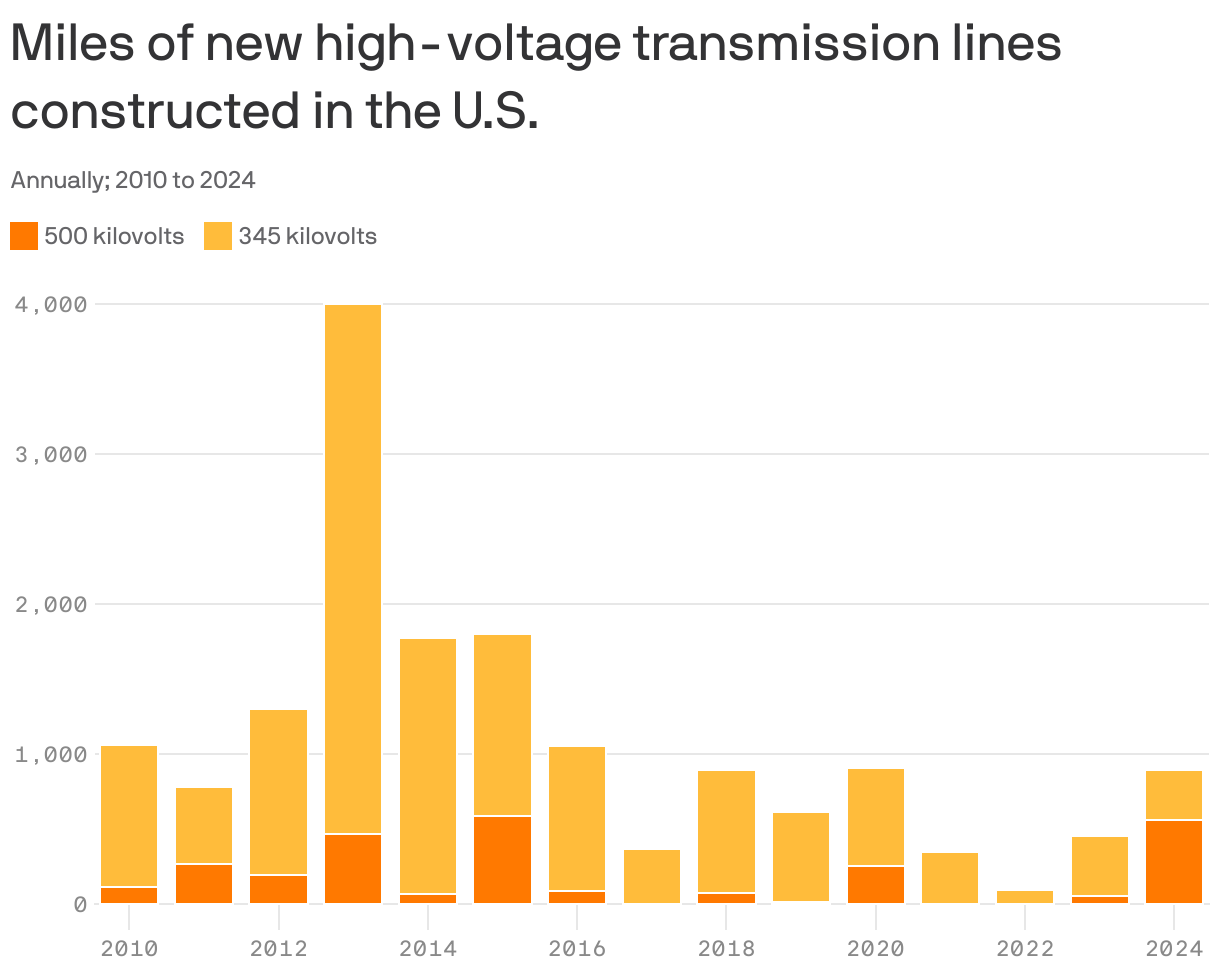
Speaking of transmission, a new report tallies 888 miles of new high-voltage lines completed in the U.S. last year.
Why it matters: It's happening too slowly to keep pace with projections of rising demand, say Americans for a Clean Energy Grid and the firm Grid Strategies.
- They warn that it's going to hold back strategic industries including AI.
What we're watching: The report authors are calling for strong regional implementation of Order No. 1920, FERC's big transmission and cost allocation rule last year, as well as permitting reform and more.
4. 🔍 What to watch in Trump's data center plans

President Trump's new AI plan and executive orders aim to speed permitting of energy projects to supply data centers.
👟 Catch up quick: Provisions that caught my eye include...
- Creating new "categorical exclusions" that enable projects to avoid full-blown environmental impact studies under NEPA.
- Expanding use of the "FAST-41" permitting process — created in the big 2015 transportation law — to cover many projects.
- Tasking EPA with identifying brownfield and Superfund sites that are suitable to host new infrastructure, and expediting reviews.
What we're watching: While officials tout new supply (of sources they like, anyway) and keeping existing fossil assets running, there's some demand response chatter tucked into the plan.
- The U.S. "should investigate new and novel ways for large power consumers to manage their power consumption during critical grid periods to enhance reliability and unlock additional power on the system," it states.
5. 🏃 Catch up quick on EVs: VW, Tesla, Rivian



🔋 Volkswagen Group's battery firm PowerCo plans to pay solid-state battery developer QuantumScape another $130.7 million to expand a collaboration and potential licensing deal, the companies tell Axios Pro.
- Why it matters: The expanded partnership is a vote of confidence in QuantumScape's battery tech, which has been in development for 15 years but isn't yet commercial.
- How it works: QuantumScape's secret sauce is a solid ceramic separator that enables charging and discharging of its solid-state, lithium-metal batteries.
- Go deeper: Unlock the whole story, and for a steady diet of scoops and smart analysis, talk to our sales team about Axios Pro Deals.
🚗 Tesla said it has begun producing a "more affordable" model last month, with "volume production planned for the second half of 2025," but didn't provide details.
- Why it matters: The EV maker has been mired in a prolonged sales slump, and its lineup is aging, so there's lots of interest in whether long-promised cheaper models can reverse the trends.
- Threat level: The new budget law has a one-two punch of ending consumer credits and ending penalties for automakers that don't meet fuel economy rules. The latter crimps the market for regulatory credits, a key Tesla revenue source.
- What's next: "We probably could have a few rough quarters," CEO Elon Musk said on an earnings call when asked about those consumer incentives. "I'm not saying we will, but we could." Axios' Nathan Bomey has more.
🚦 Rivian finds itself at a critical juncture. Sales of its pricey R1 models are headed in the wrong direction, but it's pinning a lot on next year's release of a smaller, $45,000 SUV, the R2, followed later by an even cheaper R3.
- Friction point: But first, the company has to get through 2025 as it faces various headwinds. Full story.
6. 🛢️ Number of the day: -21%
That's the year-over-year decline in Q2 upstream oil and gas dealmaking value in the U.S., per Enverus Intelligence Research, which tallied $14 billion worth of deals.
State of play: The $30.5B total in the first half of 2025 is 60% lower than the same period last year.
The bottom line: The frenzy is over for now.
- "Volatility in commodity and equity markets raised a major yellow flag for M&A, slowing the pace of dealmaking," said EIR principal analyst Andrew Dittmar.
- "That added an additional barrier to a market that was already challenged by the lack of remaining attractive opportunities for public E&Ps, especially in the Permian Basin," he said.
📧 Did a friend, colleague or an AI chatbot send you this newsletter? Welcome, please sign up.
🙏 Thanks to Chuck McCutcheon and Chris Speckhard for edits to today's edition, along with the brilliant Axios Visuals team.
Sign up for Axios Generate