International law includes climate-change obligations, UN court says

Add Axios as your preferred source to
see more of our stories on Google.
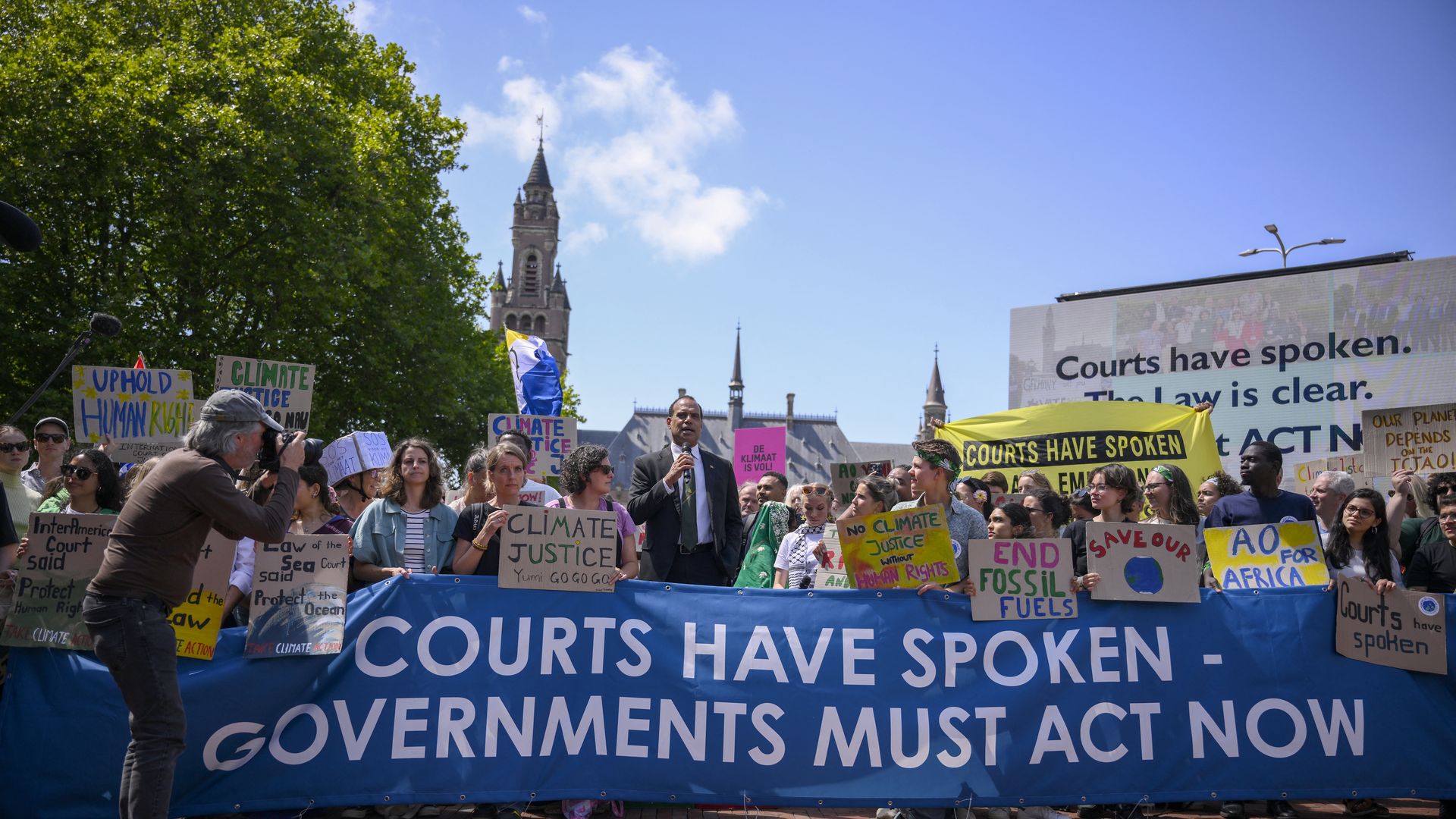
Vanuatu' Climate Change Minister Ralph Regenvanu speaks at a demonstration ahead of the International Court of Justice session on Wednesday. (Photo: John Thys/AFP via Getty Images
The United Nations' judicial arm — citing "severe" effects and "existential" risks — ruled Wednesday that multiple international agreements require countries to battle climate change and cut emissions under international law.
Why it matters: While non-binding, advocates hope the International Court of Justice's advisory opinion adds new weight to global courtroom and diplomatic efforts to win tougher climate policies.
- It specifically calls out the responsibility of industrialized nations to take the lead in limiting emissions.
- It's also rich in symbolism, the culmination of a campaign by the Pacific island nation of Vanuatu and other countries that are facing massive climate harms.
Driving the news: The ruling explicitly holds that countries should face legal requirements for breaching obligations under agreements including the UN Framework Convention on Climate Change.
- This includes ceasing activities that are in violation and providing compensation to harmed parties in some cases.
The ruling is expansive, spanning obligations under human rights law and multiple environmental agreements, including marine protection.
- The court is "unanimously is of the opinion that the climate change treaties set forth binding obligations for state parties to ensure the protection of the climate system and other parts of the environment from anthropogenic greenhouse gas emissions," Judge Iwasawa Yuji, the court's president, said in reading the decision in the Hague.
Reality check: The opinion is a big deal — but only to a point.
- The Trump administration in particular is moving the U.S. away from working with UN-affiliated bodies, and is again leaving the Paris Agreement. Ignoring the ICJ opinion could further isolate the U.S. in the world's eyes.
- Industrial nations' on-the-ground work to check emissions — or not — is rooted in domestic economic needs, politics and market realities.
- Global venues like the ICJ or the UN climate summits are more secondary influences, but they do create pressure for stronger policies.
Catch up quick: The court, at the behest of the UN General Assembly in 2023, considered two big questions.
- What are nations' obligations under international law to protect the environment for present and future generations?
- What are the legal consequences under these obligations for countries that have caused "significant harm" to the climate and environment?
What they're saying: "When a court like the ICJ recognizes new connections between conduct and legal norms, like the idea that failing to curb fossil fuels-related emissions can violate international legal obligations, it does not stop there," said Sebastien Duyck, senior attorney with the Center For International Environmental Law
- "That recognition opens the door for further legal claims," Duyck said in a statement.
- Adds Tasneem Essop, executive director of Climate Action Network International: "Governments and corporations now face clearly defined legal obligations to prevent climate catastrophe and make reparations for decades of reckless pollution."
- The liberal Center for American Progress think tank said on X: "The ICJ ruling is a major indictment against the Trump administration's climate denial and their efforts to let polluters off the hook."
What we're watching: How it starts filtering into legal proceedings in various countries.
