Axios Generate

October 06, 2022

👋 Hi Thursday! Hi readers. Today's newsletter has a Smart Brevity count of 1,229 words, 5 minutes.
👀 Join Axios reporters in Washington, D.C., at 8am ET on Oct. 11 for a global look at energy security and climate change. Guests include DOE deputy secretary David M. Turk. Register to attend in person or virtually.
🎶 At this moment in 1998, Monica was #1 on Billboard's Hot 100 with today's absolutely irresistible intro tune...
1 big thing: OPEC's deal in Vienna prompts a scramble in Washington

Illustration: Sarah Grillo/Axios
It looked like President Biden was out, but they pulled him back in: OPEC+ is forcing the White House to again confront the specter of rising gas prices, Ben writes.
Catch up fast: The coalition of OPEC, Russia and allied producers yesterday agreed to cut joint output by 2 million barrels per day.
Why it matters: Saudi Arabia, OPEC's dominant producer, rebuked White House calls to avoid cuts and continues to work with Russia despite its invasion of Ukraine.
U.S. officials bashed the decision with blunt comments that reflect the strained ties with Riyadh. “It's clear that OPEC+ is aligning with Russia," press secretary Karine Jean-Pierre told reporters.
What we're watching: U.S. officials hinted at policy responses, though maintained some ambiguity.
- The White House said it would release more from the Strategic Petroleum Reserve "as appropriate," but it's unclear how far beyond the ongoing 180 million barrel effort that might go.
- Its statement also vowed to work with Congress on "additional tools and authorities." That could refer to "NOPEC," an aggressive, if likely symbolic bill bouncing around Congress for decades that would go after OPEC with U.S. antitrust laws.
- The Wall Street Journal scooped Wednesday evening that Biden is preparing to scale down sanctions on the Maduro regime in Venezuela to allow Chevron to resume its activities.
The big picture: The OPEC+ decision means pulling barrels from what's already a very tight oil market.
- The real-world cuts will be smaller, perhaps half the headline 2 million number, because many OPEC+ members are already pumping below quotas.
- Nonetheless, emergence of plans for a major cut days ago has pushed what had been generally declining crude prices back upward again — and more gasoline price increases are likely to follow.
What they're saying: Crude price forecasts are often wrong, but multiple analysts see the global benchmark Brent crude en route back to $100-per-barrel (it's in the $93 range this morning).
GasBuddy analyst Patrick DeHaan predicts an overall effect of 15-30 cents per gallon on average U.S. gasoline prices, though he sees only some areas rising due to the complexities of refinery conditions.
Quick take: The OPEC+ move is an ink-blot test in Washington.
- GOP lawmakers used the decision to attack what they call undue White House restrictions on domestic production.
- Sen. Joe Manchin (D-W.Va.) said OPEC+ underscored the need for passing his stalled bill to speed up domestic energy projects, including oil and gas.
- The White House statement used the occasion to promote the climate law as a way to speed the use of zero-carbon technologies.
2. Global droughts' human fingerprints

Illustration: Annelise Capossela/Axios
Human-caused climate change made the drought conditions that gripped large portions of the Northern Hemisphere this past summer far more likely to occur, a new study found, Andrew writes.
Why it matters: The study, published yesterday, found human-caused global warming dramatically upped the odds of drought throughout the hemisphere outside of the tropics — making them at least 20 times more likely compared to the preindustrial era.
- The Northern Hemisphere summer of 2022 brought extreme heat and drought to three continents: Europe, Asia and North America.
- Drought conditions tied to the heat caused water stress in the Western U.S., led to rivers running critically low in countries like Germany, and caused food prices to increase.
The big picture: The Western and Central U.S., Western Europe and large swaths of China were hit especially hard.
- The study finds that warmer temperatures are the primary cause of the increase in drought likelihood since hotter weather increases evaporation.
- The new study was conducted by 21 members of the World Weather Attribution group. It is a global collective of researchers that examines the ties between extreme weather events and human-caused climate change using peer-reviewed methods.
What they're saying: "There's absolutely no doubt that climate change did play a big role here," said study coauthor Friederike Otto, a climate scientist at Imperial College London, in a press call yesterday.
Bonus: Greenland's record, Australia floods & IMF
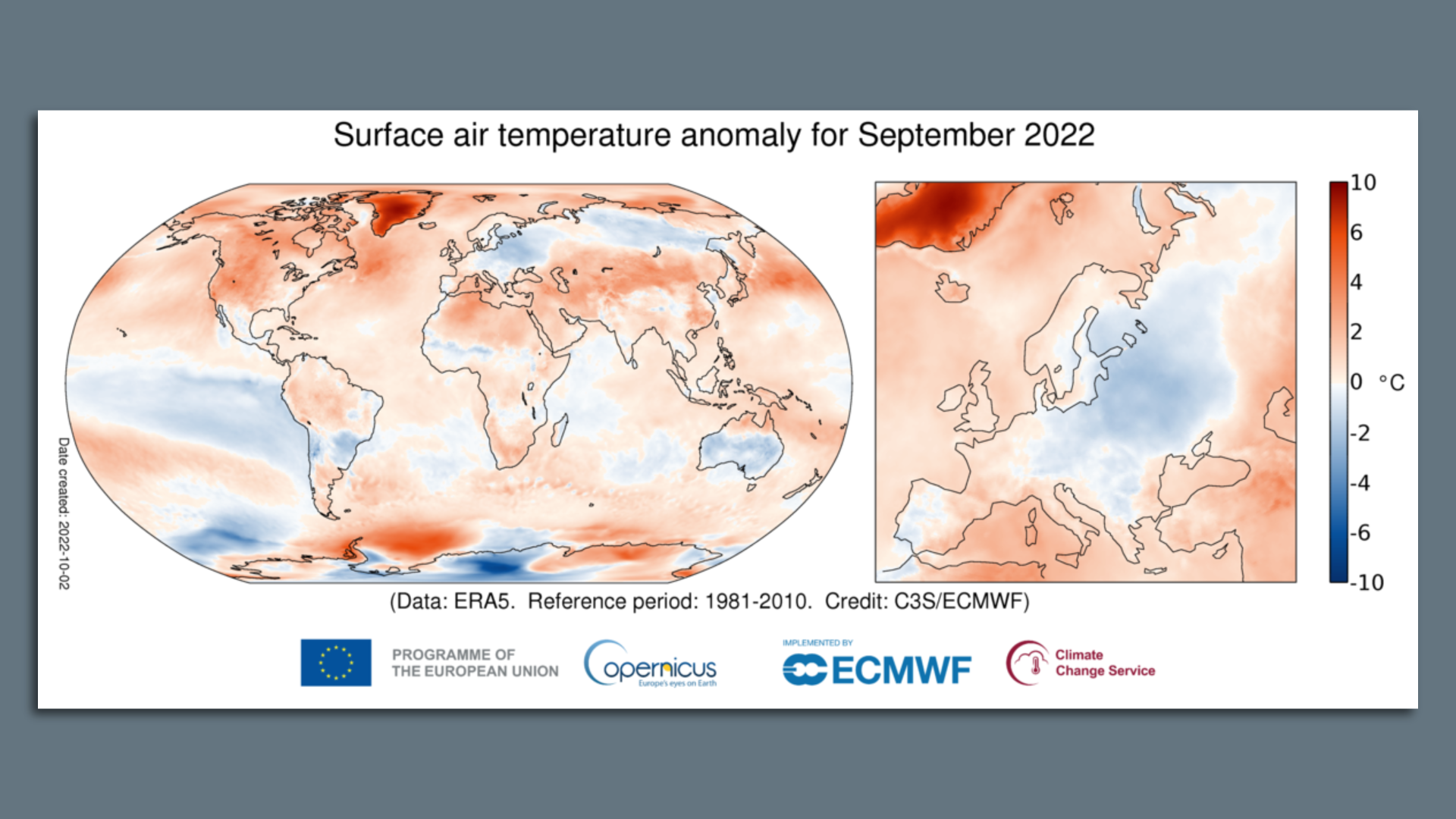
Global temperature departures from average (1981-2010) during September. (Copernicus Climate Change Service.)
While the globe overall saw its fourth-warmest September on record, Greenland was exceptionally warm for the month, according to new data released this morning by the Copernicus Climate Change Service, Andrew writes.
By the numbers: Melting of the Greenland Ice Sheet is already the largest contributor to sea level rise, and some areas were 8°F above average for the month.
Meanwhile, Sydney, Australia, set its record for the wettest year since at least 1858, driven by La Niña conditions and enhanced by global warming, Axios' Rebecca Falconer reports.
And a new IMF report details the costs of climate inaction in the near term.
3. 🏃🏽♀️Catch up fast on business: LNG, Big Oil, EVs
🤝 U.S. LNG producer Venture Global expanded its long-term export deal with German energy heavyweight EnBW by 500,000 metric tons annually to reach 2 million, Ben writes.
- Why it matters: The deal announced this morning comes amid wider European efforts to secure more LNG supplies to offset declines in Russian gas exports.
📉 Big Oil has been reporting huge profits in recent quarters, but Shell warned this morning that Q3 numbers won't be as robust in key areas.
- The company said that much lower refining margins will mean that segment's earnings will be $1 billion to $1.4 billion lower than in Q2. Chemical margins and gas trading results will also be lower, it said. Reuters has more.
📈 "Ford Motor is increasing the starting price of its electric F-150 Lightning pickup by $5,000 for the 2023 model year, citing rising costs and supply chain issues." (CNBC)
4. The brewing map for implementing climate law

Illustration: Annelise Capossela/Axios
The Treasury Department said it's moving quickly to transform new and expanded tax credits in the big climate law into formal guidance that's important for spurring use of the incentives, Ben writes.
Driving the news: Treasury yesterday solicited public comment within 30 days on a slew of areas like subsidies for renewable power, manufacturing, and more.
It includes calls for input on specific topics like labor and domestic content rules linked to the subsidies.
Why it matters: Various kinds of tax incentives are meant to be the biggest muscles in the law — they represent $270 billion of the roughly $370 billion of the climate and energy investments.
But Treasury efforts to transform the statutory language into more granular guidance are key for project developers and other companies.
What we're watching: "The goal to complete the rule-writing process for some programs in the coming months means that the Internal Revenue Service will have to move much more rapidly than normal," Bloomberg reports.
5. EV owners stay with the plug

Illustration: Sarah Grillo/Axios
People who buy electric vehicles really like them, according to U.S. vehicle registration data, which shows most EV owners tend to go with plugs for their next car, too, Axios' Joann Muller reports.
Why it matters: The data reveals a growing embrace of EVs as automakers and the federal government pour billions of dollars into EV and battery production.
Driving the news: Axios is tracking the historic shift away from gasoline by examining vehicle registration data from S&P Global Mobility. Here's a peek at the latest data:
- Roughly two-thirds (65.3%) of EV-owning households that bought a new car in 2022 got another electric one.
- That's up sharply from the second quarter of 2021 when about 48% of EV-owning households seeking a new car bought another EV.
- The trend has been consistent throughout 2022, notes S&P Global Mobility analyst Tom Libby.
The big picture: The U.S. lags behind China and Europe when it comes to EV adoption, but the market is clearly shifting.
📬 Did a friend send you this newsletter? Welcome, please sign up.
🙏Thanks to Mickey Meece and David Nather for edits to today's newsletter. We'll see you back here tomorrow!