
Axios Generate

April 28, 2023
🍺 Yes. Friday. Today's newsletter has a Smart Brevity count of 1,217 words, 4.5 minutes.
🎶 At this moment in 1987, U2 were #1 on the Billboard album charts with The Joshua Tree, which provides today's intro tune ...
1 big thing: A key deal in home decarbonization

Illustration: Annelise Capossela/Axios
First look: Renewables infrastructure investor True Green Capital Management is acquiring a majority stake in CleanChoice Energy, a firm that helps consumers and businesses tap zero-carbon power, Ben writes.
Why it matters: The deal injects $100 million of equity capital into CleanChoice for owning, operating and growing its multi-state portfolio of solar assets.
- Founded in 2012, CleanChoice — which has over 215,000 residential customers — has a solar project pipeline of over 300 megawatts and plans to expand it.
- The acquisition keeps the CleanChoice brand and team. Terms were not disclosed.
The big picture: The companies say the deal fuels CleanChoice's growth as the first "100% green gen-tailer" — a combo of generator and retailer.
- CleanChoice owns solar assets and sells renewable energy to directly to consumers in several competitive U.S. markets.
How it works: The company offers ways for customers to tap renewables while keeping their current utility, including ...
- Community solar, in which customers subscribe to power from a specific off-site project and receive credits on their bills.
- Renewable energy credits, which match ratepayers' power use with regional wind and solar generation in competitive retail markets.
What they're saying: "We're bringing the same kind of access to clean energy that giant companies like Google and Microsoft have to residential consumers and small businesses," CleanChoice CEO Tom Matzzie tells Axios in an interview.
- He noted consumers are exposed to the price volatility in an increasingly global gas market.
- Wider renewables access is a way to control emissions and costs, Matzzie said.
Zoom in: CleanChoice has community solar assets in New York, Minnesota, Maryland, Massachusetts and Washington, D.C.
- It has a pipeline of utility-scale and community solar projects in a suite of states, including New York, Maine, Pennsylvania and Indiana.
- The company's retail offerings cover markets in eight states and D.C., and has other options available to nationwide customers.
The bottom line: "The combination of green customers with solar power development and asset ownership will be paramount in the clean energy transition regime in which we are operating," True Green Capital co-founder Panos Ninios said in a statement.
2. Climate "blockade" planned for Correspondents' Dinner

Illustration: Sarah Grillo/Axios
Attendees of the White House Correspondents' Dinner tomorrow may be greeted by a "climate blockade" motivated by the Biden administration's continuation of drilling for oil and gas on public lands, Andrew writes.
Why it matters: The exact details of the protest are being kept under wraps, but it aims to spotlight the urgency of tackling climate change.
The big picture: Climate Defiance, a relatively new activist group, is coordinating the blockade. The group's website states it will blockade the dinner "To demand an end to fossil fuel extraction on public lands."
- The group is funded in part by the Climate Emergency Fund (CEF). Film director Adam McKay, among other high profile donors, contributes money to CEF.
- Documentary filmmaker Rory Kennedy helped found CEF, and she told Axios its goal is to provide support to organizations that use certain attention-grabbing tactics to raise awareness of climate change.
- “Take a look through the history of the United States and other countries where you see significant shifts happen successfully,” Kennedy said in an interview. “They never happen without people getting into the streets and protesting.”
The intrigue: As for why the dinner is an ideal protest venue, she cited its combination of political and media power.
- While the Biden administration has taken historic steps on climate change, particularly through the climate law enacted last year, Kennedy said the White House needs to be pressured to do more.
- "I think it gives them the support they need to take the steps they're taking,” she said.
3. Big oil earnings and other petro-notes
Illustration: Annelise Capossela/Axios
💰 The market remains very lucrative for Big Oil even as commodity prices have eased, Ben writes.
- Driving the news: Exxon this morning reported a $11.4 billion Q1 profit, down slightly from Q4 but a record for any January-March period. Chevron reported a $6.6B profit on the strength of its downstream performance.
- Zoom in: Exxon, in a separate announcement, said it's going ahead with a multi-billion dollar investment in the latest stage of its huge oil development in offshore Guyana. Reuters has more.
🤝🏼 Venture Global, a growing U.S. LNG provider, announced a 20-year deal with Japanese power giant JERA to provide 1 million metric tons of the fuel annually.
- Why it matters: Projected long-term demand in Asia is helping to fuel new U.S. projects.
- Catch up fast: In February, Venture announced a pair of 20-year deals with China Gas that will supply a combined 2 million metric tons annually.
🥊 Via the Financial Times, "BP went head to head with investors and campaigners at its annual meeting, claiming that its strategy was aligned with the Paris climate agreement despite having slowed the pace at which it will reduce oil and gas output this decade."
4. Heat shatters records in Europe, Africa
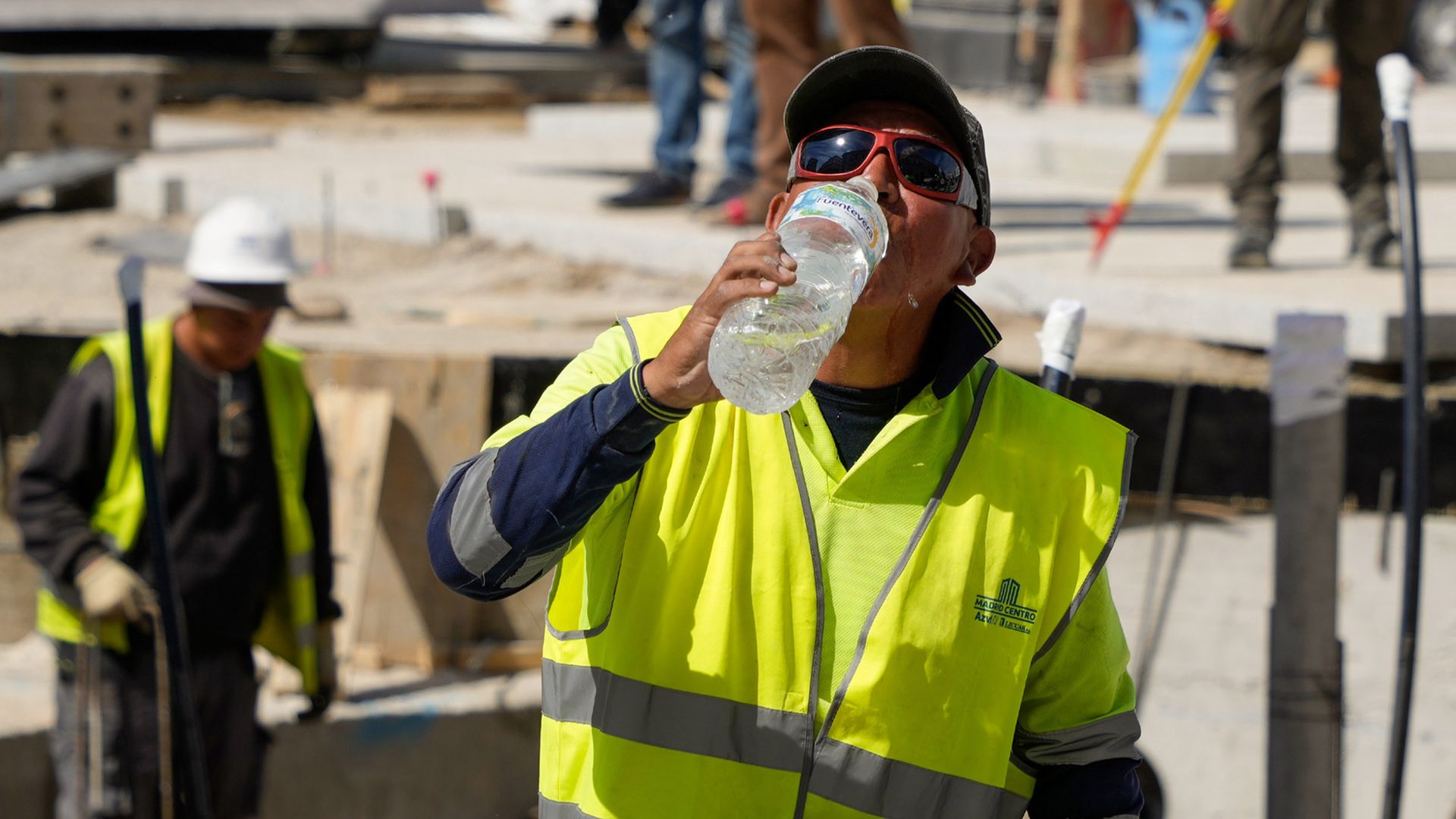
A construction worker rehydrates with water during high temperatures at the Puerta del Sol in Madrid, Spain, on Thursday. Photo: Paul Hanna/Bloomberg via Getty Images
A heat wave affecting northwest Africa and southwestern Europe led to dozens of temperature records Thursday, including a preliminary milestone for the hottest reading in Europe during April, Andrew writes.
Threat level: More intense and longer-lasting heat waves are one of the clearest indications of human-caused climate change, studies have consistently shown.
The big picture: An area of low pressure parked over the North Atlantic, and a high-pressure area over Spain is drawing warm and dry air northward from the Sahara Desert, into northwestern Africa and Iberia.
- The highest temperatures have been set in Europe, Portugal and Spain.
- Some records are being broken by large margins of 5°C (9°F) or more, which is noteworthy.
- In Marrakech and Ben Guerir, Morocco, new April national records were set with a high of 41.3°C (106.3°F).
- Córdoba, Spain, set a monthly national record high, and a provisional monthly high temperature record for all of Europe. The temperature reached a July-like high of 38.8°C (101.8°F).
- In addition, a new April record was set in Portugal, with 36.9°C (98.4°F) in Mora.
What's next: Even hotter weather is forecast Friday in northwestern Africa, with another hot day set for Spain and Portugal, too.
5. Where U.S. air quality is getting better — and worse
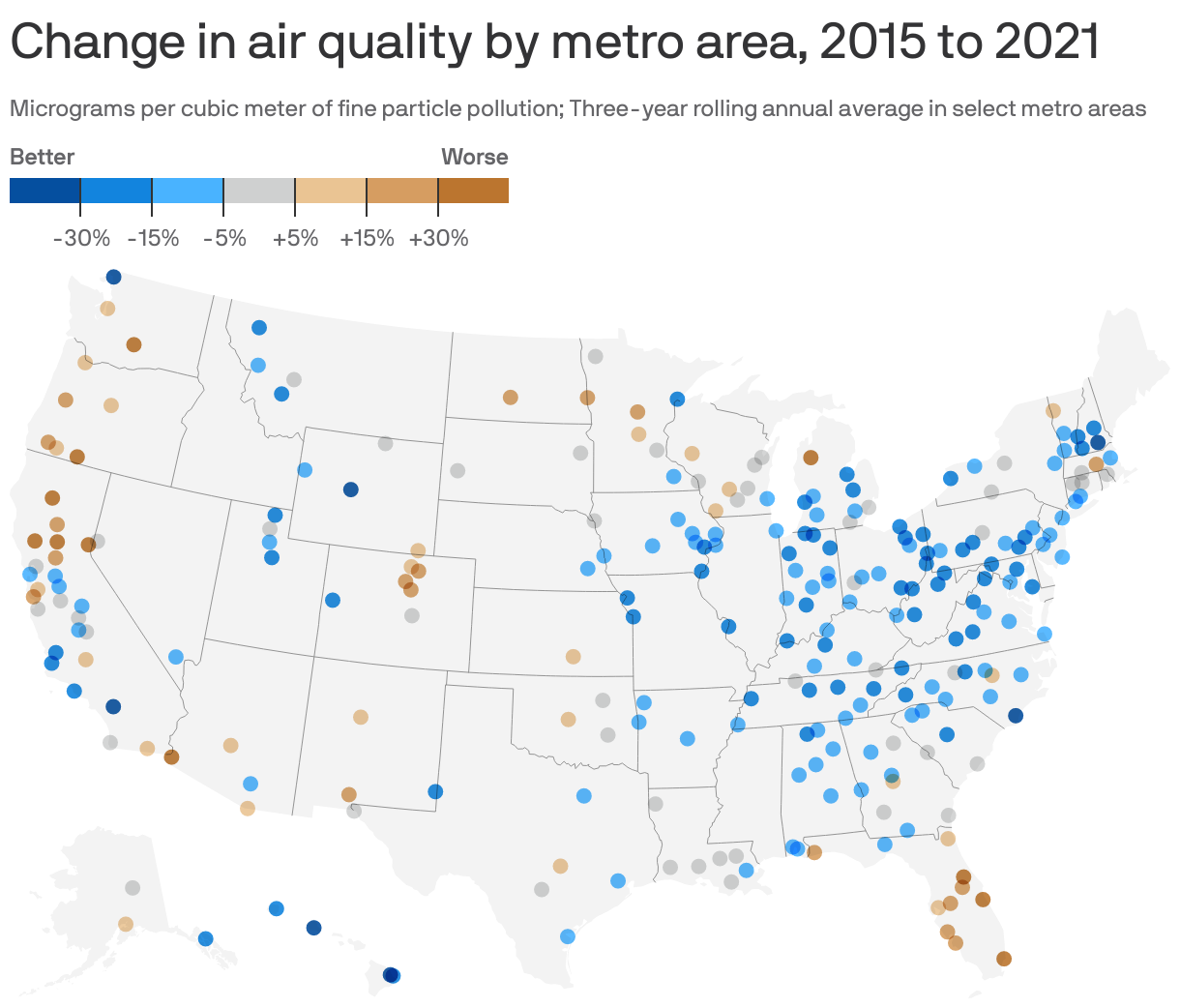
Air quality, as measured by fine particle pollution, improved across much of the country between 2015 and 2021, but worsened across several Western states and Florida, Axios' Alex Fitzpatrick and Kavya Beheraj report.
Why it matters: Fine particles, generated from fossil fuel-burning and other sources, can make their way into people's lungs or bloodstream, causing myriad health problems.
- It's linked to nearly 11,000 excess deaths across the U.S. annually, by one estimate.
By the numbers: The three-year rolling annual average concentration of fine particle pollution across the U.S. was 8.5 micrograms per cubic meter as of 2021 — a 37% decrease from 2000.
The big picture: Broadly speaking, air quality improved nationwide during COVID-19 pandemic's height, in part because fewer people were driving.
- As the pandemic ebbs and people's activities return to normal, air quality nationally is worsening accordingly.
Zoom in: Fine particle pollution increased notably between 2015 and 2021 in Western states such as California, Oregon and Washington, where drought created prime conditions for wildfires and thus increased pollution from smoke.
6. 💬Quote of the day
“It’s becoming almost comical: The gap between what European policy makers are saying and what’s happening on the ground is absurd.”— Morten Dyrholm, a senior VP with Denmark-based wind turbine giant Vestas
He's quoted in the Wall Street Journal in a feature on hurdles facing renewables developers in Europe.
📬 Did a friend send you this newsletter? Welcome, please sign up.
🙏 Thanks to Lisa Hornung and Javier E. David for edits to today's edition.
Sign up for Axios Generate

Untangle the energy industry’s biggest news stories


