
Axios Generate

June 25, 2025

👋 Welcome back. It's been dangerously hot, but we've got a breezy 1,099 words, 4 minutes.
🌡️ Situational awareness: New York City, Philadelphia, Baltimore and Boston all hit 100°F yesterday as a record heat wave baked the eastern U.S., AP reports.
🎙️Bulletin: Shares of Sunrun and other rooftop solar firms jumped after a GOP senator hinted at softening House plans to quickly end tax credits.
🎧 Happy birthday to singer-songwriter Carly Simon, who has today's intro tune...
1 big thing: Where AI emissions are heading — and how to bend the curve


A new analysis sees carbon emissions linked to AI data centers growing 11-fold (!) this decade — and offers ways to limit its environmental footprint.
Why it matters: Accenture's study offers fresh modeling as policymakers, companies and other stakeholders try to understand AI's path.
The big picture: Its "base case" scenario sees emissions linked to AI rising to 3.4% of the global total in 2030, with data centers powering the tech using as much electricity as Canada.
- "Cooling those data centers may consume 3.02 billion cubic meters of fresh water, more than the total annual freshwater withdrawals of countries like Norway or Sweden," the research finds.
Threat level: Beyond ecological harms, Accenture's report warns of companies scaling their AI investments facing rising costs, regulatory risks, public backlash and more.
The intrigue: The consulting giant urges companies to employ a new frame that looks holistically at AI costs and benefits, as opposed to just measures like efficiency.
- It calls it the "Sustainability-Adjusted Intelligence Quotient."
- It's designed to measure "how efficiently AI systems convert money, electricity, water and carbon into actual performance."
State of play: The analysis offers companies several categories of advice for making AI less costly and resource-intensive.
- One of them is "smart silicon" — that is, ways to integrate hardware and software more efficiently, such as emerging systems that cut down on the "costly movement of data between memory and processors."
What we're watching: Other advice explores topics like data center location and ways to sell idle computing capacity.
- And sometimes the only winning move is not to play.
- The study notes that organizations sometimes default to using large language models when more "task-specific" ones would do the trick.
2. 🔭 Chris Wright leaps into fray over IEA outlook

Energy Secretary Chris Wright is joining criticism of the International Energy Agency's projection that global oil demand will peak this decade.
Why it matters: Dissatisfaction with the Paris-based multilateral agency — which the U.S. helps fund — has reached the highest levels of Trump 2.0.
Driving the news: Wright, in an interview with Breitbart yesterday, called the IEA outlook "nonsensical," noting consumption has risen consistently for many decades.
- Seven billion people aspire to high-energy living standards and comforts enjoyed by 1 billion today, he said.
"They're just saying to those 7 billion people, a billion of us are going to keep living these well-energized lives, but you guys, you've got to stay where you are," he said.
- Wright said that IEA and DOE's independent stats arm — the Energy Information Administration — had become "political."
- DOE is "in dialogues" with IEA, he said.
The big picture: IEA analyses inform policymakers, companies, academics, journalists, and more.
- But some GOP lawmakers and oil analysts have knocked the body, alleging it makes unrealistic projections about energy transition and acts like a climate NGO.
The latest: IEA, in a statement to Axios, said it works constructively with governments from all its member countries.
- "The IEA welcomes feedback on our work and attaches great importance to our dialogue with the Department of Energy and other branches of the US Government."
Catch up quick: The agency has defended its overall approach and specific oil viewpoint, most recently last week in its latest oil outlook through 2030.
- EV growth, substitutions for oil in power generation, macro-economic trends, and other forces are already eating into demand growth and will going forward, it says.
State of play: While IEA's take collides with some look-aheads, executive director Fatih Birol points out that IEA's work is within the wider analytical mainstream.
- And IEA's long-term outlook hardly sees oil going away under countries' stated policies, with only gentle declines through 2050 after the peak.
What we're watching: Whether and how Trump officials and Senate Majority Whip John Barrasso — a vocal IEA critic — push for changes at the body.
3. 🛢️ White House to China: Buy oil from us, not Iran
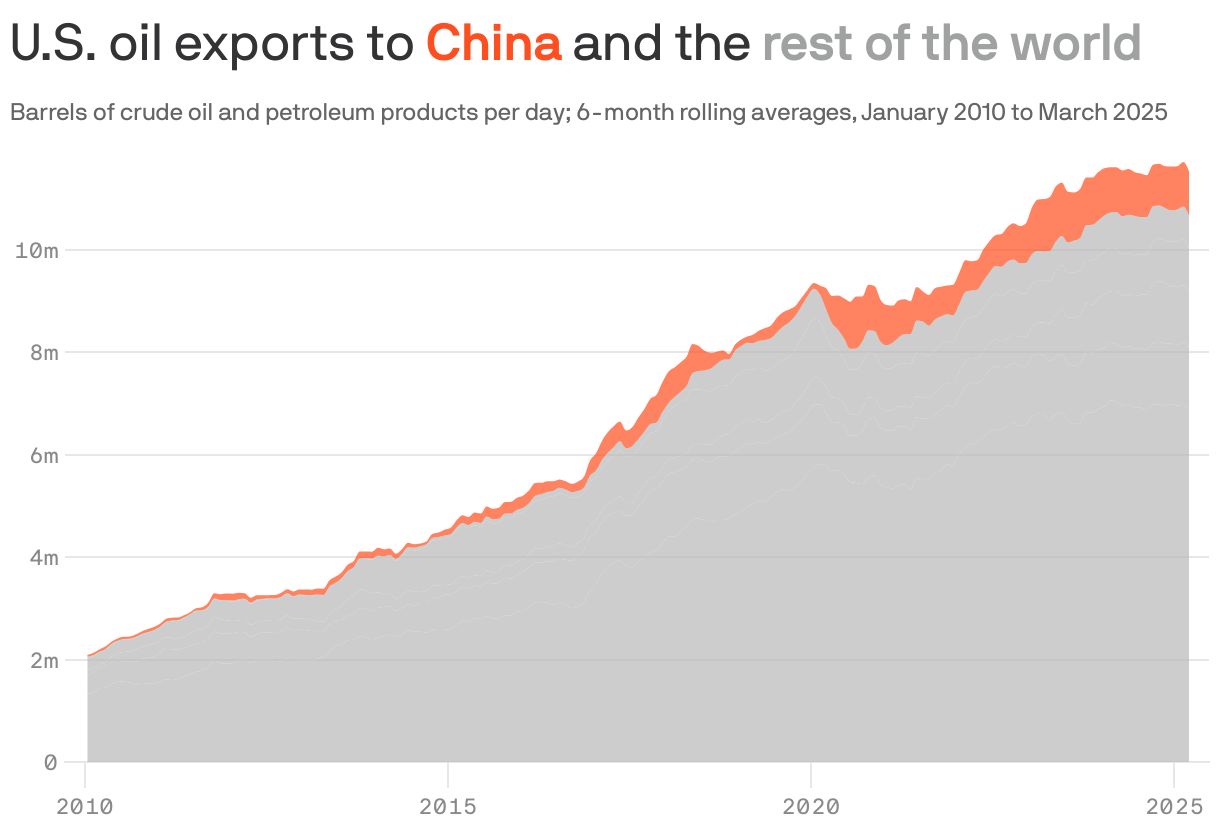
A cryptic post from President Trump drew speculation that U.S. officials could ease sanctions on China's purchase of Iranian oil — but the White House later offered a different reading.
Why it matters: China — the world's largest oil importer — accounts for the vast majority of Iran's shipments.
- It's also among the largest buyers of U.S. petro-exports, but a small portion of overall U.S. sales.
Catch up quick: "China can now continue to purchase Oil from Iran. Hopefully, they will be purchasing plenty from the U.S., also," Trump posted on Truth Social yesterday morning.
- The administration has sanctioned Chinese refiners, ports that take Iranian oil, and ships carrying it.
- "US Treasury and State department officials handling Iranian oil sanctions were surprised by Trump's statement and uncertain how to immediately interpret it," Bloomberg reports.
Yes, but: "The President was simply calling attention to the fact that, because of his decisive actions to obliterate Iran's nuclear facilities and broker a ceasefire between Israel and Iran, the Strait of Hormuz will not be impacted, which would have been devastating for China," a senior White House official told Axios via email.
- "The President continues to call on China and all countries to import our state-of-the-art oil rather than import Iranian oil in violation of U.S. sanctions," the official said.
What we're watching: How U.S. energy exports may factor into ongoing U.S.-China trade talks.

4. 🗜️ White House pressures FERC on fossil fuels
The White House wants FERC to do more fast-tracking of fossil fuels to shore up electricity grid shortfalls, leading some agency watchers to fear the energy regulator will become politicized.
Why it matters: The Trump administration's approach follows its decision not to renominate FERC Chair Mark Christie, who staved off deep DOGE cuts.
- FERC watchers expect an overhaul following executive orders exerting White House oversight over independent agencies.
Driving the news: Gas and coal are "the tried-and-true energy projects that are going to keep us from blackouts and brownouts," a senior White House official told Axios.
- "We really have to rethink how FERC is prioritizing the projects that are going to have the most baseload energy to help the grid," said the official, who spoke on condition of anonymity to discuss future plans.
Friction point: Former FERC GOP Chairman Neil Chatterjee fears the commission will become politicized under the White House and future administrations, he said at a recent Politico event.
- The departing Christie has been a fierce defender of FERC's independence.
Unlock the whole story, and if you need smart, quick intel on energy and climate policy for your job, get Axios Pro Policy.
5. 🌲 Number of the day: over 425,000 acres
That's how much eastern U.S. forestland will be protected under Microsoft's new CO2 removal deal with Anew Climate and Aurora Sustainable Lands.
Why it matters: The acreage, part of an agreement for 4.8 million nature-based removal credits, is the "largest permanent working forest protection project in the eastern U.S. in two decades," the companies said.
📧 Did a friend, colleague or an AI chatbot send you this newsletter? Welcome, please sign up.
🙏 Thanks to Chris Speckhard and Chuck McCutcheon for edits to today's edition, along with the brilliant Axios Visuals team.
Sign up for Axios Generate