Key agency sticks to its guns on peak oil demand

Add Axios as your preferred source to
see more of our stories on Google.
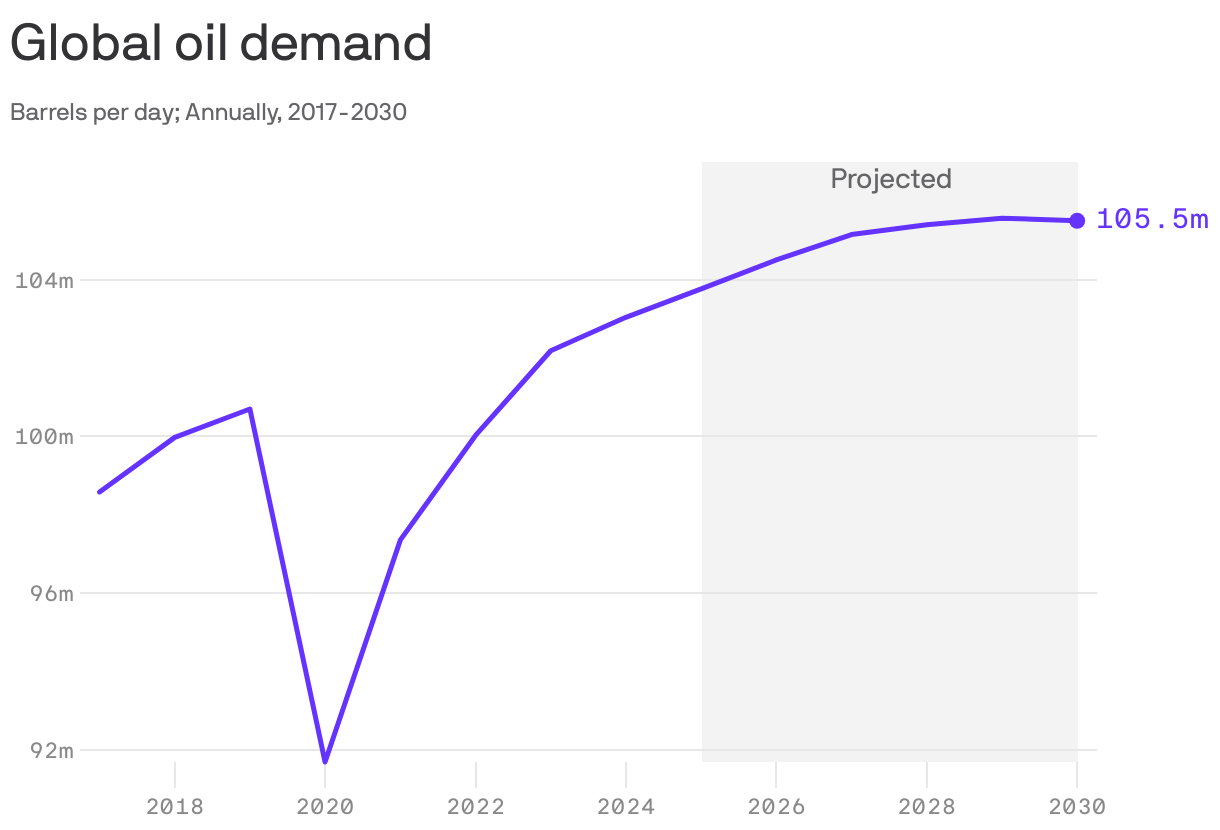
The International Energy Agency is sticking by its controversial view that global oil demand growth will end this decade, even dipping slightly in 2030.
Why it matters: The timing of a peak — and more importantly, the slope of any decline — affects everything from emissions to investment strategies.
The latest: IEA sees growth of roughly 700,000 barrels per day this year and next, and then increases slow to "a trickle" for the rest of the decade.
- "This is driven by below-trend economic growth, weighed down by global trade tensions and fiscal imbalances, and the accelerating substitution away from oil in the transport and power generation sectors."
- The annual look-aheads are based on today's policies and market trends and needless to say are stuffed with uncertainties.
Zoom in: While IEA is sticking with its overall demand outlook, specific markets are shifting.
- Chinese oil consumption in 2030 will only be "marginally higher" than in 2024, IEA now projects, citing rapid EV growth and other forces.
- But in the U.S., IEA revised its 2030 demand forecast upward by 1.1 million barrels per day, citing lower gasoline prices and "loss of momentum in EV adoption."
The intrigue: The agency just lowered its U.S. shale outlook as low prices prompt companies to scale back and the sector consolidates.
- It now sees shale largely plateauing for the rest of the 2020s.
- The new report projects U.S. production of "light tight oil" (basically shale) at 9.8 mbd in 2030, compared to 10.6 mbd in 2030 in last year's version.
The bottom line: IEA predicts global production capacity rising faster than demand, with a "comfortably supplied oil market through 2030."
- But as the current Mideast crisis shows, there's a lot in flux.
