Axios Generate

January 03, 2025

šŗ Happy Friday! We've got breaking hydrogen policy news and much more, all in a quick 1,248 words, 4.5 minutes.
šø This week in 1979, Elvis Costello released the album "Armed Forces," which provides today's intro tune...
1 big thing: 2025 climate reality check
2025 begins amid fresh signs that steering global energy use away from fossil fuels will be even harder than many governments and C-suites once hoped.
Why it matters: The world is already far off pace from meeting Paris Agreement targets and emissions keep rising ā even as climate harms pile up.
Here's a quick tour of the latest reality checks ...
š Global coal demand is proving very persistent. The International Energy Agency's latest outlook is more pessimistic than the 2023 and 2022 versions on the most CO2-heavy fuel (h/t @JavierBlas).
- Coal use reached another all-time high last year, defying an earlier prediction of decline. But IEA sees only small growth ā largely a plateau ā through 2027.
š„ļø The mammoth scale of AI-driven data center power needs is really coming into focus.
- A new Energy Department report sees data centers accounting for up to 12% of U.S. power demand in 2028.
- The growth is likely to boost gas in the near- to medium-term.
š³ļø President-elect Donald Trump is vowing to nix Biden administration climate policies and plans to exit the Paris Agreement.
šÆ Other national targets could face peril as deadlines loom and elections unfold in Canada and elsewhere.
šµ Big banks are recalibrating, too. In recent days and weeks, a number of Wall Street giants like Morgan Stanley and CitiGroup left the UN-affiliated Net-Zero Banking Alliance.
- Banks, however, say they remain committed to their climate goals.
š¢ļø Big Oil has slowed its roll. European giants Shell and BP have gotten more selective about renewables, even as they maintain 2050 net-zero targets.
- Shell has softened some climate goals, and watch BP's February strategy update after Reuters reported it will scrap 2030 oil and gas production-cutting aims.
What's next: S&P Global Commodity Insights sees overall 2025 global energy demand growth once again outstripping additions of clean sources.
- "While the supply of clean energy is growing faster than it ever has in history...it is not yet fast enough to curtail the growth in fossil fuel demand, let alone displace existing fossil fuel consumption," its recent 2025 outlook states.
- Aside from the pandemic and other big recessions, clean supply ā renewables and nuclear ā has never had a year that outpaced rising consumption.
The intrigue: Veteran analyst Arjun Murti, in a recent post, argued the "energy transition era" ended in 2024.
- It began 2019 with the rise of net-zero commitments and Wall Street focusing heavily on the "E" in ESG, he said.
- Now, he said, things are moving toward a "healthier" conversation centered on everyone deserving the energy abundance of the select few in Western nations.
The bottom line: National and corporate targets are "really hard to achieve in the real world," said Daniel Raimi of the nonpartisan think tank Resources For the Future.
- Still, some nations are making progress (albeit not hitting their goals). "They are demonstrating that energy transition is possible. It just hasn't happened at a global scale yet," he said.
2. šØ Breaking: Long-awaited hydrogen tax credit unveiled

The Biden administration finalized long-awaited rules today on a hydrogen production tax credit that loosens some requirements on project developers while maintaining core environmental guardrails.
Why it matters: The Treasury Department's 45V tax credit, established by the Biden climate law, is the biggest federal incentive to jump-start large-scale production of hydrogen.
- Industry advocates, backed by the Energy Department, see hydrogen as crucial to slashing emissions from heavy-duty trucking, steel, chemicals, shipping and other sectors that heavily depend on fossil fuels.
Yes, but: The incoming Trump administration could rewrite the rules or scrap the DOE's $8 billion hydrogen hub program.
Zoom in: Treasury's final guidance allows hydrogen developers until 2030 ā an extra two years compared with proposed guidance ā to meet requirements to match their production with low-carbon electricity on an hourly basis.
- Nuclear reactors at risk of closing and dependent on hydrogen investment can qualify up to 200 megawatts per reactor.
- Hydrogen drawing from electricity generated in California and Washington can qualify because those states' greenhouse gas emissions caps and clean electricity standards prevent significant induced emissions from hydrogen production, the guidance determined.
- Hydrogen using power from a plant that has recently added carbon capture and sequestration also can qualify.
Unlock the whole story, and if you need smart, quick intel on energy and climate policy for your job, get Axios Pro Policy.
3. š§ Major winter storm to be followed by enduring Arctic chill
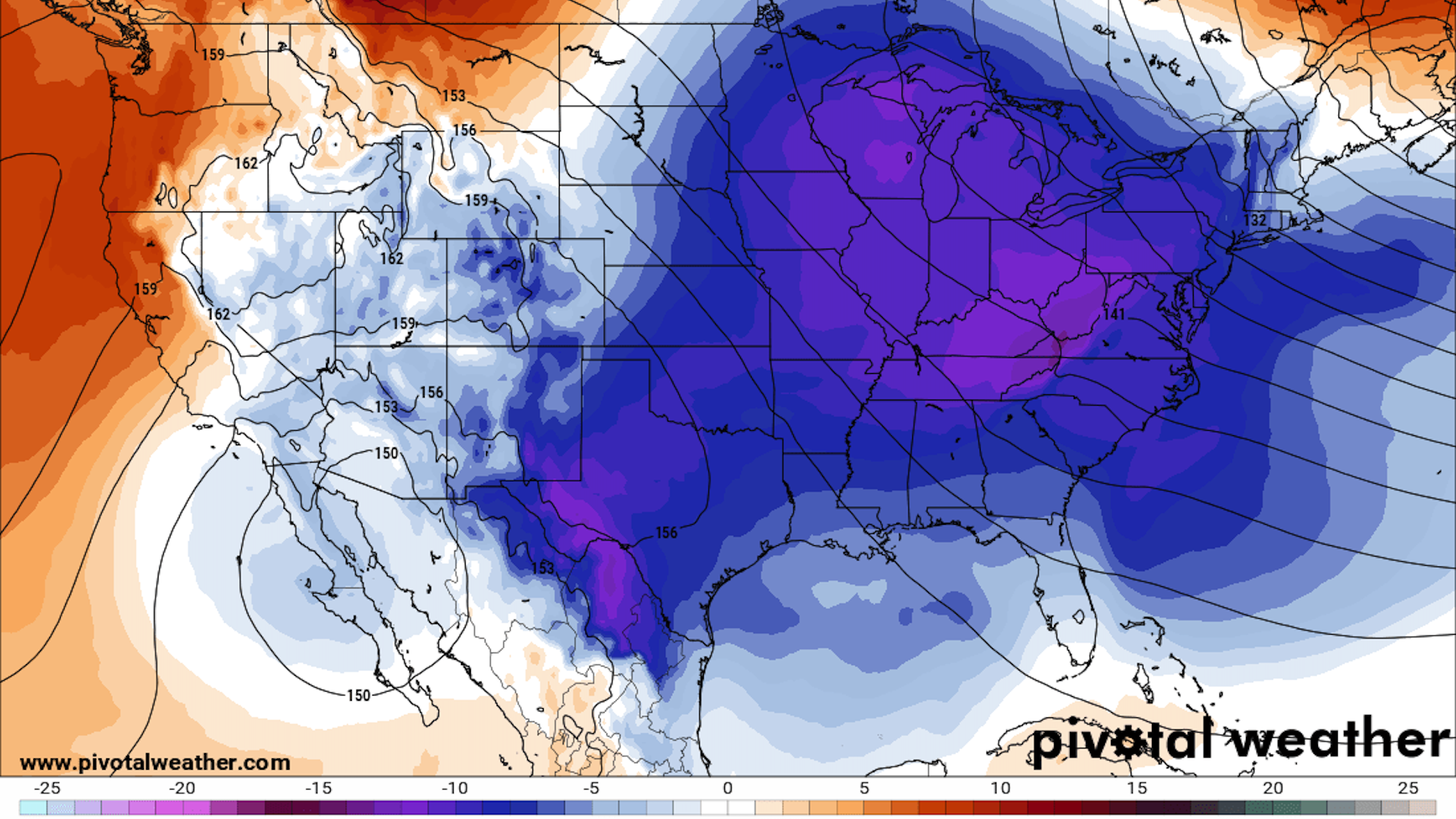
The much-advertised, long-lasting Arctic outbreak with ties to the polar vortex, and potentially to rapid Arctic climate change, will be accompanied by a significant winter storm over the weekend.
Threat level: The storm is set to deliver upwards of a foot of snow in parts of the Plains, Midwest and Appalachians, with somewhat lower amounts for Washington, D.C., Baltimore and potentially Philadelphia and New York City as well.
- Multiple states are forecast to see a damaging ice storm that could lead to widespread, enduring power outages. The ice zone will stretch from parts of Nebraska eastward to Kentucky and West Virginia.
- "Treacherous travel conditions are expected with power outages likely in areas that receive over a quarter-inch of ice accumulation," the National Weather Service said via X yesterday evening.
By the numbers: As the storm exits late this weekend into early next week, Arctic air will be drawn southward out of Canada, sending temperatures plummeting below zero Fahrenheit across the northern Plains and Upper Midwest.
- The fresh snow and ice cover will exacerbate the cold.
- Temperatures may drop below freezing overnight as far south as the Gulf Coast next week.
- During the next seven days ā week one of an enduring cold snap that could stretch through Inauguration Day ā a total of 234 million people in at least 40 states could see temperatures at or below 32°F, according to WeatherBell Analytics.
What's next: For most, the cold will be noteworthy for its duration rather than its severity, as computer models have backed off from earlier projections of historically low temperatures.
- The possibility remains that more high-impact winter storms could come before this weather pattern breaks down in January.
4. š The message in Tesla's sales dip

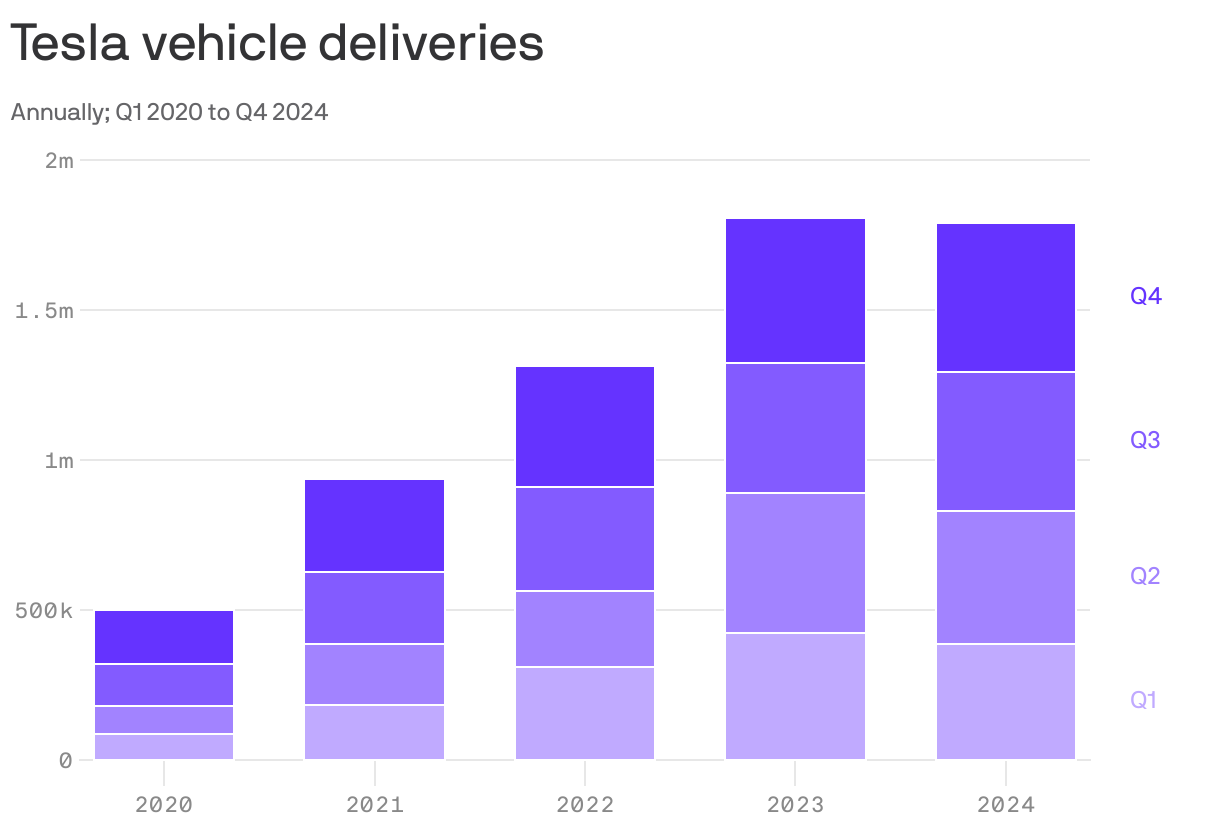
Whether this chartāļø is an ominous sign for Tesla or just a blip depends on your confidence in CEO Elon Musk's theory of the case.
Catch up quick: Tesla saw its first annual sales decline since it became a mass-market automaker.
- Q4 deliveries reported yesterday set a record but missed Wall Street expectations and weren't enough to push 2024 above 2023.
The intrigue: The pessimistic view is that this reveals an empire in decline.
- Tesla has an aging lineup, faces rising competition in the U.S. and overseas, and has yet to really show it's committed to a far cheaper, mass-market car.
The other side: The more optimistic view is that Musk is right ā Tesla's future value lies in AI and autonomy and that it has massive advantages there.
- "We have never viewed Tesla simply as a car company ... instead we have always viewed Musk and Tesla as a leading disruptive technology global player," Wedbush Securities analyst Dan Ives wrote in a research note.
What we're watching: With Musk's newfound perch as a close adviser to President-elect Donald Trump, Tesla may benefit from federal policies to come on AI and driverless vehicles.
The bottom line: Tesla's stock fell 6% after the Q4 miss but remains roughly 53% higher than it was a year ago ā and the market cap remains over $1 trillion.
5. š¢ļø Number of the day: 68%
That's the share of oil and gas execs who predict slightly or much faster drilling permits on federal lands under Trump, per the Dallas Fed's latest survey.
šØ Did a friend, colleague or even a professional rival send you this newsletter? Welcome, please sign up.
š Thanks to Chris Speckhard and Chuck McCutcheon for edits to today's edition, along with the brilliant Axios Visuals team.
Sign up for Axios Generate