
Axios Generate

May 30, 2024

📡 Our instruments detect an approaching weekend. Here's a quick 1,106 words, 4 minutes of news while we investigate.
🚨 Situational awareness: Investment heavyweight Brookfield plans to acquire Neoen, a major multinational renewables and storage developer, in a deal valued at $6.6 billion.
- Go deeper: Brookfield and Neoen announcement...WSJ coverage
🎸 At this moment in 2017, Luis Fonsi and friends began a summer-long run atop Billboard's Hot 100 with today's intro tune...
1 big thing: The challenging data about data centers
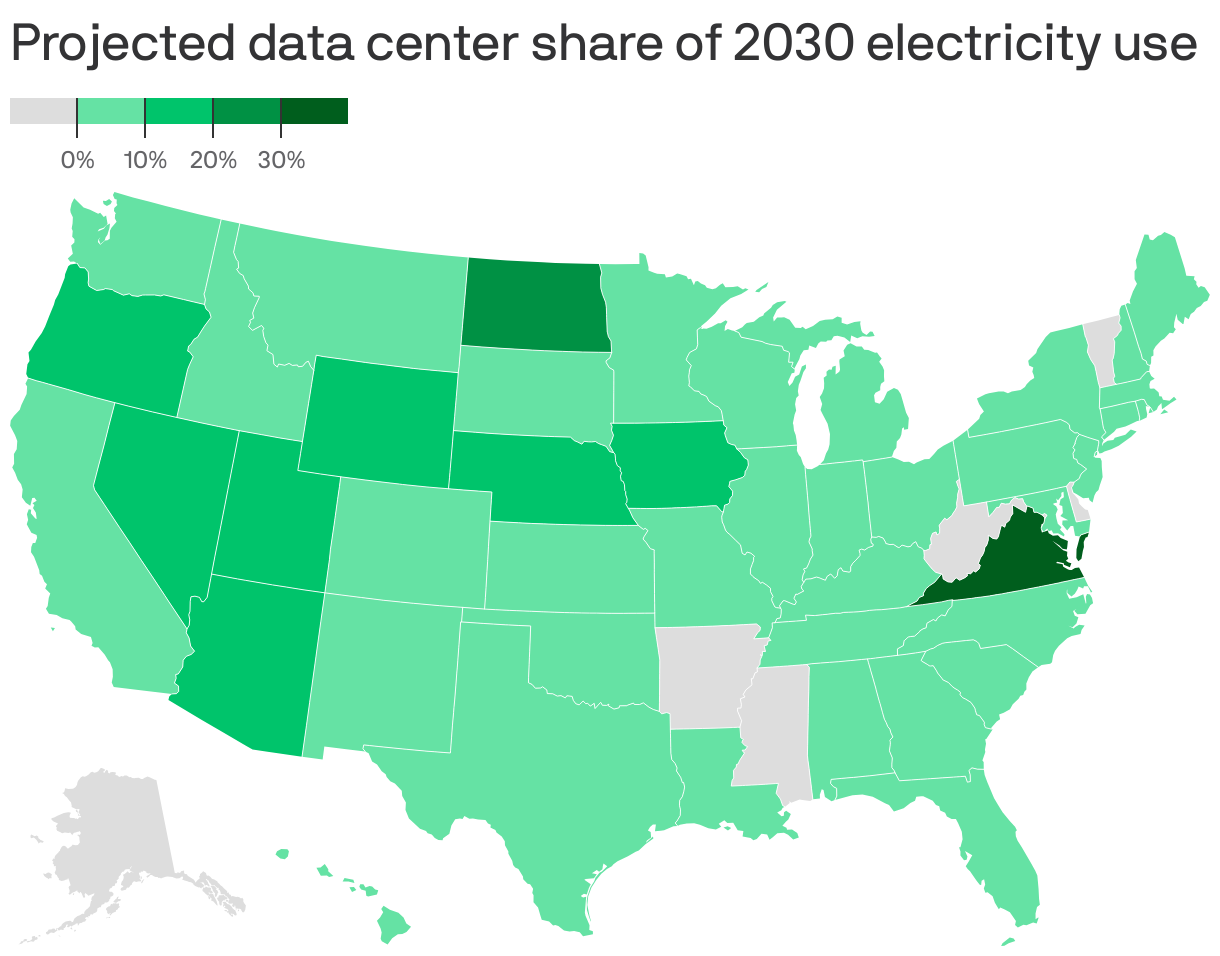
New projections help crystallize a huge challenge: meeting the surging energy needs of data centers as artificial intelligence joins other forces pushing up U.S. power demand.
Why it matters: The balance of fuels that meet this added thirst — gas, renewables, coal, batteries, nuclear and more — will sway future carbon dioxide emissions.
Driving the news: The Electric Power Research Institute sees these digital hubs draining between 4.6%-9.1% of U.S. electricity in 2030, based on four scenarios.
- Last year it was 4%, the nonprofit's new report states.
- It's very regional too — the state-by-state graphic above averages their four growth cases.
- Today, data centers in 15 states account for 80% of the total.
Stunning stat: "At 2.9 watt-hours per ChatGPT request, AI queries are estimated to require 10x the electricity of traditional Google queries," EPRI finds.
- Emerging AI video, image and audio applications "have no precedent."
What we're watching: Which energy sources are used to meet energy thirst from AI, new manufacturing, EVs and more.
- Tech companies like Google and Microsoft are big players in zero-carbon energy purchase deals.
- But a new TD Cowen report projects "75-100% of incremental U.S. data center load growth in the near to medium-term will be supported by natural gas."
Zoom in: A recent Goldman Sachs analysis sees data centers driving over a third of what they project will be 2.4% compound annual growth rate of U.S. power demand through 2030.
- Goldman projects these hubs using 8% of U.S. electricity by then, and assumes a 60/40 split between gas and renewables in meeting new demand growth for this infrastructure.
State of play: EPRI calls for a multipronged strategy that includes efficiency gains, but they warn that since 2018, these improvements have slowed.
What's next: EPRI's working with the data center industry and utilities to explore sustainable approaches.
- One of the ideas: backup generators powered by "clean fuels" that help move the data center-grid relationship from a passive one to a "shared energy economy."
- That means "grid resources powering data centers and data center backup resources contributing to grid reliability and flexibility."
2. 15 years later, a promise kept on climate finance

Industrialized countries (finally) made good on their pledge to provide at least $100 billion a year in climate assistance to poorer nations in 2022, according to a new analysis.
Why it matters: There was a two-year delay in fulfilling the pledge, which was made at the Copenhagen climate talks in 2009. It generated resentment and doubts among developing nations regarding future climate funding promises.
Zoom in: A new OECD report shows developed countries provided $115.9 billion for developing nations in 2022, exceeding the $100 billion goal for the first time.
- This was a 30% jump from 2021, which was the biggest year-on-year increase.
- Hitting the $100 billion goal comes as countries work to come up with a new target to be decided at COP29 in Baku, Azerbaijan, in November.
Yes, but: $100 billion a year was always a paltry sum compared with what is needed to meet the Paris targets.
- Many billions more are required for the world to improve its chances of slashing emissions deeply enough to avoid potentially catastrophic climate change and to help developing countries withstand climate change-worsened extreme weather events.
The bottom line: "It is always essential to fulfill past promises, but even more so this year as the Presidency is bringing the parties together to agree [to] a fair and ambitious new climate finance goal," said COP29 president-designate Mukhtar Babayev in a statement.
3. What they're saying about ConocoPhillips deal
Let's gauge early fallout from ConocoPhillips' $22.5 billion deal (including debt) to acquire Marathon Oil.
State of play: ConocoPhillips stock fell 3% yesterday and Marathon's jumped over 8%, as investors and analysts digest the premium paid, acreage obtained, and what it all means for COP's strategy.
What they're saying: CFRA's Stewart Glickman's note has a "hold" rating on COP's stock but also highlights the deal's geographical benefits.
- Marathon's Eagle Ford and Bakken shale holdings cut the Permian's share of ConocoPhillips' Lower 48 production from 70% to 57%, "which would reduce exposure to possible midstream capacity headwinds" there.
- Enverus Intelligence Research's Andrew Dittmar, in a note, sees a "pivot in U.S. shale M&A from deals focused on increasing exposure in a single key basin or play to acquiring a multi-basin operator."
What we're watching: Regulatory snags can't be ruled out.
- But University of Houston energy economist Ed Hirs tells Yahoo! Finance he doesn't see antitrust hurdles, based on their size and absence of refining or retail assets.
4. Parsing Exxon's shareholder meeting
If there's a shareholder rebellion brewing over ExxonMobil's approach to activist investors, it's starting extremely slowly.
Driving the news: Shareholders yesterday backed the 12 directors with votes ranging from 87% to 98%, compared with 91% to 99% last year.
Why it matters: The annual meeting was a referendum of sorts on Exxon's ongoing lawsuit over an activist resolution that called for much more expansive climate targets.
- Some investors, including CalPERS, have attacked the lawsuit and said they were voting against some (or all) directors.
Catch up quick: Critics of the litigation over the since-withdrawn proposal call it bullying that will chill shareholder advocacy.
- Exxon says it brought the case because the SEC process fails to ensure companies can exclude resolutions that would erode shareholder value.
What they're saying: "Today our investors sent a powerful message that rules and value-creation matter," Exxon said.
The other side: The advocacy group Majority Action said the vote as low as 87% sent a signal, though they acknowledge the largest asset managers stood with Exxon. Reuters has more.
5. Catch up quick on policy: Nukes, SPR, Big Oil
⚛️ The White House isn't giving up on the prospect of large new nuclear reactor construction, despite huge cost overruns and delays that have hobbled projects.
- State of play: Biden officials yesterday announced a working group on "Nuclear Power Project Management and Delivery."
- What's next: It will tap experts from the nuclear and "megaproject construction industry" to help "proactively mitigate sources of cost and schedule overrun risk." H/t to Bloomberg, which has more.
- The intrigue: The Energy Department tells Axios that it's aimed at helping potential large-scale projects with existing tech, but also small modular reactors and other advanced designs.
- Quick take: The mammoth overruns with Southern Company's recently completed Plant Vogtle could make it the last nuclear megaproject for a long time, but never say never.
📬 Top Republicans on the House and Senate energy panels are warning the White House not to use the Strategic Petroleum Reserve as a "political tool to offset high gas prices." Full letter.
📬 Senate Majority Leader Chuck Schumer and 22 other Senate Democrats this morning asked Attorney General Merrick Garland to investigate the oil industry for potential collusion. Full letter.
📨 Did a friend, colleague or even a frenemy send you this newsletter? Welcome, please sign up.
🙏 Thanks to Chris Speckhard and Javier E. David for edits to today's edition, along with the brilliant Axios Visuals team.
Sign up for Axios Generate