Axios Generate

May 03, 2022
🕺🏽Monday is behind us! Welcome to Tuesday and a Smart Brevity count of 1,121 words, 4.5 minutes.
📬 Did a friend send you this newsletter? Welcome, please sign up.
🎶 Exactly 25 years ago the late Notorious B.I.G. ruled the Billboard Hot 100 with today's immortal intro tune...
1 big thing: Shaping direct air capture hubs

Illustration: Aïda Amer/Axios
An influential nonprofit called Carbon180 is working to shape how the Energy Department spends $3.5 billion to develop four regional direct air capture hubs, Andrew writes.
Driving the news: These installations would seek to prove the scalability of the climate tech option, which is attracting increasing interest from investors.
In a white paper shared first with Axios and through exclusive interviews with staff, Carbon180 laid out its views on how to best administer the largest-ever federal investment in DAC technology, which is still in its early days.
Why it matters: Depending on the level of greenhouse gas emissions in the next few decades, humanity may need to lean heavily on technologies like direct air capture to bring down atmospheric concentrations of planet-warming gases.
Zoom in: Whether and how to scale the technology will be partly determined by the criteria used for designing and implementing the regional DAC hubs, which were funded over the course of five years under the bipartisan infrastructure bill.
- To be eligible for the program, a hub, which involves the colocation of complementary infrastructure, must eventually be capable of capturing at least 1 million metric tons of carbon dioxide annually.
By the numbers: The program "represents a 400-times increase in the size of the global DAC industry," said Erin Burns, executive director of Carbon180.
The big picture: "Essentially, this is going to help define, at least for the near term, what does DAC look like in practice," Burns stated.
- Carbon180 is seeking to ensure that direct air capture is used "as a means to remediate legacy carbon emissions," rather than as an "excuse" to continue with business as usual emissions, per the white paper.
- The organization is also focused on ensuring the funding of a range of technologies in ways that enhance equity, address environmental justice concerns, obtain community buy-in and provide long-term job opportunities.
The intrigue: Carbon180 has clout within the Energy Department when it comes to DAC. Its co-founder, Noah Deich, recently took a leave of absence to serve in a top carbon removal role at the department.
- Carbon180 shared some of its views from the white paper with DOE via the department's request for information earlier this year.
What they're saying: "I think there's no longer a question of does this work? It clearly works. The big question now is can you make it work at scale? And that's the only real question that matters," Peter Minor, director of science and innovation at Carbon180, told Axios.
- "We have to start solving the really big problems now," he said, citing providing megawatts worth of clean electricity 24 hours a day for such plants to operate.
What's next: DOE is expected to issue its DAC hub guidance later this month.
2. Uneven EV growth and its discontents
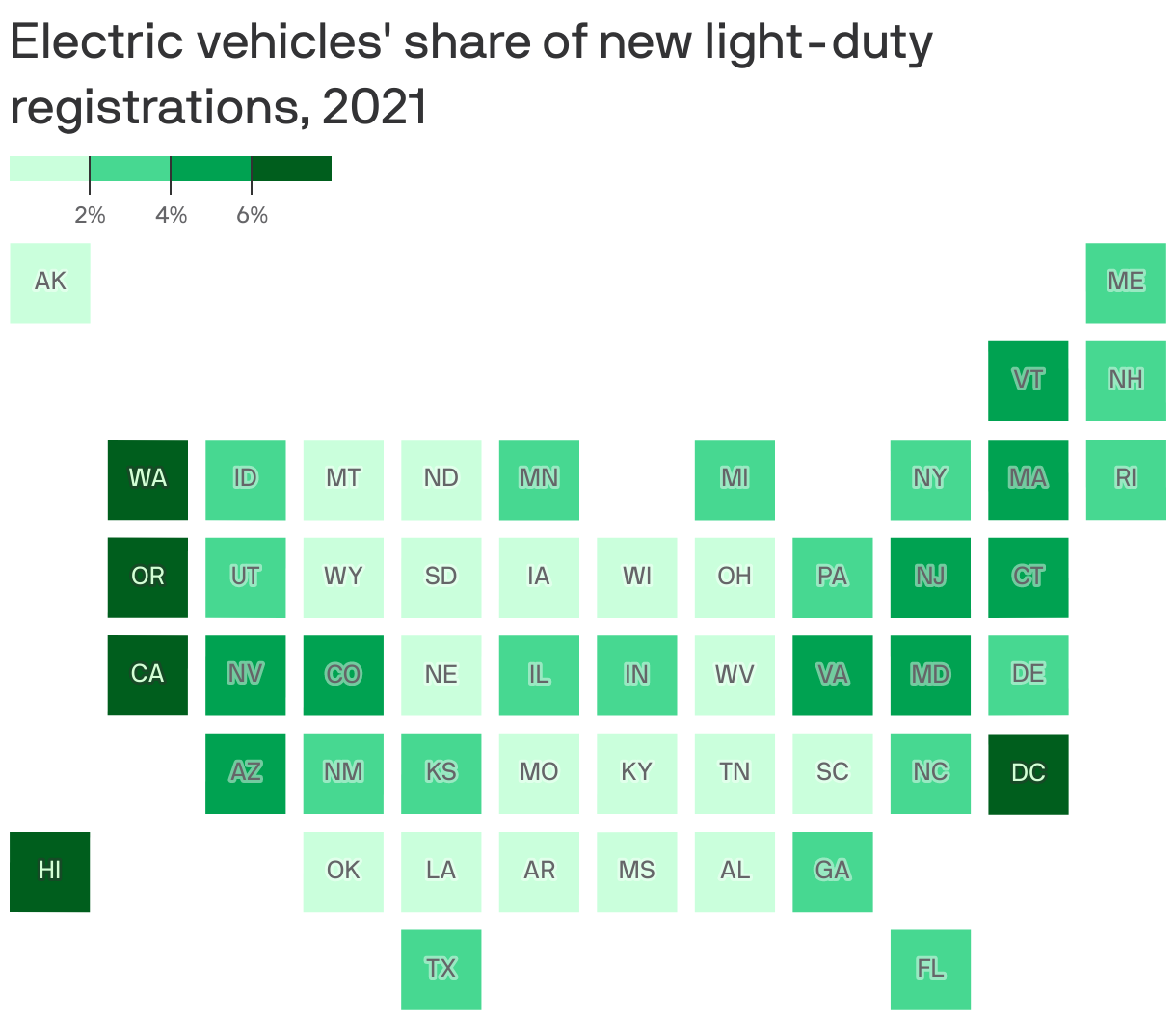
EV sales growth is highly uneven, and a new(ish) analysis argues this badly limits the climate benefits of federal purchase subsidies, Ben writes.
The big picture: EVs were over 12% of new light-duty vehicles registered in California last year, and Oregon, Washington, Hawaii and D.C. were all over 7%, per the Energy Department.
Uptake is way slower in many other states, including huge interior areas where people drive long distances.
Why it matters: Check out this new analysis by the nonprofit Niskanen Center (h/t Matt Yglesias).
- It notes EVs aren't yet catching on among drivers who use the most gasoline.
- They're often in rural, suburban, or exurban areas and drive pickups and SUVs.
Zoom in: It draws on work by the clean transport group Coltura, which looked at "super users" — the top 10% of drivers who account for a third of gas use.
- Niskanen sets this against the target of ramping up EVs to 50% of sales by 2030, which is shared by the White House and several automakers.
- It models two scenarios: uptake continuing among "super progressives" — wealthier, more urban buyers who tend to drive efficient cars anyway — and "super users."
What they found: If all those new EVs went to "super users," it would displace 170 billion gallons of gas by 2030. That's 10 times the same uptake among "super progressives."
What's next: It suggests changing purchase incentives by linking them to miles driven to provide more climate bang for the buck.
"Reforming EV subsidies to target Super-Users would make them more equitable, helping less well-off Americans, and particularly those hit hardest by big payments at the pump."
3. Catch up fast: LNG, coal, wildfires, Congress
Russia fallout: "France’s state-backed utility Engie has signed up for natural gas from Texas in the first US contract with a European buyer since Washington pledged to help the continent break its reliance on Russian gas." (Financial Times)
India: "India’s state-run electricity giant NTPC Ltd. plans to expand its coal-fired power fleet with a first new project in six years, a policy shift that reflects alarm over the nation’s worsening power crisis." (Bloomberg)
Extreme weather: Wildfires driven by strong winds and drought continued to threaten northern New Mexico, forcing thousands to evacuate. (Axios)
Capitol Hill: "Senator Joe Manchin and other lawmakers are weighing a border adjustment tax that would slap a levy on imports of carbon-intensive goods from countries with weaker climate policies as they work on a potential bipartisan energy and climate package." (Bloomberg)
4. BP ups buybacks as profits surge (with an asterisk)
Photo illustration: Thiago Prudencio via Getty Images
BP this morning became the latest oil giant to boost shareholder payouts as high prices are enabling an earnings surge, Ben writes.
Driving the news: BP reported a $6.25 billion Q1 net profit, beating expectations, but also took a $25.5 billion write-down linked to ditching its big stake in Russia's Rosneft.
It plans to buy back $2.5 billion in shares during Q2, up from $1.5 billion in the first three months of 2022. CNBC goes deeper on BP's quarter.
Speaking of earnings, Reuters reports: "U.S. shale producers Devon Energy, Diamondback Energy and Coterra Energy on Monday reported sharp increases in profit that beat Wall Street estimates, but held production plans steady as they stressed a focus on shareholder returns."
5. Biden officials launch battery manufacturing push
Illustration: Aïda Amer/Axios
The Energy Department just opened the doors for applications to tap over $3 billion for domestic battery manufacturing and supply chain projects, Ben writes.
Driving the news: DOE on Monday published solicitations for cash made available under the bipartisan infrastructure law.
- The largest tranche announced, at $3.1 billion, is for projects to manufacture batteries or process raw materials like lithium and graphite.
- There's also $60 million for recycling and "second life" opportunities for EV batteries.
Why it matters: Growth in EVs will require a lot more batteries and related materials.
The solicitation notes that demand for EVs and stationary storage is projected to expand the global market by up to tenfold by 2030.
Threat level: U.S. risks falling further behind Europe and China in the race to create a thriving domestic industry, Axios' Joann Muller reported.
Thanks for reading and see you back here tomorrow.
Sign up for Axios Generate

Untangle the energy industry’s biggest news stories