Axios Generate

August 31, 2023
🧭 The compass is pointing toward the weekend. We'll prevent delays with a Smart Brevity count of just 1,250 words, 4.5 minutes.
🎶 At this moment in 2015, Omi was No. 1 on the Billboard Hot 100 with a summer smash that's today's intro tune...
1 big thing: A (mostly) successful intensity forecast
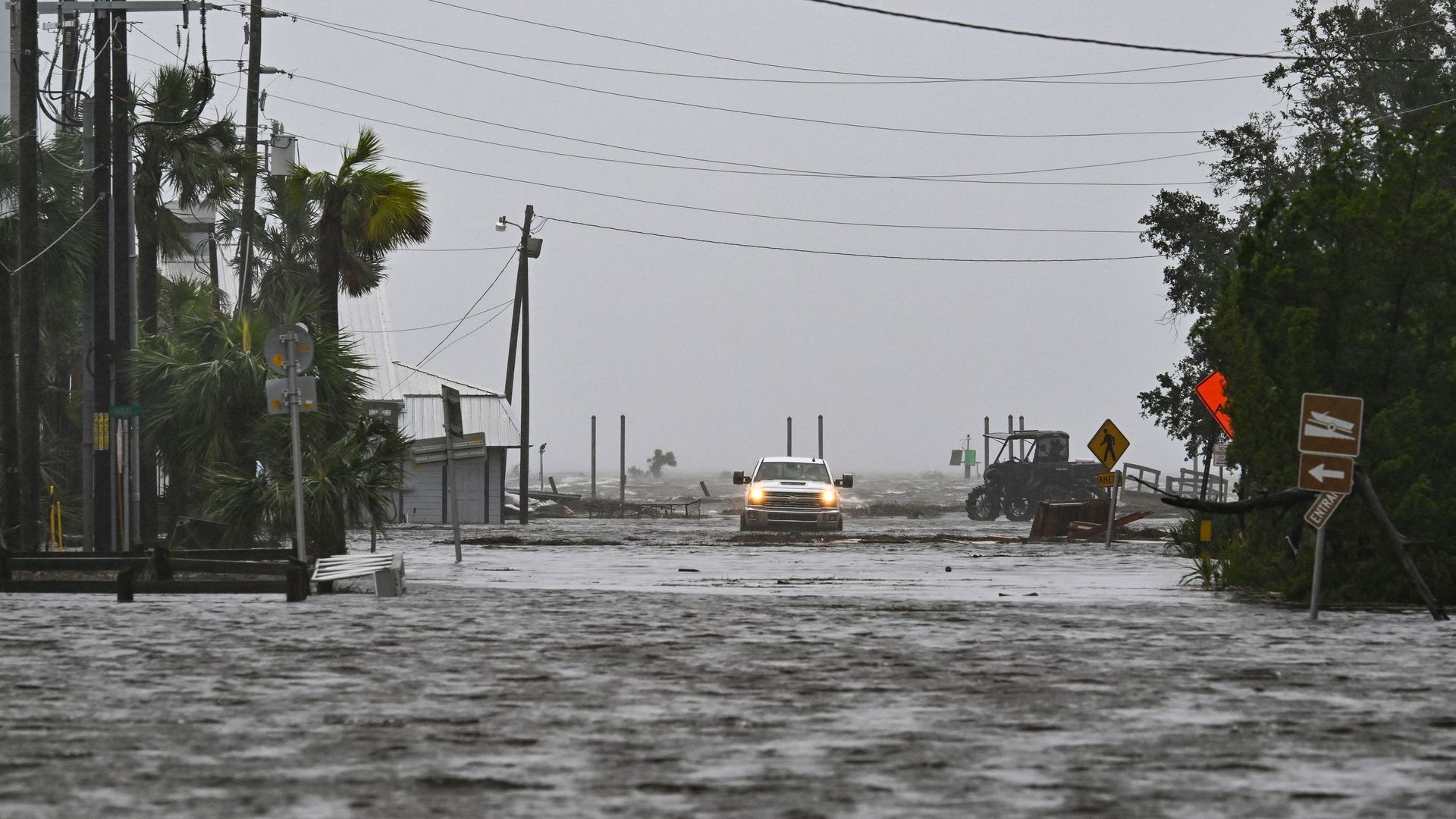
A vehicle is driven through a flooded street Wednesday in Steinhatchee, Fla., as Hurricane Idalia made landfall. Photo: Chandan Khanna/AFP via Getty Images
The National Hurricane Center successfully predicted Hurricane Idalia's dramatic intensification during the 24 hours leading up to landfall, a major advance from where forecast skill was just several years ago, Andrew writes.
The big picture: The storm illustrates how NHC forecasters' capabilities are largely keeping pace despite climate-change related trends in rapid intensification.
- "While climate change makes certain kinds of forecasts (like hurricane intensity) harder, our techniques for making skillful forecasts are improving even faster," MIT meteorologist Kerry Emanuel told Axios via email.
Between the lines: Storm intensity forecasts have long lagged behind NHC's improved skill at making track projections.
- But now the investment in new computer models that aim to better resolve small-scale features in the core of a tropical storm or hurricane may be making a clear difference.
- For example, these models, fed with Hurricane Hunter data, consistently showed a "caution" flag for Idalia's intensification.
- With this storm, nearly every single indicator showed the same scenario: the Jacuzzi-like waters of the Gulf of Mexico plus favorable atmospheric conditions would allow it to rapidly intensify.
Yes, but: The Hurricane Center's forecasts for Idalia were not perfect.
- Three days in advance, which is within the window when evacuation and other crucial planning decisions need to be made, it was predicted to be a Category 1 storm at landfall.
- At 5am ET on Sunday, NHC meteorologist Eric Blake sounded the alarm in a technical forecast discussion that caught the attention of meteorologists and emergency managers outside of NHC.
- "There's a notable risk of rapid intensification while the system moves across the record warm eastern and northeastern Gulf of Mexico," he wrote.
- The official forecast at the time was for a 90-mile-per-hour Category 1 storm at landfall.
Of note: It wasn't until about 48 hours before landfall that NHC's forecast was brought in line with the eventual outcome of a Category 3 hurricane hitting Florida.
- In the end, Hurricane Idalia's top sustained winds increased by 55 mph in 24 hours, greatly exceeding the 35-mph increase needed to meet the definition of rapid intensification.
- But this also exceeded NHC's 45-mph predicted intensity increase.
The intrigue: Idalia's example showcases the improvements forecasters, modelers and researchers have made to better predict a phenomenon that is becoming more common and pronounced as the world warms.
- Climate change trends are providing more opportunities for storms to rapidly intensify when other conditions allow due to increasing sea and air temperatures and the related higher amount of water vapor in the atmosphere.
The bottom line: The popular assumption that because the weather is becoming more extreme it is getting harder to predict did not hold up with Idalia.
2. VC funding gets climate law lift
Illustration: Sarah Grillo/Axios
Venture funding for clean energy startups in Q2 was the strongest since the last three months of 2021, per PitchBook, Ben writes.
The big picture: The VC data and analysis firm said higher investment in solar and hydrogen tech helped drive the total — and the 2022 climate law is among the reasons.
State of play: Q2 saw $5.4 billion in total global deal value, though the number of deals is smaller than the same period last year.
- Notable Q2 transactions PitchBook highlights include Electric Hydrogen's $355.7M Series C round and solar and storage developer Nexamp's $400M late-stage round.
How it works: The Inflation Reduction Act can help companies directly and indirectly, depending on their maturity level and what exactly they do.
- In a bank-shot way, tax subsidies for clean generation help give investors confidence in a market for startups' technologies.
- More mature companies on the commercial development side, meanwhile, can tap incentives for energy production projects.
What they're saying: "Regarding hydrogen generation, more established startups that are already producing low-carbon hydrogen are well-placed to take advantage of the available incentives — those in the IRA, and those from other initiatives," PitchBook senior analyst John MacDonagh said via email.
🤘 And some metal VC news: Recycling startup Sortera yesterday announced close of a $30.5 million Series C funding round, Axios Pro: Climate Deals' Alan Neuhauser was first to report.
3. Pre-COP28 jockeying and more petro-notes

Illustration: Annelise Capossela/Axios
♟️ Positioning and expectations-setting over the role of oil producers and companies at COP28 is heating up, Ben writes.
- What's new: OPEC boss Haitham Al Ghais penned an op-ed citing the cartel's projection that demand will be higher in 2045 than today and that a "healthy degree of pragmatism" is needed to meet energy needs while curbing emissions.
- Catch up fast: U.S. climate envoy John Kerry, in Scotland last week, called for the fossil fuel industry to arrive at the late-year United Nations summit with a "clear road map" that's in sync with Paris Agreement goals.
💰 The Biden administration is throwing open the doors for states to tap $350 million in grants for curbing methane emissions from certain oil and gas wells.
- Why it matters: It's part of wider finance via the 2022 climate law for helping stem the powerful greenhouse gas. Applications for this tranche are due Sept. 30.
🇨🇳 "China's Sinopec Corp is setting up a new entity to invest in refinery and petrochemical assets overseas in a bid to leverage its expertise and deep pockets to expand globally as local Chinese oil demand nears a plateau," Reuters reports.
4. A stark sign of offshore wind hurdles


An ominous warning from offshore wind heavyweight Ørsted is bringing the hurdles facing developers into stark relief, Ben writes.
Driving the news: The Danish firm behind several planned Atlantic Coast projects yesterday estimated up to $2.35 billion in writedowns.
- The company's stock plunged nearly 25% in trading Wednesday.
- It cited supply chain delays, problems tapping additional tax U.S. credits beyond the 30% base rate, and interest rates also affecting onshore plans.
- Ørsted's planned offshore projects include Ocean Wind 1 off New Jersey, Sunrise Wind off New York, and Revolution Wind off Connecticut and Rhode Island. The latter two are joint ventures with Eversource.
Why it matters: It's an escalation of a trend that's threatening to weaken the U.S. offshore buildout — a White House climate and economic priority.
"Developers including Avangrid Inc. and Shell New Energies are delaying projects after rising costs made some plans economically unviable," Bloomberg reports.
What we're watching: Ørsted said it remains committed to the projects and is talking with federal officials about the additional tax incentives.
But via Reuters, CEO Mads Nipper told reporters: "The situation in U.S. offshore wind is severe."
5. 🖥️ On my screen: EU power, LNG, transportation
📉 Fossil fuels were a record-low 33% of European Union power generation in the first half of 2023, per the climate group Ember that tracks the region's electricity sector, Ben writes.
- State of play: Coal saw by far the steepest drop, followed by natural gas. Lower overall power use and renewables growth shake up the mix. Full analysis.
📈 Nations' combined capacity to import liquefied natural gas is slated to grow 16% from 2022 levels by the end of next year, per a new Energy Information Administration primer.
- Three countries — Germany, the Philippines and Vietnam — began first-time imports this year, while several others are on tap.
📈 Here's a noteworthy stat: In 2000, Brazil, China, India, Indonesia, Mexico and South Africa were 14% of road transport energy demand, and by 2021 that nearby doubled to 27%, per an International Energy Agency report.
- Why it matters: A thorny question is how to meet growing demand with lower emissions. The report offers governments a suite of recommendations — and flags programs underway.
- The intrigue: Chinese gasoline demand may peak this year, Bloomberg reports, citing Sinopec estimates. The story notes diesel is expected to keep rising, though EVs are making some inroads into trucking.
Did someone forward you this newsletter? Welcome, and please sign up.
🙏 Thanks to Chris Speckhard and Chuck McCutcheon for edits to today's edition, along with the talented Axios Visuals team.
Sign up for Axios Generate

Untangle the energy industry’s biggest news stories