
Axios Generate

October 14, 2022
๐บ Happy Friday! Today's newsletter has a Smart Brevity count of 1,272 words, 5 minutes.ย
๐ President Biden said in Los Angeles yesterday that he'll have "more to say" next week about attempts to curb gasoline prices.
๐ถ Today marks 45 years since the late David Bowie released the album "Heroes," which provides this week's final intro tune...
1 big thing: Qatar sees EU as long-term LNG customer

Photo illustration: Annelise Capossela/Axios. Photo: Karim Jaafar/AFP via Getty Images
Qatar's energy minister sees his country supplying liquefied natural gas to Europe for decades, despite the EU's plans to pivot quickly to renewables in the wake of the Ukraine-related energy crisis, Andrew writes.
Why it matters: This view reinforces the anxiety among climate activists and some world leaders about locking in too much gas infrastructure.
Driving the news: European countries dependent on Russian gas to heat homes and power factories have been scrambling for alternative supplies and the infrastructure to receive them, and many are turning toward tiny Qatar, a global gas powerhouse.
- In a wide-ranging interview with Axios, Saad bin Sherida Al-Kaabi said Europe made a mistake in pushing to switch to renewable energy too quickly while remaining dependent on Russian gas supplies for baseload power.
- Qatar and the U.S. rank as the world's top LNG suppliers, and Qatar will significantly increase its capacity when new facilities open in 2026.
- Al-Kaabi met with Energy Secretary Jennifer Granholm and top Biden energy official Amos Hochstein yesterday in Washington.
What they're saying: "Whether it's in the U.S. and EU, in the Americas and Europe and Asia, gas is absolutely going to be needed for a very long time," Al-Kaabi said.
- "So if they have other ideas in Europe and so on, well, if they materialize into something that's a reality... good for them. But until then we'll be serving their markets."
What we're watching: Al-Kaabi said the global community is heading into the next round of UN climate talks in Egypt next month after a year of emissions backsliding.
- "Realistically, what are we going to say in COP27?" Al-Kaabi said.
- "Coal today is at its highest ever utilization in the history of humanity," he said.
- "I think we're in a very delicate situation that we have to be very careful" about pushing fossil fuels to the maximum without considering the climate consequences, he said.
- "Global warming is a reality that we can't hide away from." He cited QatarEnergy, which he leads, for moving aggressively into solar, carbon capture and storage, and blue ammonia projects.
The intrigue: He gave his take on whether industrialized countries should set up a fund to compensate developing countries for the climate disasters they are already experiencing as a result of the developed world's emissions.
- Qatar's official position on "loss and damage," as it is known in UN climate parlance, will be decided at the political level in his government, Al-Kaabi said.
Yes, but: The creation of a loss and damage fund will be a major point of contention at COP27 in Sharm El-Sheikh.
- "I would not support putting a fund together or whatever they're trying to do to compensate [countries] because I think there are much bigger polluters than us that would not actually participate in doing it," he said.
Our thought bubble: This response illustrates the difficulty negotiators will have in coming away from COP27 with a tangible funding mechanism, given a perceived first-mover disadvantage.
2. Energy inflation falls but winter is coming
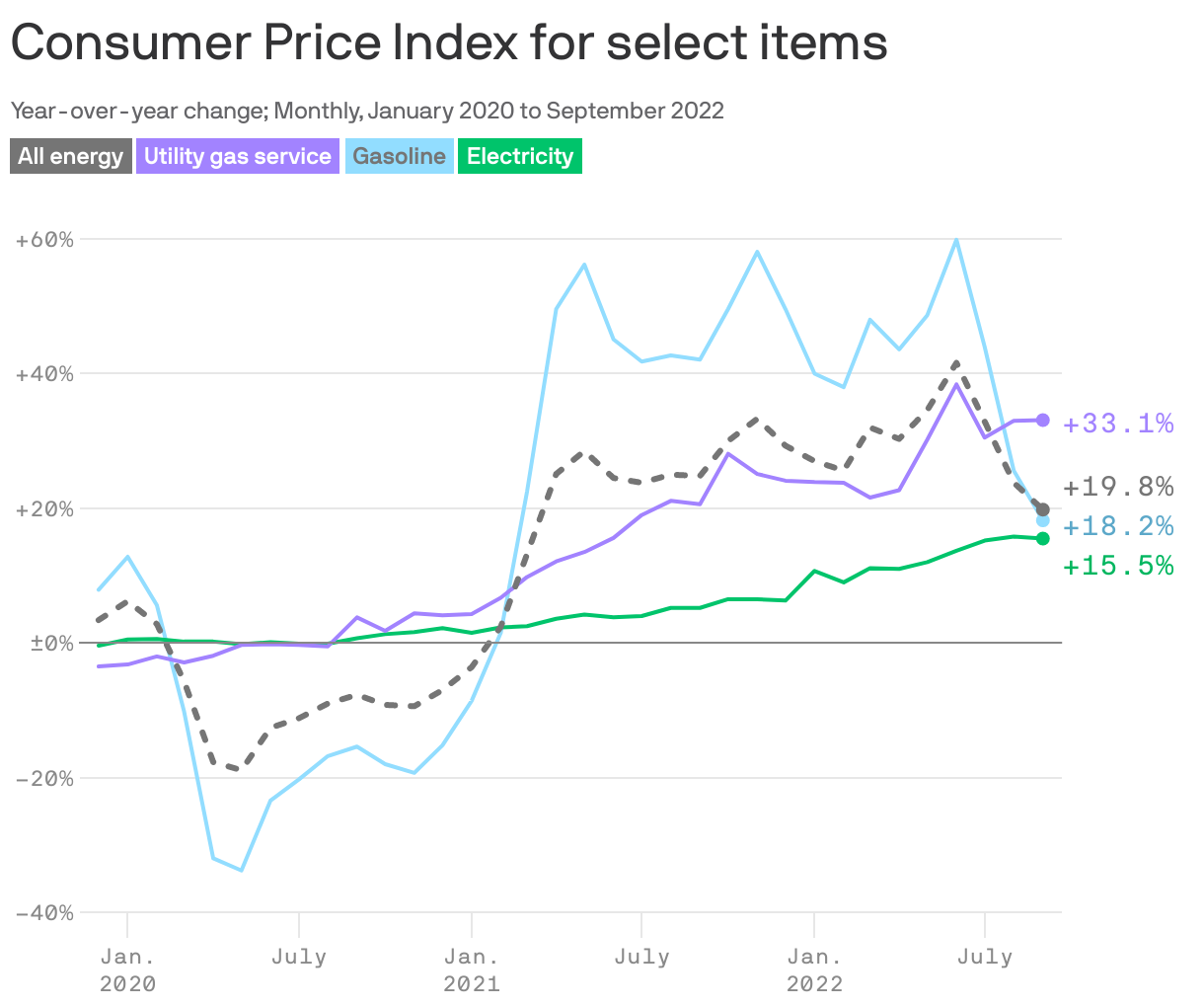
Energy cost inflation eased last month thanks largely to falling gasoline prices, but federal analysts project most households will face higher heating costs this winter, Ben writes.
Driving the news: The latest Consumer Price Index, a measure of what consumers pay for goods and services, showed overall September prices up 8.2% year over year.
As you can see above, gasoline is sharply lower, while natural gas and electricity costs have been more stubborn.
The big picture: Falling energy prices have held down overall inflation for the last few months. But outside of gasoline, most other goods and services keep getting markedly more expensive. And gas prices have started to rebound in recent weeks, Axios' Neil Irwin reports.
What's next: While motor fuels are way below the June peak, when average gasoline prices briefly hit $5 per gallon, winter could mean new financial pain for many households.
In a separate report, the federal Energy Information Administration is out with winter heating cost estimates for households using various types of fuel.
Why it matters: While gasoline prices are highly visible โ especially in election years โ the EIA data shows how the commodity cost surge is hitting consumers from several angles.
Zoom in: In their "base case" for the October-March season, the 60 million U.S. households that heat mostly with natural gas will pay an average of $931, which is 28% above the same period a year earlier.
The roughly 54 million households heating primarily with electricity are projected to see a 10% rise to $1,359.
Yes, but: There's considerable regional variation, and the report also looks at less common heating sources including fuel oil. Check it out.
3. Disaster-ready affordable housing is en route
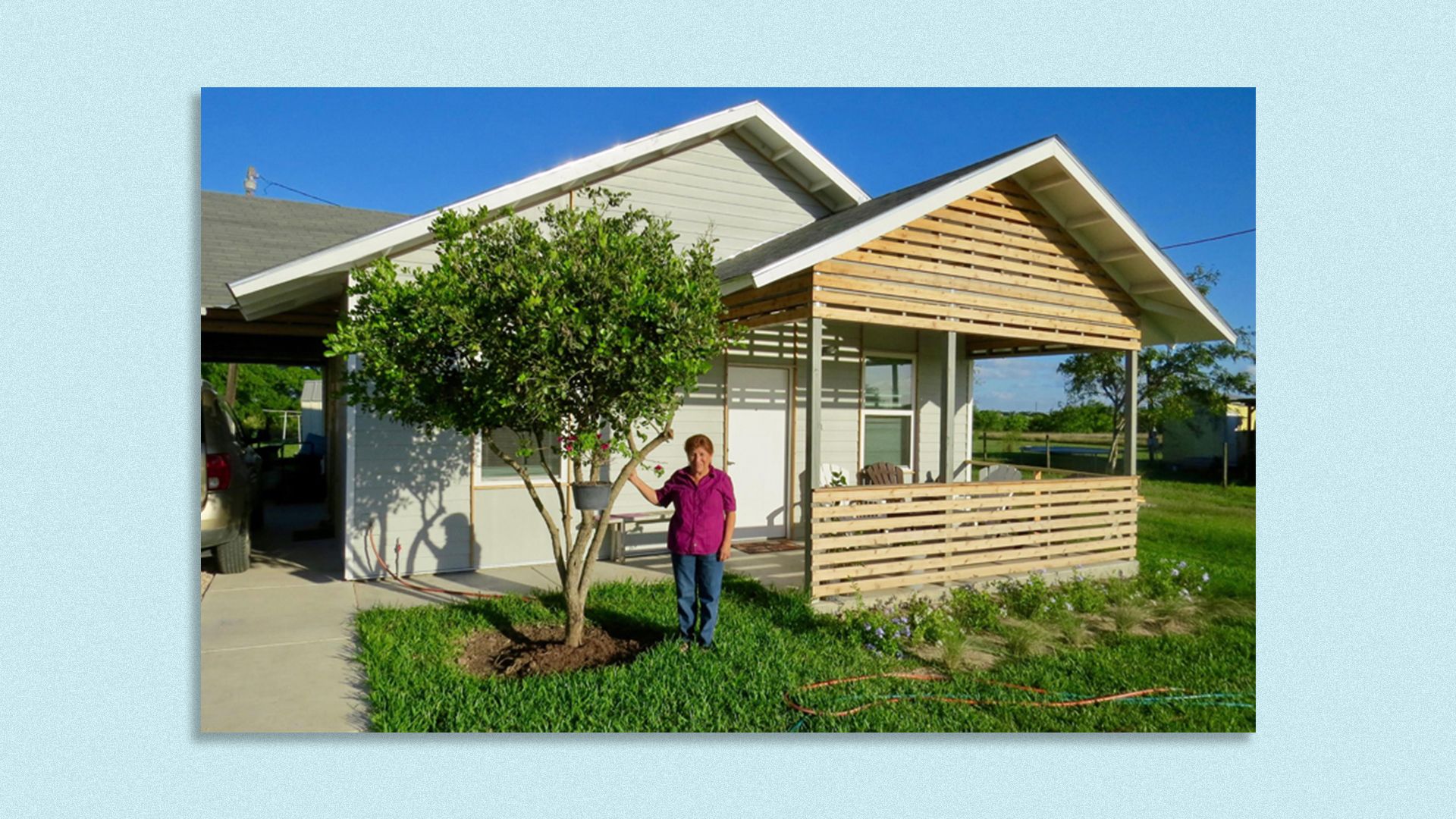
A MiCASiTA home. Photo: Courtesy of Marcella Sรกenz/cdcb
Two Texas-based nonprofits are developing disaster-resilient affordable homes in the Rio Grande Valley for low-income communities of color, Axios' Ayurella Horn-Muller reports.
Why it matters: Organizations like these are working to mitigate the affordable housing crisis that emerges after disaster events like hurricanes โ which are intensifying, due to human-caused climate change.
The intrigue: The homes are touted as disaster-resilient. That means they're built to withstand winds up to 130 miles an hour, or a Category 4 hurricane, and elevated at least 18 inches above floodplain, which is a typical required building code for cities across the country.
How it works: Developed by two nonprofits โ "come dream. come build," or cdcb, and "buildingcommunityWORKSHOP," or bc โ MiCASiTA is an affordable housing homeownership model.
The backstory: MiCASiTA started out as RAPIDO, an emergency housing model that could be quickly built for lower-income families left unhoused following an extreme weather event.
- Increasing temperatures are fueling more intense hurricanes, heavier rainstorms, hotter heat waves and other extreme events โ all of which amplify shortages in affordable housing.
Of note: According to cdcb's executive director Nick Mitchell, MiCASiTA's homeownership model is part of a "pre-recovery" process โ maximizing community resilience to future storms.
4. ๐งฎ Need-to-know numbers: China, methane, EVs
๐ฐ$14 trillion, the investment level needed to decarbonize China's power and transport sectors in line with its goal to be carbon neutral by 2060, per a new World Bank analysis.
- Why it matters: China is the world's largest greenhouse gas producer, and the report provides a roadmap for integrating climate and development goals.
๐ 40%, the methane emissions cuts since 2017 from exploration and production sites operated by member companies in the Oil and Gas Climate Initiative, the group said.
- Why it matters: Methane is a very powerful planet-warming gas, and OGCI's dozen members include many of the world's largest oil-and-gas companies.
- Yes, but: Overall, industry-wide methane emissions have not fallen nearly that much and are not on a pathway consistent with Paris Agreement goals, per International Energy Agency data.
๐ 15%, the increase in global bank lending to fossil fuel companies in the first nine months of 2022 compared to the same stretch last year, Bloomberg reports.
๐ Over $13.8 billion, the number of economic development subsidies that states have awarded for EV and battery factories, per a new report by the corporate watchdog group Good Jobs First.
- Why it matters: The figure, which the group says does not include many undisclosed subsidies, underscores the intense competition among states to capture pieces of the fast-growing sector.
5. ๐ฎ Where power conservation is an extreme sport
An in-depth New York Times feature explores a new frontier of activism in France: very athletic youth โ like, think Spider-Man โ undertaking a guerrilla form of energy saving.
- "Over the past two years, groups of young athletes practicing Parkour โ a sport that consists of running, climbing and jumping over urban obstacles โ have been swinging around big French cities switching off wasteful shop signs at night, in a bid to fight light pollution and save energy."
๐ฌ Did a friend send you this newsletter? Welcome, please sign up.
๐Thanks to Mickey Meece and David Nather for edits to today's newsletter. Have a great weekend and we'll see you Monday!
Sign up for Axios Generate

Untangle the energy industryโs biggest news stories

