
Axios Generate

August 01, 2023
😲 Somehow it's August already! Today's newsletter has a Smart Brevity count of 1,221 words, 4.5 minutes.
⚛️ Situational awareness: Southern Co. began commercial operation at one of two large new nuclear reactors at its Vogtle site in Georgia on Monday after years of delays and huge budget overruns.
- Why it matters: It's the first newly built U.S. reactor to come online in decades. U.S. utilities aren't eyeing more huge projects, though interest in small modular reactors is rising. Go deeper
🎶 Exactly 40 years ago, The Police were No. 1 on Billboard's album charts with "Synchronicity," which provides today's intro tune...
1 big thing: U.K.’s North Sea drilling moves

Illustration: Tiffany Herring/Axios
The United Kingdom now finds itself at the epicenter of global tensions between energy security and lofty climate goals, which are playing out ahead of the COP28 conference in Dubai, Andrew writes.
Driving the news: Prime Minister Rishi Sunak announced plans on Monday to issue more than 100 new oil and gas drilling licenses in the North Sea, along with approvals for carbon capture and storage sites and hydrogen projects.
Why it matters: The move signals the West's continued appetite for more secure fossil fuel supplies. That inevitably runs counter to climate change goals, which have taken on new significance as heat waves envelop much of the world.
- The Sunak government insists that more drilling is compatible with the country’s 2050 net zero emissions target.
The big picture: Spiking energy prices acutely impacted the U.K. after Russia invaded Ukraine last year.
- Sunak is framing the move as key to the country's energy security while also claiming that North Sea-produced gas is far less carbon intensive than imported liquefied natural gas.
- Since the U.K.’s oil and gas production has been falling quickly, the new developments would arrest the decline, a government statement said, rather than leading to a net production increase.
- Climate activists and scientists are slamming the new drilling plans as sending a "wrecking ball" through the UK's climate goals.
Zoom in: On climate and energy issues, the U.K. has parallels with the U.S. and Australia, with the three allies each playing host to robust climate change contrarian movements.
- National governments have see-sawed between aggressive climate objectives and fossil fuel-friendly administrations.
What they’re saying: “Even when we’ve reached net zero in 2050, a quarter of our energy needs will come from oil and gas,” Sunak said in the government statement.
Flashback: When the U.K. hosted COP26 in Glasgow, then-Prime Minister Boris Johnson positioned the country at the forefront of climate action.
State of play: Now Sunak’s government, battered in the polls, is taking a different approach to the energy transition, betting that voters will reward him and his Conservative party.
- “We’re going to do that in a proportionate and pragmatic way that doesn’t unnecessarily give people more hassle and more costs in their lives," Sunak told reporters last week about his approach to net zero.
- The government is reportedly considering modifying a planned 2030 ban on the sale of new gasoline and diesel-powered cars. Other measures to decarbonize homes and transportation are reportedly under review, too.
- Meanwhile, Sunak’s rival Labour Party has endorsed a ban on new oil and gas drilling in the North Sea.
Context: Studies show the world must cut greenhouse gas emissions quickly and steeply, reaching net zero emissions by midcentury in order to have a chance of limiting climate change’s severity below potentially catastrophic levels.
Yes, but: So far, countries are nowhere close to being on that path.
Bonus: Charting the U.K. oil fade


Prime Minister Rishi Sunak's plan to grant new North Sea oil and gas development licenses arrives amid a steep long-term drop in production, Ben writes.
What we're watching: The regions could be adjacent to already-licensed areas, enabling them to be "brought online faster due to existing infrastructure and previous relevant assessments," the announcement states.
2. North Atlantic hits hottest temperature yet
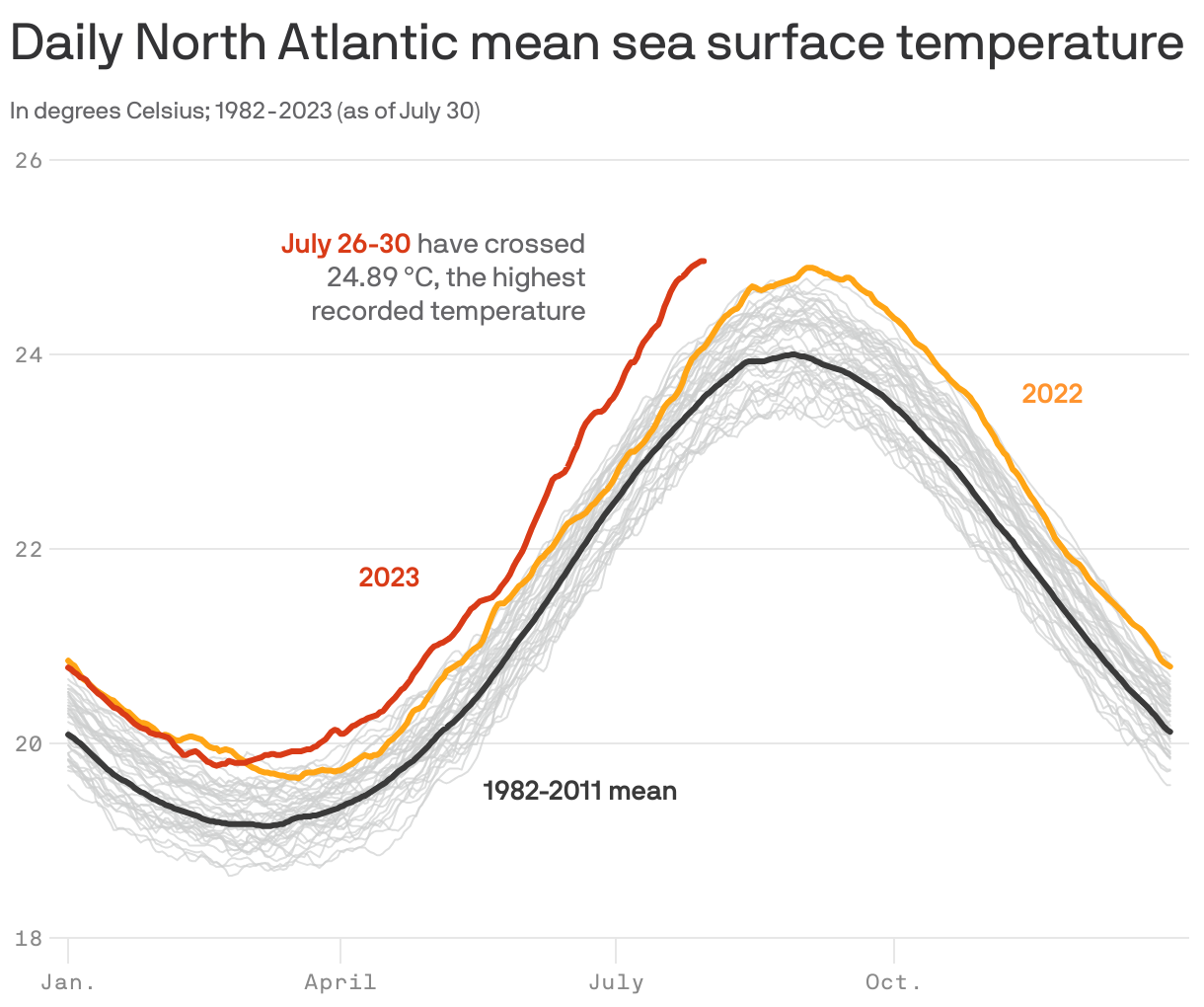
The marine heat wave in the North Atlantic Ocean has shifted from extremely rare to downright unprecedented, Andrew writes.
Why it matters: Elevated ocean heat can lead to extreme weather events on land as warmer waters allow more water vapor to enter the atmosphere, supercharging storms.
Zoom in: There is also concern among weather forecasters that record warm waters will boost hurricane activity, including at unusually high latitudes.
- In addition, marine heat waves of this magnitude can have far-reaching effects on marine life.
The big picture: According to NOAA, about 40% of the globe's oceans are experiencing a marine heat wave, a record high. This is forecast to increase to as high as 50% by September.
- The ocean milestone coincides with record-warm surface air temperatures, driven mainly by human-caused climate change, and deadly heat waves on land as well.
3. 🗳️ 2024 watch: DeSantis and VC investors

Illustration: Annelise Capossela/Axios
◀️ Ron DeSantis is vowing to "reverse the federal government's attempt to force people to buy electric vehicles," Ben writes.
- Why it matters: The GOP White House hopeful unveiled the move in his new economic outline, amidst 2024's high stakes for EV policy. Donald Trump, the GOP frontrunner, recently vowed to dismantle federal support for EVs.
- The big picture: EPA and the Transportation Department are both crafting regulations aimed at speeding up EV deployment. The Democrats' climate law, meanwhile, has major consumer purchase subsidies.
💵 Speaking of the climate law, Axios ProRata's Dan Primack reports that venture investors are divided over what potential Democratic losses would mean for their portfolios.
- State of play: Some investors are prepping for a worst-case scenario of full repeal, which means "ignoring potential climate law benefits beginning in 2025 for prospective portfolio companies, and hardening revenue streams for existing ones."
- The other side: Other climate tech investors remain all-in on the benefits, believing that a victorious GOP would be more talk than walk — especially as money from the law flows to red states. Full story
4. 🛢️ BP earnings and more petro-notes

Illustration: Annelise Capossela/Axios
📉 BP's profits tumbled sharply to close out Big Oil's earnings season, Ben writes.
- Driving the news: It reported $2.6 billion in Q2 haul, down from almost $8.5B in the same period last year, when commodity prices were much higher.
- State of play: Peers Exxon, Chevron, Shell and TotalEnergies also saw big drops, though BP's was steeper.
- The big picture: BP's report aligns with a trend of oil giants continuing investor payouts even as prices have moved lower. It's hiking dividends 10% and announced another $1.5B in buybacks.
👀 New info is emerging about Exxon's foray into lithium. Bloomberg reports Exxon is talking with Tesla, Ford, VW and other automakers about supplying them the key battery metal.
- Why it matters: The reported early-stage discussions with car companies and major battery manufacturers signal Exxon's potentially major move into the lithium market.
- Catch up fast: Exxon has reportedly acquired development acreage in Arkansas, and CEO Darren Woods on Friday gave his strongest statements to date about the oil giant's interest.
🖋️ Four Democratic senators on the party's left flank are pushing AG Merrick Garland to sue oil majors over an alleged "coordinated campaign to mislead consumers and discredit climate science in pursuit of massive profits."
- Driving the news: A new letter from Sens. Bernie Sanders, Elizabeth Warren, Ed Markey and Jeff Merkley calls on the Department of Justice to work with the Federal Trade Commission and "other law enforcement agencies."
- Why it matters: There's growing Democratic pressure on Garland. The letter comes after a separate group of congressional Democrats urged him to probe the industry on similar grounds, though they stopped just short of explicitly urging litigation.
5. 🔥 Quoted
"There is already a whole lot of communication underway about this, but with this incident it becomes apparent we might need to speed up the process, especially when you consider that the number of this sort of cars is only going to rise."— Nathan Habers, spokesperson for the Royal Association of Netherlands Shipowners, via Reuters
Habers discussed the major fire aboard a ship off the Dutch coast carrying hundreds of electric cars. A battery fire is a suspected cause, Ben writes.
Why it matters: More EVs are crisscrossing oceans as sales rise, so potential safety concerns are becoming more important.
📬 Did a friend send you this newsletter? Welcome, please sign up.
🙏 Thanks to Chris Speckhard and Javier David for edits to today's edition, along with the talented Axios Visuals team.
Sign up for Axios Generate

Untangle the energy industry’s biggest news stories


