Axios Generate

July 02, 2021
It's Friday! Today's Smart Brevity count is 1,307 words, 5 minutes.
📊 Data point of the day: 73%. That's the share of SUVs in Volkswagen of America's second-quarter sales, a new record, per a company release.
🇺🇸 We'll be off Monday and return Tuesday. Happy 4th of July weekend!
🎶 And today marks 25 years since De La Soul released the album "Stakes is High," which provides today's intro tune...
1 big thing: Welcome to our hellscape summer
Illustration: Brendan Lynch/Axios
Deadly heat waves. An epic drought. More than a million acres in the West gone up in smoke before the end of June. And the earliest-fifth-named Atlantic tropical storm on record.
- Welcome to the summer of 2021, when scientists' steady drumbeat of climate change warnings have reached an all-too-real crescendo, Andrew writes.
Why it matters: The calamities playing out across the country may have repercussions in Washington as lawmakers debate potentially huge investments for the country's aging infrastructure.
- Depending on its provisions, the eventual legislation could make or break America's ability to sharply cut greenhouse gas emissions in the near term, thereby affecting how disastrous future extreme weather events become.
The big picture: The deadly heat waves, which continue in portions of the Northwest and Canada, are a public health crisis as record temperatures have soared far into triple digits. This is partly because they're hitting a region where air conditioning is uncommon.
- The heat waves — along with overly thirsty California crops, and electric rail systems that cease operations at high temperatures, and highways that have buckled in the heat — demonstrate the limitations of our current infrastructure.
- Everything from our roads and bridges to buildings, mass transit and water treatment facilities were built for a climate that no longer exists.
Threat level: Some of the temperature records set during the past week have shaken even climate scientists, despite the projections of exactly these outcomes in study after study.
What we're watching: Top White House climate adviser Gina McCarthy said at a Punchbowl News event Wednesday that the Biden administration views the Pacific Northwest heat wave, as well as the drought and other extremes, as newly urgent reasons to take action on climate.
- "These are things that remind us that time is running out here. We have to get moving," McCarthy said.
Between the lines: Studies show clear links between upticks in wildfire intensity and acreage burned in the West and human-caused climate change.
- Similarly, research has pointed again and again to how the warming climate dramatically increases the odds, severity, extent and longevity of extreme heat events.
The bottom line: With new forecasts calling for continued warmer and drier than average conditions in the West amid the worst drought of the century, and a hurricane season that is already in hyperdrive with the earliest "E" storm on record, don't bet on much of a reprieve.
2. The grim numbers behind the crisis
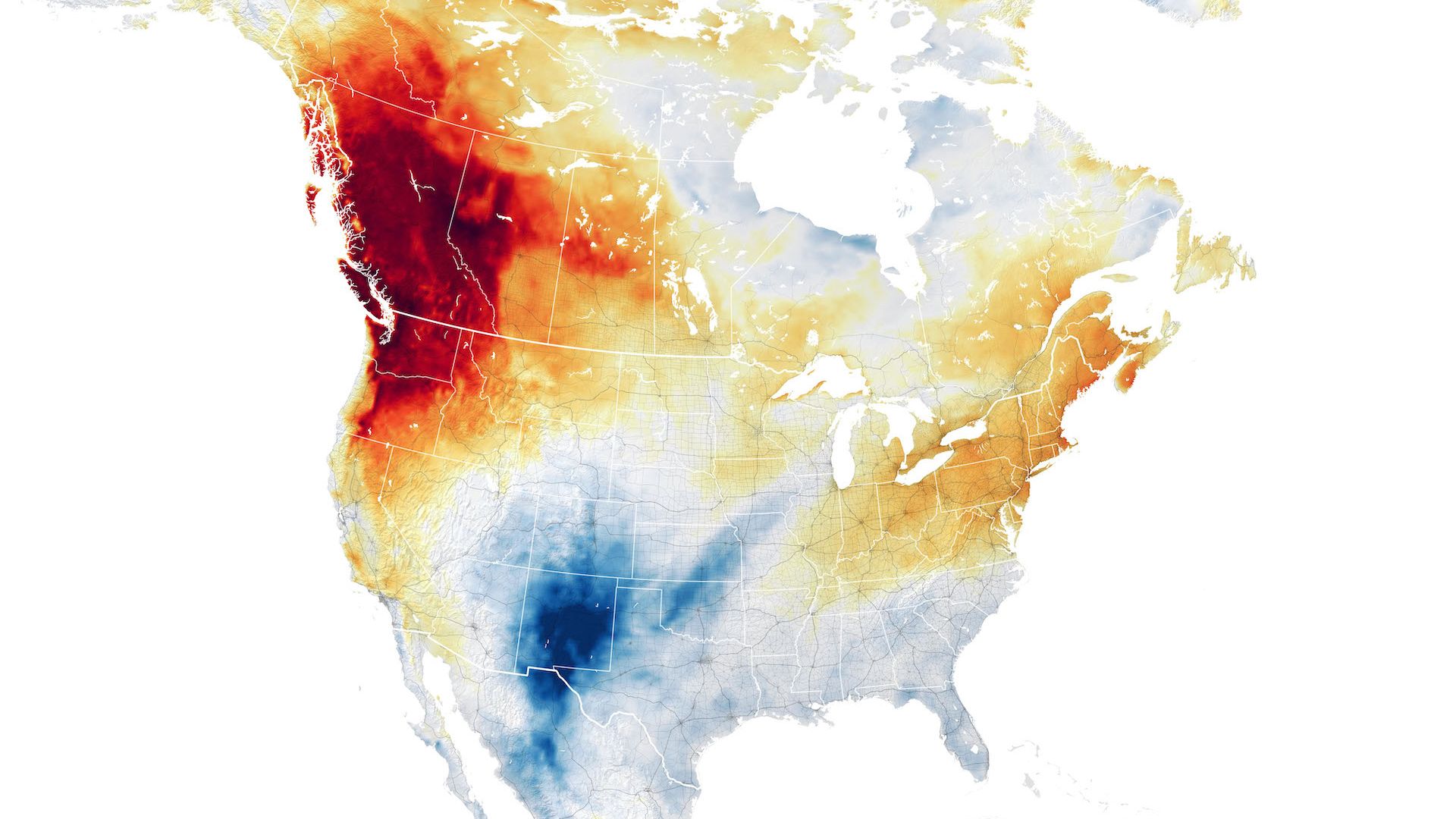
Near-surface air temperature departures from average on June 29, 2021, showing the Pacific Northwest and British Columbia heat wave. (NASA)
In the past 10 days, record-shattering temperatures have killed dozens in Oregon and Washington, as the thermometer hit 116°F in Portland, Ore., and 108°F in Seattle, both all-time highs for those locations, Andrew writes.
- The heat has killed nearly 500 in British Columbia.
- And Lytton, a small about 95 miles town northeast of Vancouver, was wiped out when a fast-moving wildfire swept through on Wednesday evening.
- The fire followed an unnerving national all-time high-temperature record set there just the day before: 121°F.
- Before the destructive blaze, Lytton shattered Canada's national high-temperature record three days in a row.
Across British Columbia, the heat wave led to an eruption of wildfires on Wednesday into Thursday, many of them resembling explosions on satellite imagery and from the ground.
- The blazes were so intense that they manufactured their own weather, generating about 710,000 lightning strikes, some of which started new fires.
3. What's up with oil as OPEC+ gathers
Illustration: Shoshana Gordon/Axios
Oil prices are on the rise, which could mean costs are going up for almost everything. And experts tell Axios that tight capacity means prices have much higher to go, Axios' Sam Ro reports.
Why it matters: Gasoline, diesel and jet fuel come from oil — which is also used widely in the chemicals industry. Climbing oil prices mean higher costs for consumers and businesses at a time when prices for many goods and services have already been rising.
Driving the news: On Thursday, WTI crude rose above $75 a barrel for the first time since October 2018.
This, as OPEC+ meets to discuss how much to increase supply.
What they're saying: "The global reopening is driving very strong oil demand at a moment when U.S. production growth remains relatively muted and OPEC has close to 6 million barrels sitting on the sidelines in a coordinated production cut," RBC Capital Markets’ head of global commodity strategy Helima Croft tells Axios.
- "US demand has been exceptionally strong as motorists get back on the road."
Where it stands: WTI is trading at slightly over $75 this morning, slightly off yesterday's highs, as traders await the OPEC+ huddle.
Read more and sign up here for Sam's daily Axios Markets newsletter.
4. Charting Exxon's influence spending


Let's follow up on revelations from Exxon lobbyists' recorded comments about climate and other topics to a Greenpeace activist posing as a corporate recruiter, Ben writes.
Why it matters: The comments — which on Wednesday brought a public apology from Exxon's CEO and his disavowal of the remarks — are a window into the oil giant's lobbying strategy.
By the numbers: The chart above shows Exxon's quarterly lobbying over the last five years.
- While it's millions of dollars for the company that employs many in-house and outside lobbyists, the amounts are lower than some other periods.
- For instance, the quarterly totals exceeded $9 million in Q3 of 2008 and Q1 of 2009, Lobbying Disclosure Act records show.
What's new: On Thursday Greenpeace released more information from its interview with senior Exxon lobbyist Keith McCoy.
- The Hill reports: "A lobbyist for ExxonMobil said that it pushed trade groups to be at the forefront on an issue dealing with a class of toxic chemicals, saying in recordings taken by undercover activists that he didn’t want the company tied to those chemicals."
What we're watching: The fallout. Environmental activists are using McCoy's remarks about Exxon's influence on infrastructure legislation to call for aggressive climate measures.
- Meanwhile, Bloomberg columnist Liam Denning writes that Exxon could face problems convincing already skeptical investors that it's well-positioned on climate.
- "What exactly is [CEO Darren] Woods going to say about that shiny new low-carbon business on the next conference call (or to its employees)? ESG-minded investors won’t likely be impressed by the spectacle of lobbyists smirking as they openly confirm everything already suspected about Exxon’s climate aspirations."
5. Breaking Friday: Exxon boss tries to make amends
Exxon CEO Darren Woods this morning released his second statement in three days on two lobbyists' covertly recorded comments, another sign of how concern about them has reached the highest levels of the powerful oil giant, Ben writes.
Driving the news: The statement says Exxon is committed to addressing climate change, citing the recent creation of its “Low Carbon Solutions” unit that’s focused on carbon capture tech and hydrogen.
It also says that while Exxon backs a carbon tax, it is "actively and publicly discussing other options, including lower-carbon fuels and other sector-based approaches that would place a uniform, predictable cost on carbon."
Catch up fast: One of lobbyist Keith McCoy’s comments — made on the covert recording by a Greenpeace activist posing as a corporate recruiter — compares lobbying to reeling in lawmakers like fish.
Elsewhere, he said Exxon knew when advocating for a carbon tax that it was highly unlikely one would be enacted but gives Exxon a "talking point."
Woods’ new comment states: "We have great respect for policy makers, elected officials and organizations across the political spectrum who are grappling to effectively address climate change, one of the greatest challenges of our time."
6. Quote of the day
“People are looking for a solution. It costs a lot of money to go out and buy a Tesla or [another] electric vehicle. It costs a lot less to express what you stand for when you buy a Beyond Burger and put it at the center of your plate.”
Who said it: Beyond Meat founder and CEO Ethan Brown on the latest edition of the Axios Re:Cap podcast.
He discusses how climate change is driving increased interest in plant-based proteins among some people. And a lot more.
Sign up for Axios Generate

Untangle the energy industry’s biggest news stories