Axios Markets

July 02, 2021

Today's newsletter is 1,089 words, 4 minutes.
🚨Situational awareness: The June U.S. jobs report will be released at 8:30am ET. The consensus forecast is for 687,000 new jobs and a 5.7% unemployment rate, according to FactSet.
🐕 of the day: "If demand for transactions in Dogecoin declines... our business, financial condition and results of operations could be adversely affected." - Robinhood S-1
1 big thing: What's up with oil
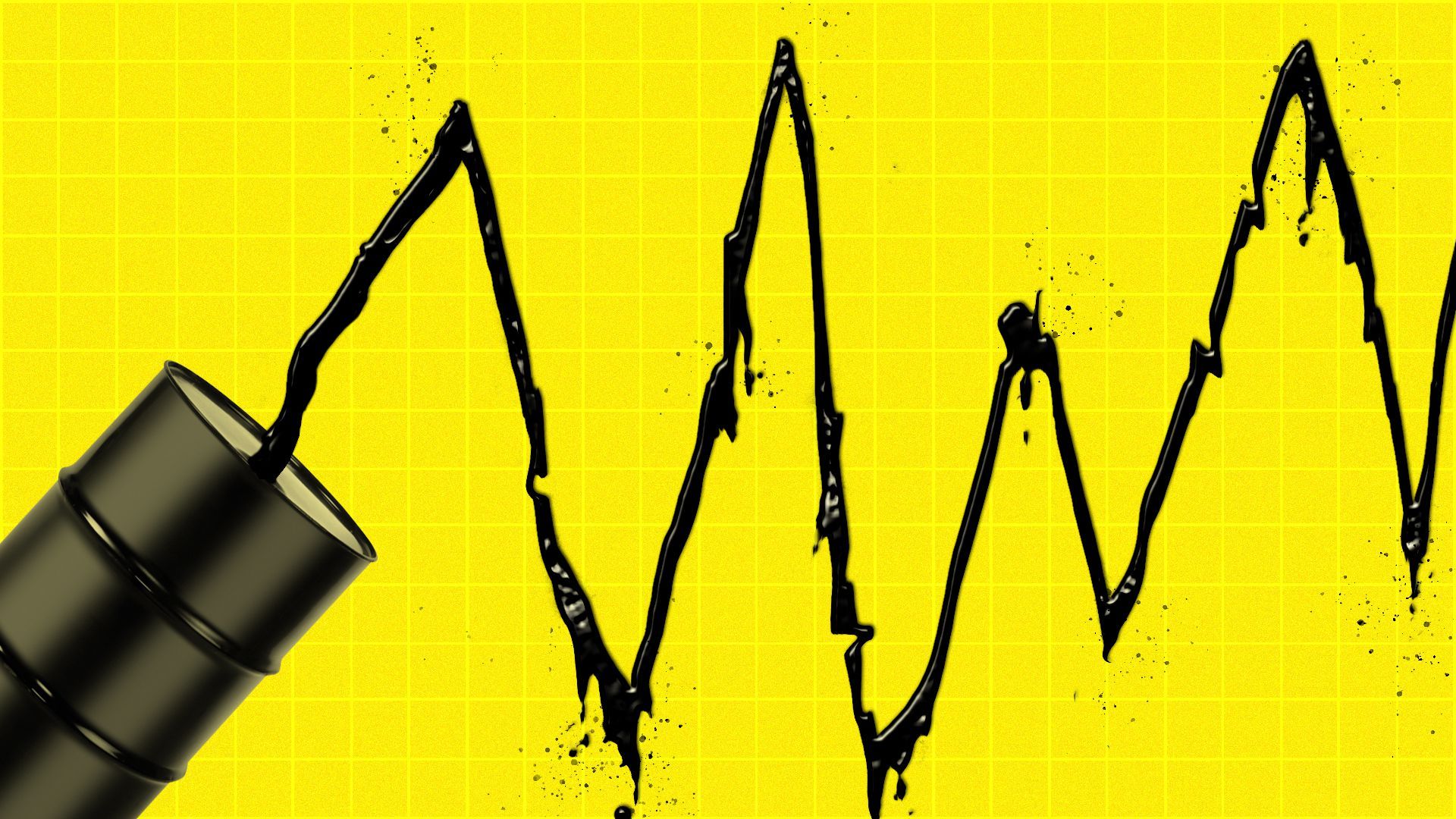
Illustration: Shoshana Gordon/Axios
Oil prices are on the rise, which could mean costs are going up for almost everything. And experts tell Axios that tight capacity means prices have much higher to go.
Why it matters: Gasoline, diesel and jet fuel come from oil — which is also used widely in the chemicals industry. Climbing oil prices mean higher costs for consumers and businesses at a time when prices for many goods and services have already been rising.
Driving the news: On Thursday, WTI crude rose above $75 a barrel for the first time since October 2018. This, as OPEC+ meets to discuss how much to increase supply.
What they're saying: "The global reopening is driving very strong oil demand at a moment when U.S. production growth remains relatively muted and OPEC has close to 6 million barrels sitting on the sidelines in a coordinated production cut," RBC Capital Markets’ head of global commodity strategy Helima Croft tells Axios.
- "US demand has been exceptionally strong as motorists get back on the road."
The big picture: What’s happening with oil can be explained simply by how supply and demand drive industry cycles, says Dan Dicker, founder of The Energy Word webinar.
- Since around 2014, drillers pumped and pumped oil, leading to an oversupply that kept prices very low. This in turn forced hundreds of producers to go bankrupt in the years that followed.
- Meanwhile, the oil companies that survived became much better about not overreacting to rising prices by pumping too much.
- Similarly, OPEC and its allies have been "surprisingly pretty firm" about not overproducing as it's been in their financial interests to keep supplies under control, Dicker says.
- And then the pandemic hit, causing demand to drop and prices to crash, triggering another wave of bankruptcies.
State of play: Oil prices are rising now because the delayed demand from the economies moving past the pandemic is being addressed by an industry that has cut way back on production capacity.
Threat level: "The pent-up demand for oil that’s happening now only is a small degree of what will happen in a much larger degree as many of these countries come out of the pandemic," Dicker says.
- "$75? You better enjoy it because you’ll see maybe twice that by the middle of 2022."
What’s next: The OPEC+ meeting continues this morning. Ministers are expected to announce a coordinated effort to increase oil production. But Dicker and other experts agree that they’ll be wary of increasing so much that prices fall.
- "Maintaining price stability at high levels, while on the same time increasing its output, could be in the best interest of OPEC+," Rystad Energy oil markets analyst Louise Dickson wrote.
2. Catch up quick
Johnson & Johnson says its single-shot COVID-19 vaccine shows promise protecting against the Delta variant. (Reuters)
ECB president Christine Lagarde warns that the eurozone's recovery remains fragile. (Reuters)
Virgin Galactic plans to send its billionaire founder Richard Branson into space on July 11. (Axios)
3. Global minimum tax vs. S&P 500 profits
Illustration: Aïda Amer/Axios
The 15% minimum corporate tax rate agreed upon Thursday by 130 countries will have a limited impact on big U.S. corporations, analysts say.
Why it matters: Large companies with sophisticated accounting departments exploit generous overseas tax policies in their efforts to minimize taxes and maximize profits.
How it works: The minimum tax will apply to large multinational companies. Any profitable firm with revenue over €20 billion ($24 billion) will be included from the start, with that number expected to decline to €10 billion ($12 billion) in time.
- The rules will be brought into domestic law in 2022 and will take effect in 2023.
What they’re saying: In an analysis published on June 7, Goldman Sachs analysts estimated that a global minimum tax rate of 15% that took effect in 2022 would "represent a downside of just 1%-2%" to S&P 500 earnings.
- "At the sector level, Info Tech and Health Care would face the greatest earnings risk, but even those sectors appear to face aggregate downside of less than 5% relative to current consensus estimates," they wrote.
What's next: Big companies will begin announcing their Q2 financial results in the coming weeks. Expect at least some executives to address questions about how a global minimum tax would affect the bottom line.
4. IPO boom times
Illustration: Sarah Grillo/Axios
It's been a banner week for public markets. They're not only hitting new record highs, but they're also successfully allocating billions of dollars of fresh capital to a slew of companies going public in IPOs, Axios' Felix Salmon writes.
Why it matters: The current market is liquid and predictable enough for the bookrunners to be able to do their job well, allocating shares to institutional investors at a price just below where the market ends up valuing the company.
Between the lines: When stocks start trading well above their IPO price, as was common earlier this year, those companies "left money on the table" and enriched well-connected investors who did nothing but hold for a few hours.
- The big test, however, is going to be Robinhood, whose S-1 was unveiled on Thursday.
- The market price of Robinhood stock is likely to be determined more by retail than by institutional demand, making it much harder for investment bankers to determine the correct IPO price.
Driving the news: This week saw 17 separate IPOs, raising more than $9 billion in total.
- By far the biggest was Didi, the Chinese ride-hailing giant, which raised $4.4 billion at $14 per share and closed Thursday at $16.40.
- SentinelOne, a cybersecurity giant, went public at $35, raising $1.2 billion, and closed Thursday at $40.04.
- Other noteworthy IPOs include Krispy Kreme (priced at $17, closed at $21) and LegalZoom, which priced at $28, raising $700 million. It had the biggest gain so far, closing Thursday at $38.50.
The bottom line: There doesn't seem to be any limit to the amount of capital available to companies wanting to go public. This means that the second quarter of 2021 has been the busiest quarter for IPOs since 2000.
5. The working spouse excuse
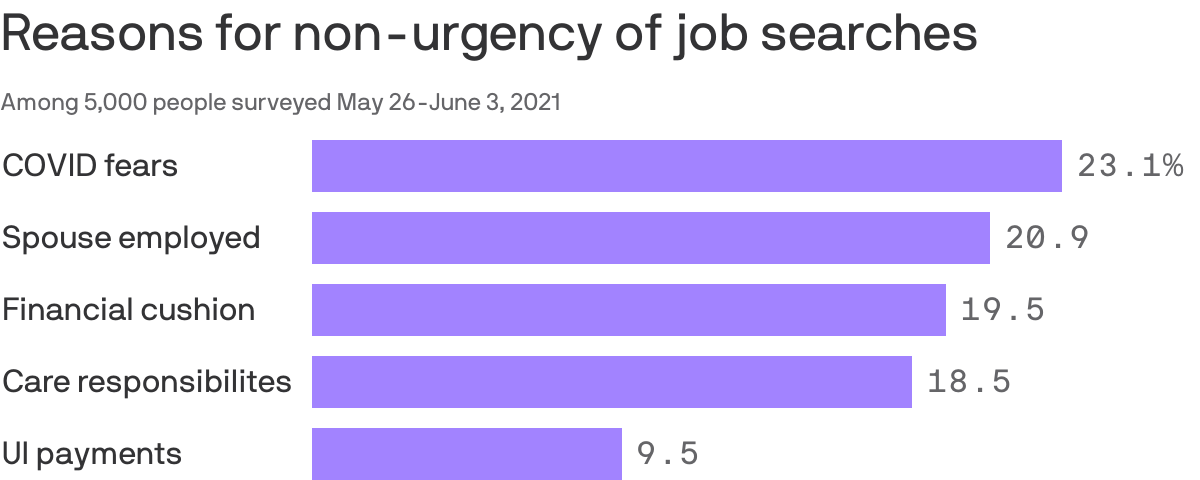
Having a working spouse has kept many unemployed Americans from scrambling to find a job.
Why it matters: U.S. employers continue to struggle with labor shortages despite employment levels being far below where they were before the pandemic.
By the numbers: According to the Indeed Hiring Lab, 20.9% of unemployed workers say that having an employed spouse has kept them from urgently seeking work.
Zoom out: Whether it's bloated savings, unemployment insurance checks, or a spouse who's bringing home the bacon, it's clear that many folks with the means to stay out of the workforce will remain on the sidelines.
Axios Markets will be back on Tuesday, July 6. Have a safe and happy Fourth of July! 🇺🇸
Sign up for Axios Markets
Stay on top of the latest market trends and economic insights