Axios Generate

April 02, 2024

👟 We're sprinting into Tuesday with just 967 words, a 3.5-minute read.
✅ Situational awareness: Biden officials just approved Avangrid's planned New England Wind project off Massachusetts, the latest in a series of green lights for coastal turbines.
- Why it matters: It would provide enough power for 900,000+ homes, the Interior Department said, and comes as the White House aims to keep development moving despite financial headwinds facing projects.
🎵 This week in 1990, R&B greats En Vogue released their aptly titled debut album "Born to Sing," which provides today's intro tune...
1 big thing: Climate law needs a permitting boost

Illustration: Natalie Peeples/Axios
The 2022 climate law advanced by Democrats will be hobbled unless policymakers greatly speed up permitting for low-carbon energy projects, International Monetary Fund analysts say.
Why it matters: The IMF scholars' report — and a related analysis — offer stark contrasts between the Inflation Reduction Act's effect under current approval timelines, and a successful acceleration, Ben writes.
Threat level: Should permitting delays persist until 2030, "the IRA-induced emission decline would be smaller by about a third," the paper states.
- "Permitting reform is therefore crucial to unlock the IRA's full potential."
- The report's power sector analysis looks at current permitting timelines averaging 4.5 years, and investment under a hypothetical reduction to 1.5 years starting last year.
What we're watching: There are still talks on Capitol Hill about a major permitting overhaul, but they face long odds.
The big picture: The paper's model of major IRA provisions shows the benefits outweighing the costs of the law, which steers hundreds of billions of dollars into decarbonization.
- Without permitting-related investment delays, renewables' share of the power mix rises almost 20 percentage points by 2030, at the expense of coal and gas.
- The law's overall impact on the macro-economy is "expansionary but very modest in size," their post states.
- Fiscal costs peak around 0.4% of gross domestic product late this decade and then decline.
The IRA alone covers around half the "implementation gap" of emissions curbs needed to meet President Biden's target of cutting greenhouse gases by 50% below 2005 levels by 2030.
- The authors see room for low-cost, complementary regulations on coal and methane that "substantially" close the gap.
The bottom line: The IRA needs help to fully blossom.
2. Bonus: The IRA with and without faster permitting
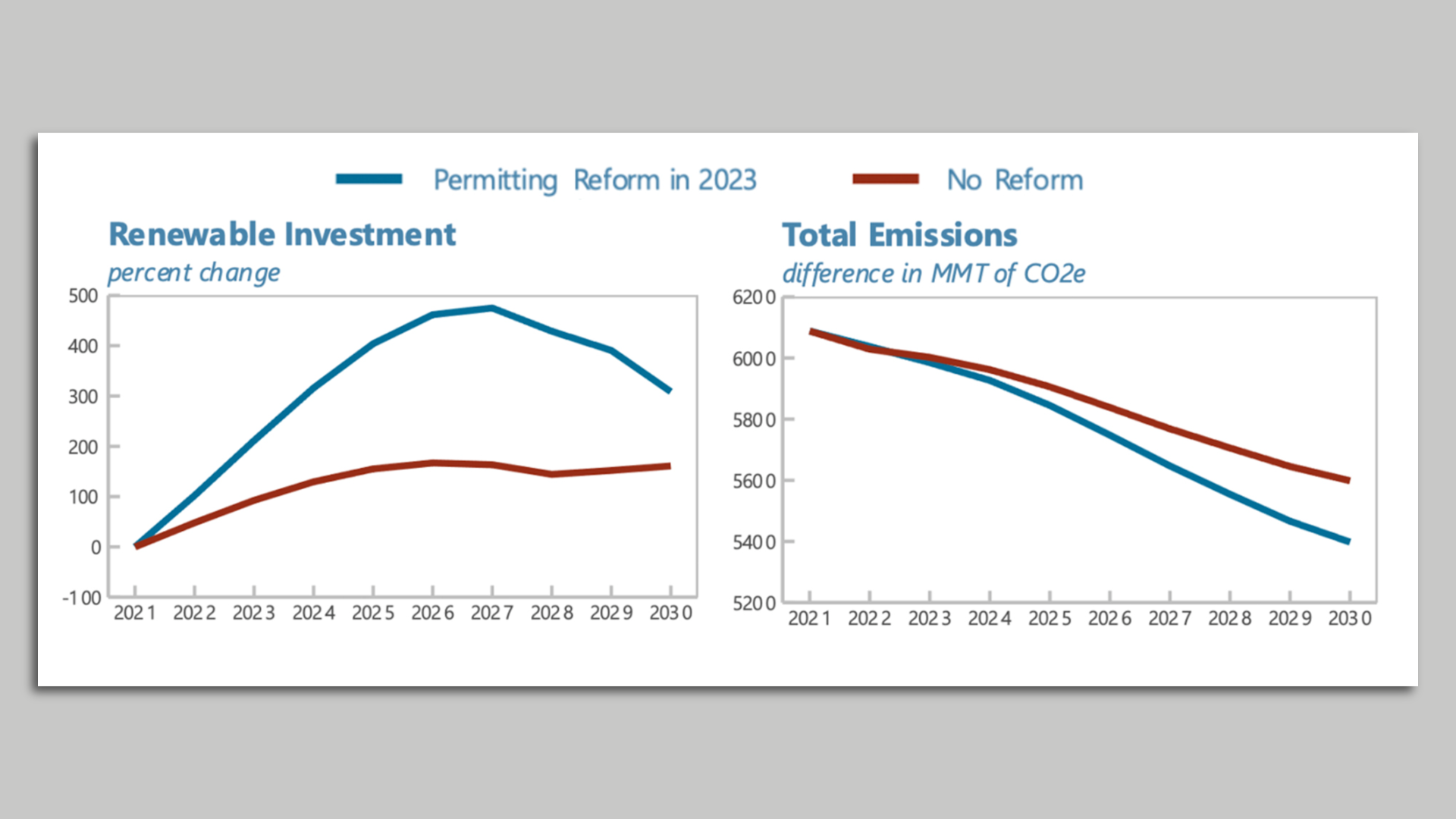
Image courtesy of the International Monetary Fund
This chart captures some of the IMF authors' findings about the impact of faster permitting, Ben writes.
3. 🏃🏽♀️ Catch up quick on oil and gas: Prices and LNG

Illustration: Sarah Grillo/Axios
📈 Oil prices hit their highest levels since October, with Brent crude trading above $89 per barrel this morning before slipping a bit, Ben writes.
- Why it matters: It follows Israel's strike on a diplomatic compound in Syria that killed a senior Iranian general that RBC Capital Markets' Helima Croft calls "one of the most serious escalatory actions since October 7th."
- The big picture: "This renewed tension comes at a time when oil fundamentals continue to firm thanks to the rollover of OPEC+ voluntary additional supply cuts," ING's Warren Patterson writes.
🎭 House Speaker Mike Johnson (R-La.) may try to tether Ukraine aid with ending the White House pause on LNG export approvals to major markets.
- Why it matters: The plan faces an uphill climb, but it underscores how reversing the gas policy is top of mind for Capitol Hill Republicans. And Johnson's state is a major LNG hub.
4. One useful thing: comparing possible futures

Illustration: Aïda Amer/Axios
Happy Energy Outlook Comparison Day to all who celebrate, Ben writes.
The latest: Resources For the Future just unveiled its latest comparison of 16 long-term scenarios from companies like Exxon and Shell, bodies like the International Energy Agency, and others.
Why it matters: These harmonized, apples-to-apples comparisons are helpful — and tough to create.
- Analysts often use different metrics, categories and baselines for energy use and sources.
What's inside: RFF also makes clear what's based on today's policies vs. policy evolution trends and goals vs. what would need to happen to meet Paris Agreement targets.
- That's important, because discussions of these possible futures by policymakers and other actors are sometimes... kind of a mess.
The big picture: In many scenarios, combined fossil fuel use reaches its highest point before 2030, but then remains high through 2050 — out of step with climate goals.
- Carbon removal technologies are deployed fast in every scenario that limits warming to 1.5°C or 2°C above preindustrial levels.
- Projected energy demand in China has been revised downward in recent years.
The bottom line: A common theme is that absent stronger clean tech deployment, the world isn't on a Paris-friendly path.
5. On my screen: international edition

Illustration: Shoshana Gordon/Axios
⛏️ The FT has great reporting on Middle East nations investing in mining for energy transition minerals in Africa and beyond, Ben writes.
- Why it matters: It's wrapped up in U.S.-China competition, with the FT reporting that U.S. officials welcome the efforts, because they help "break Beijing's monopoly" over critical mineral processing.
- The big picture: "The U.S. has been actively brokering Saudi, Emirati and Qatari investment in riskier jurisdictions, such as the Democratic Republic of Congo, where western companies struggle to enter, in order to keep China out," it adds.
🛢️ A big New York Times feature is well timed to help contextualize the viral clip of Guyana's president defending the nation's offshore oil development.
- The big picture: It dives into thorny questions about the windfall and impacts — financial, ecological and social — of the Exxon-led group tapping giant fields.
- The intrigue: One example surrounds a deal with Exxon to ship gas extracted alongside the oil to help provide electricity. It notes that rich-country pledges to help use renewables have fallen short, and gas is cleaner than heavy fuel used in Guyana's erratic power system.
6. 🚰 Stunning stats about the energy-water link

Illustration: Aïda Amer/Axios
"In 2023, the energy used by desalination services in the Middle East was equivalent to almost half of all energy consumed by the region's residential sector," per the International Energy Agency.
Why it matters: That remarkable stat in this IEA primer is just one example of the crucial interdependence between water usage and energy, Ben writes.
The big picture: Climate change is stressing water resources in multiple regions, while many energy systems require vast amounts of freshwater.
- The energy sector accounts for 10% of global freshwater use, per IEA.
Threat level: Getting back to desalination, right now much of it runs on fossil fuels.
- "Global energy demand for desalination has nearly doubled since 2010, and current trends point to another doubling to 2030," IEA finds.
What's next: As desalination needs grow, IEA recommends wider use of membrane-based systems, rather than fossil-intensive thermal methods.
📬 Did a friend send you this newsletter? Welcome, please sign up.
🙏 Thanks to Chris Speckhard and Javier E. David for edits to today's edition, along with the brilliant Axios Visuals team.