Axios Generate

June 03, 2025

⚛️ We're charged up with lots of nuclear news today — and plenty more, all in just 1,281 words, 5 minutes.
🍤 Calling all Baton Rouge-based readers: Join Axios journalists at 9:30am CT Wednesday for an event on Louisiana's economy, featuring state Economic Development Secretary Susan Bourgeois & more newsmakers. RSVP
🤦♂️ I messed up. Sorry! See the bottom of this newsletter for more.
🕺At this moment in 1978, the "Saturday Night Fever" soundtrack was on a 24-week run atop Billboard's album charts and provides today's intro tune...
1 big thing: Meta goes nuclear to power AI with clean electrons
Facebook parent Meta just inked a 20-year deal with power giant Constellation Energy to keep a large Illinois nuclear plant running until mid-century.
Why it matters: It's a big addition to a hot power trend — big tech looking to reactors big and small to meet AI's electricity thirst with zero-carbon energy.
Driving the news: The companies announced a 20-year power purchase agreement for the 1.1-gigawatt Clinton Clean Energy Center in Illinois.
- The plant — which provides enough power for over 800,000 homes — had been slated to retire in 2027.
- Constellation, with the Meta deal, now intends to continue operations until 2047 if federal regulators grant an extension it began seeking last year.
How it works: The power will keep feeding the regional grid, but Meta's financing helps enable the plant's relicensing and extended operations.
- "Securing clean, reliable energy is necessary to continue advancing our AI ambitions," Urvi Parekh, Meta's head of global energy, said in a statement.
- It comes after Microsoft's 2024 deal with Constellation to revive a shuttered reactor at Pennsylvania's Three Mile Island (not the damaged one).
State of play: Meta and Constellation didn't provide cost details beyond noting it's a multibillion-dollar proposition.
- The agreement will "preserve 1,100 high-paying local jobs; deliver $13.5 million in annual tax revenue; and add $1 million in charitable giving to local nonprofits over five years," they said.
Catch up quick: Clinton had been slated for early closure in 2017, but state legislation created an emissions credit program that brought a decade's worth of support.
- The new deal with Meta is a "market-based solution" that replaces those credits and "ensures long-term operations of the plant without ratepayer support," the companies said.
The big picture: Joe Dominguez, Constellation's CEO, said Meta agrees that "supporting the relicensing and expansion of existing plants is just as impactful as finding new sources of energy."
- The company pointed to a Brattle Group study it commissioned, which found that shutting the plant at the end of 2026 would boost emissions by 34 million metric tons of CO2 over 20 years.
- That's "the equivalent to putting approximately 7.4 million gasoline-powered cars on the road for a year," today's announcement states.
What we're watching: The growing mix of big tech deals to support new reactors of various sorts, including small modular tech, though they're typically early stage and aspirational.
- Google, Amazon and other heavyweights players are involved, and action includes Meta too.
- In late 2024 it issued a "request for proposals" that targets a large pipeline — one to four gigawatts — of new generation.
- This morning Meta said it has received over 50 qualified submissions and identified a short list to evaluate.
The bottom line: The planned extension in Illinois is among the most tangible big tech-nuclear tie-ups yet.
2. 🛢️ The new push to change Alaska's oil future
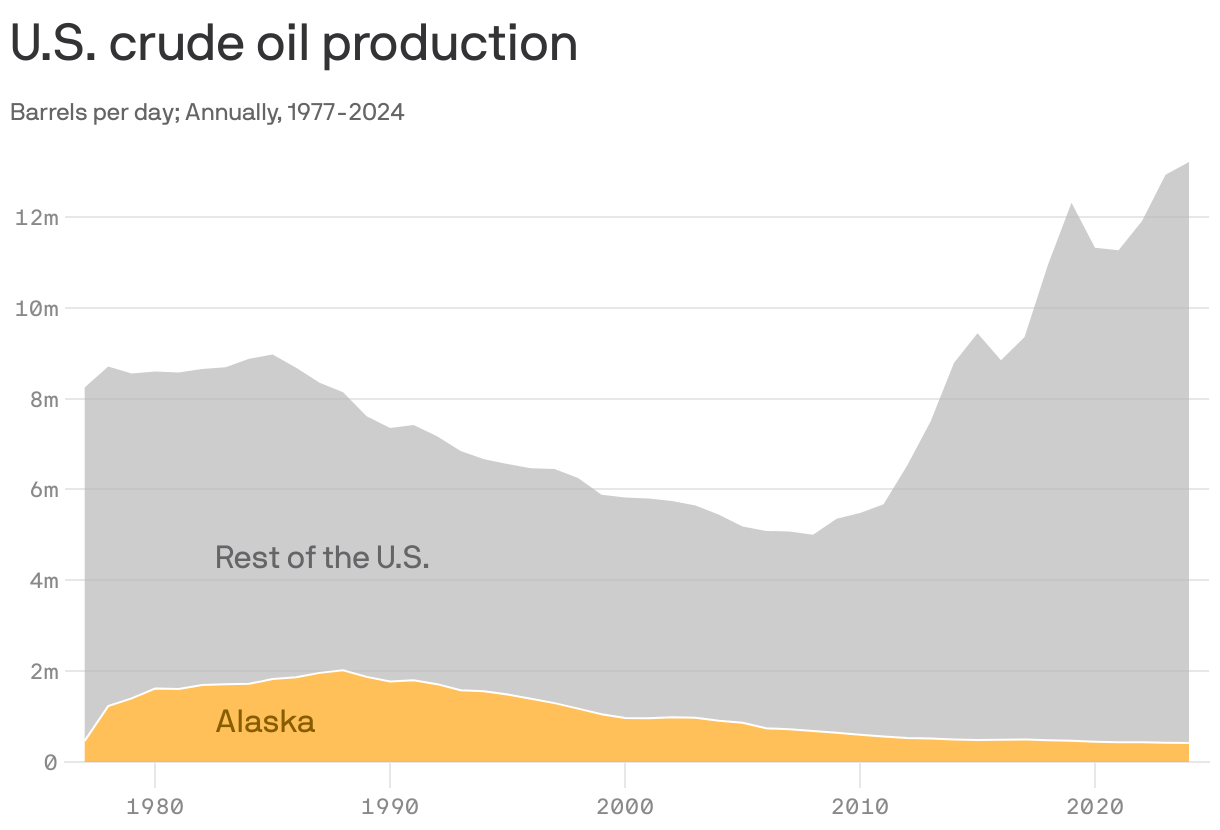
New and future Trump 2.0 moves could add momentum to a looming turnaround in Alaska's long-declining oil output.
Why it matters: The state has huge hydrocarbon reserves, but many sit within ecologically sensitive regions.
Catch up quick: The Interior Department plans to rescind Biden-era drilling restrictions in the National Petroleum Reserve-Alaska, it said yesterday.
- It's part of wider plans to promote oil and gas development in the state.
- Beyond NPR-A, Trump officials are also looking to reignite interest in drilling in the Arctic National Wildlife Refuge and Arctic seas.
The big picture: In its late-80s peak, Alaska rivaled Texas as the country's top producer, but output has steadily declined.
- But the Energy Department's independent stats arm projects that production will rise in coming years as some key projects ramp up or, like ConocoPhillips Willow Development, come online.
- Those reflect past corporate investments and decisions, and now White House policies are aimed at spurring new, long-horizon industry plans.
What we're watching: How much additional capital and effort oil companies are willing to invest, given potential policy swings, litigation, and opportunities elsewhere.
3. 🏃 Catch up quick on policy: FERC drama, sanctions, new energy firm

🆕 President Trump has nominated energy attorney Laura Swett to sit on the Federal Energy Regulatory Commission, replacing current Chairman Mark Christie, per the Congressional Record.
- The intrigue: Christie said on X that he learned of the move through a press inquiry that Trump had tapped Swett — a former Vinson & Elkins attorney and former FERC adviser — to replace him when his term expires.
- Why it matters: The move comes as FERC addresses rising power demand and White House efforts to expand its sway over independent commissions.
- What they're saying: ClearView Energy Partners, in a note, predicts Commissioner Lindsay See (R) will become FERC chair at least on an acting basis.
- The intrigue: The research firm also writes that Swett's nod over other candidates in a rumor mill could signal that Trump officials want to prioritize permitting of interstate gas pipelines and setting rates for interstate oil pipelines.
- What's next: "I will remain in office for a few weeks after June 30 to help get key orders out," Christie posted as he congratulated Swett. Trump had tapped the Republican Christie as chairman in January.
🛢️ Senate Majority Leader John Thune (R) said the Senate could take up bipartisan Russia sanctions legislation this month, my Axios congressional colleagues report.
- Why it matters: The bill with over 80 backers includes massive new U.S. import tariffs on countries that buy Russian energy. Co-sponsors Lindsey Graham (R) and Richard Blumenthal (D) say one goal is to "hold China accountable for propping up Putin's war machine."
- What we're watching: The White House, because Thune has indicated that he's taking cues from President Trump. Thune said yesterday that senators "stand ready to provide President Trump with any tools he needs to get Russia to finally come to the table in a real way."
💼 Attorneys who held senior Biden- and Obama-era roles at DOE, FERC and the White House have formed a new boutique firm, Roselle, that's focused on energy transition.
- State of play: The founding partners are Kim Smaczniak, Avi Zevin, Miles Farmer and Sam Walsh.
- What's next: The firm "supports, advises, and advocates for companies developing, buying, and investing in energy infrastructure as they navigate the rapidly changing legal, regulatory, and policy environment," an announcement states.
4. ⚛️ Google pushes deeper into fusion tech with TAE

Fusion energy startup TAE Technologies has raised over $150 million in an ongoing funding round, Axios Pro Deals first reported.
Why it matters: The company is working closely with Google, which is seeking advanced energy sources to power its hyperscale data centers.
Driving the news: The round has drawn investment from existing backers Google, Chevron and New Enterprise Associates. TAE began the raise last fall and expects to reach a final close in August.
- "If we raise another $50 [million] or so, that would probably be best," CEO Michl Binderbauer says, referring to the round as a Series 12.
Follow the money: TAE, based in Foothill Ranch, California, has raised $1.2 billion since its launch in 1998, including $250 million in Series G funding during the height of the climate tech boom in 2022.
- "TAE has built itself milestone by milestone," Binderbauer says, referring to the comparatively smaller current raise.
Between the lines: The company has also started generating revenue through power management and life sciences spinoffs.
Talk to our sales team about Axios Pro Deals for a steady diet of scoops and smart analysis.
5. ⚛️ Number of the day: +73%
That's the jump in supply chain spending by fusion energy companies last year, rising to $434 million, per new data from a Fusion Industry Association survey.
- And the group said the total is likely higher because not every company responded.
Why it matters: It's a sign of the industry — long an over-the-horizon dream — moving ever closer to commercial deployment. But there's a long way to go.
What's next: Spending is projected to rise another 25% this year. Full report.
📧 Did a friend, colleague or an AI chatbot send you this newsletter? Welcome, please sign up.
🙏 Thanks to Chris Speckhard and Chuck McCutcheon for edits to today's edition, along with the brilliant Axios Visuals team.
Editor's note: The third story in yesterday's newsletter was updated to correct the fuel source for two Pennsylvania power plant units. They run on gas with flexibility to use oil.
Sign up for Axios Generate