Axios Generate

June 02, 2025

š§ We're starting June with a data center exclusive and then diving into lots of news, all in just 1,320 words, 5 minutes.
š¤ If you're in Baton Rouge: Join Axios journalists at 9:30am CT Wednesday for an event looking at Louisiana's economy, supply chains and local operations, featuring Louisiana Economic Development Secretary Susan Bourgeois & more newsmakers. RSVP
šļø Happy birthday to B-Real of brain-bending hip-hop craftsmen Cypress Hill, who have today's intro tune...
1 big thing: Ex-Microsoft, BP execs team up on quick data center power

Exclusive: Former Microsoft and BP execs are launching a startup to quickly deploy data centers with on-site power ā and very high efficiency.
Why it matters: Rapidly building and powering data centers ā and doing it without straining grids or spiking emissions ā is key to the global AI race.
Driving the news: The startup GridFree AI, born in "electron economy" incubator Montauk Climate, emerges from stealth today with $5 million led by Giant Ventures.
- Its modular, off-grid "power foundry" concept integrates gas power, battery storage, and cooling with computing infrastructure.
- It's "systematic, repeatable, and becomes a manufacturing process, not a stick-built process," GridFree AI co-founder and executive chairman Ralph Alexander said.
The big picture: Time is money. The tech "dramatically" cuts development timelines, the company said, enabling tech companies to accelerate revenue generation.
- They envision additive units to match various computing needs and their growth, with multiple gigawatts of scale possible.
- Alexander compares it to a "Lego set that you just continue to connect."
State of play: Alexander is the former CEO of power producer Talen Energy and was also once CEO of BP's gas, power and renewables unit.
- The other co-founder is Patrick Yantz, a top data center infrastructure exec at Microsoft until late 2024.
- Advisers include Gary Wojtaszek, the former CEO of data center heavyweight CyrusOne, and Tim Duncan, former CEO of the oil and gas company Talos Energy.
How it works: GridFree AI says its system cuts capital and operating costs by a third via "elimination of legacy infrastructure," such as diesel generators and traditional fan cooling.
- It converts gas into electricity and cooling with 90% efficiency and ensures more power is used for the actual data center IT and processing units, which means much lower CO2, it said.
- "The efficiency of the overall solution enables a 50% increase in available power for IT loads," the announcement states.
š„ Reality check: Building and deploying new hard tech is really tough. And competition is intense, with lots of deep pockets and big brains trying to crack the data center energy code.
- But Philip Krim, Montauk Climate's co-founder and CEO, said GridFree AI has key advantages.
- It brings to data centers the oil and gas industry's expertise on supply chains and building and deploying assets in predictable and scalable ways, he said.
What we're watching: The company has ID'd sites in the southeastern U.S. that have gas access, fiber-optic connectivity, favorable regulations, and access to sequestration infrastructure if CO2 capture is ever integrated.
- "We reverse engineered and basically asked our consultants to tell us, where would you build something with a minimum amount of NIMBY issues and NGO issues," Alexander said.
- It also sees opportunities in the U.K. and Europe. The startup has held technical discussions with multiple hyperscalers, the execs said.
The bottom line: "The special sauce of GridFree AI is we can build the power foundry and the cooling operation faster and operate it more efficiently than anyone else out there," Krim said.
2. š¢ļø New sanctions pressure and more petro-notes
āļø GOP Sen. Lindsey Graham is seeking Senate votes before the mid-June G7 meeting on bipartisan plans to impose massive U.S. tariffs on countries that buy Russian energy.
- Why it matters: Russian exports of oil, gas and other commodities provide lots of cash for the Kremlin's war on Ukraine.
- State of play: "By the G7 summit, we hope to have sanctions put in place ā in coordination with Europe ā to deliver an unequivocal message to China," Graham and co-sponsor Sen. Richard Blumenthal (D) said in a statement.
- What we're watching: The bill has 82 Senate backers, but Majority Leader John Thune has signaled he won't move it unless there's White House support.
š Crude oil prices jumped to start the week despite OPEC+ agreeing to another 411,000-barrel-per-day supply increase in July, with Brent up over 4% to $65.50.
- State of play: Market watchers say traders had already priced in the expected hike. ING analysts said in a note there had been suggestions of an even bigger hike. Geopolitical risk is also lifting prices.
- What they're saying: "Rising tensions between Russia and Ukraine added further support to the market this morning," they write, citing Ukraine's weekend drone strikes on Russian airfields.
š§³ The heads of DOE, EPA and Interior are in Alaska this week talking up plans for a huge new gas pipeline and LNG export proposal, drilling in the Arctic National Wildlife Refuge and more.
- What we're watching: Tangible signs of progress for the $44 billion LNG and pipeline proposal, which faces big private investment amid competing Gulf Coast supplies and the massive, remote project's price tag.
3. šāāļø Catch up quick on policy: Power plants and carbon

ā¶ļø For the second time in two weeks, DOE is using emergency authorities to keep a power plant running past its scheduled retirement.
- Driving the news: Late Friday, Secretary Chris Wright told grid operator PJM to keep two units at a Constellation Energy plant in Pennsylvania running through late August. The gas-fired units, which can also run on oil, had been slated to shut down May 31. It follows a similar order for a Michigan coal-fired plant earlier in May.
- State of play: Wright's statement called the move needed to ensure reliable and affordable power during high-demand summer months. PJM, the grid operator for large parts of the Midwest and mid-Atlantic, called the order "prudent," citing a "confluence" of retirements and demand growth.
- What we're watching: Whether more of the mandates surface. It "could portend future muscular interventions by the DOE aimed at keeping preferred resources online," ClearView Energy Partners said in a note after the Michigan order.
āļø The White House released more details on budget proposals that would deeply cut or kill low-carbon programs at DOE, EPA and other agencies.
- Why it matters: While these requests to Congress are typically just messaging, Trump 2.0 officials want to reshape agencies without explicit Capitol Hill sign-off.
- The big picture: The documents detail billions of dollars worth of specific programs EPA and DOE programs that officials want to greatly scale back or cancel.
- Go deeper: Full cross-agency request...DOE request...DOE high-level summary...EPA request
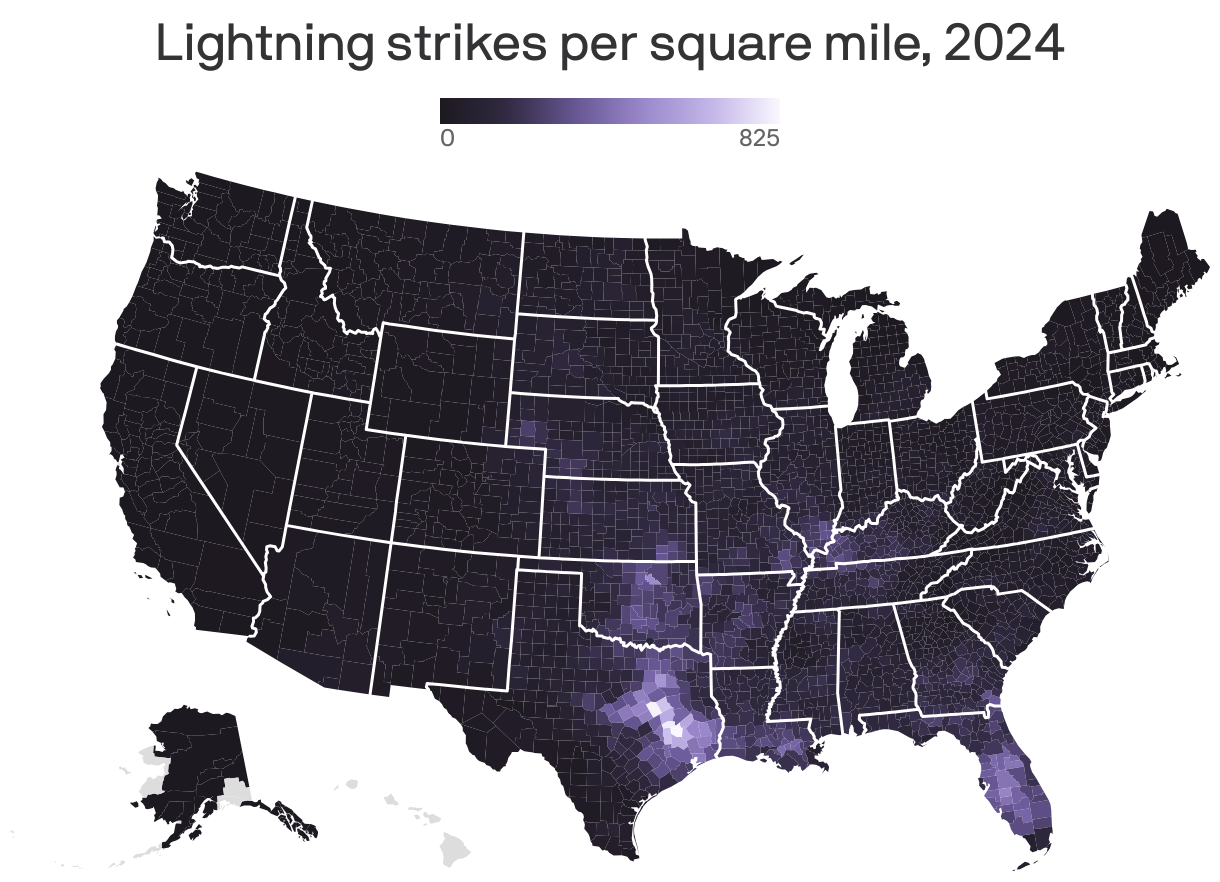
4. š©ļø Where lightning strikes most ā and why

Texas, Florida and Oklahoma are America's lightning capitals, per weather data firm Vaisala Xweather.
Why it matters: The number of strikes is predicted to increase amid climate change, researchers have found.
- Lightning can present immediate danger to people, aircraft and infrastructure, and spark wildfires.
By the numbers: Texas has all of the top 10 U.S. counties ranked by strikes per square mile in 2024, per Vaisala Xweather's report.
- Walker County, Texas, had about 825 strikes per square mile in 2024, Limestone County, Texas, had 811, and Madison County, Texas, had 795.
- In terms of most lightning strikes overall, Polk County, Florida, is the big winner, with nearly 852,000 for the year.
The bottom line: These totals reflect thunderstorms and hurricanes driven by climate and geography in and around the Gulf. Go deeper.
5. ICYMI: DOE's $3.7B clean tech reversal
DOE is canceling over $3.7 billion in awards for 24 projects through its Office of Clean Energy Demonstrations created under the 2021 bipartisan infrastructure law.
Why it matters: Friday's move is among the biggest and most specific cases yet of Trump 2.0 officials halting the Biden administration's unprecedented funding for low-carbon projects.
- The awards included projects at corporate giants including Exxon, Kraft Heinz and Eastman Chemical Company. Full story.
6. š¬ Quote of the day: EV pullback edition
"If the United States doesn't recommit to new-generation vehicle development, the result could be one where in just a few years U.S. consumers may go on vacation abroad and discover that their rental car or taxi is running on a technology that looks different and is in many ways more attractive than what is available at home."ā Ilaria Mazzocco, a scholar with the Center for Strategic and International Studies
Why it matters: The U.S. faces long-term isolation and competitive harms in innovation by pulling back from pro-EV policies, her new post argues.
š§ Did a friend, colleague or an AI chatbot send you this newsletter? Welcome, please sign up.
š Thanks to Chris Speckhard and Chuck McCutcheon for edits to today's edition, along with the brilliant Axios Visuals team.
Editor's note: The third story in today's newsletter was updated to correct the fuel source for two Pennsylvania power plant units. They run on gas with flexibility to use oil.
Sign up for Axios Generate