Texas and Oklahoma face flooding threats as deadly storms sweep much of U.S.

Add Axios as your preferred source to
see more of our stories on Google.
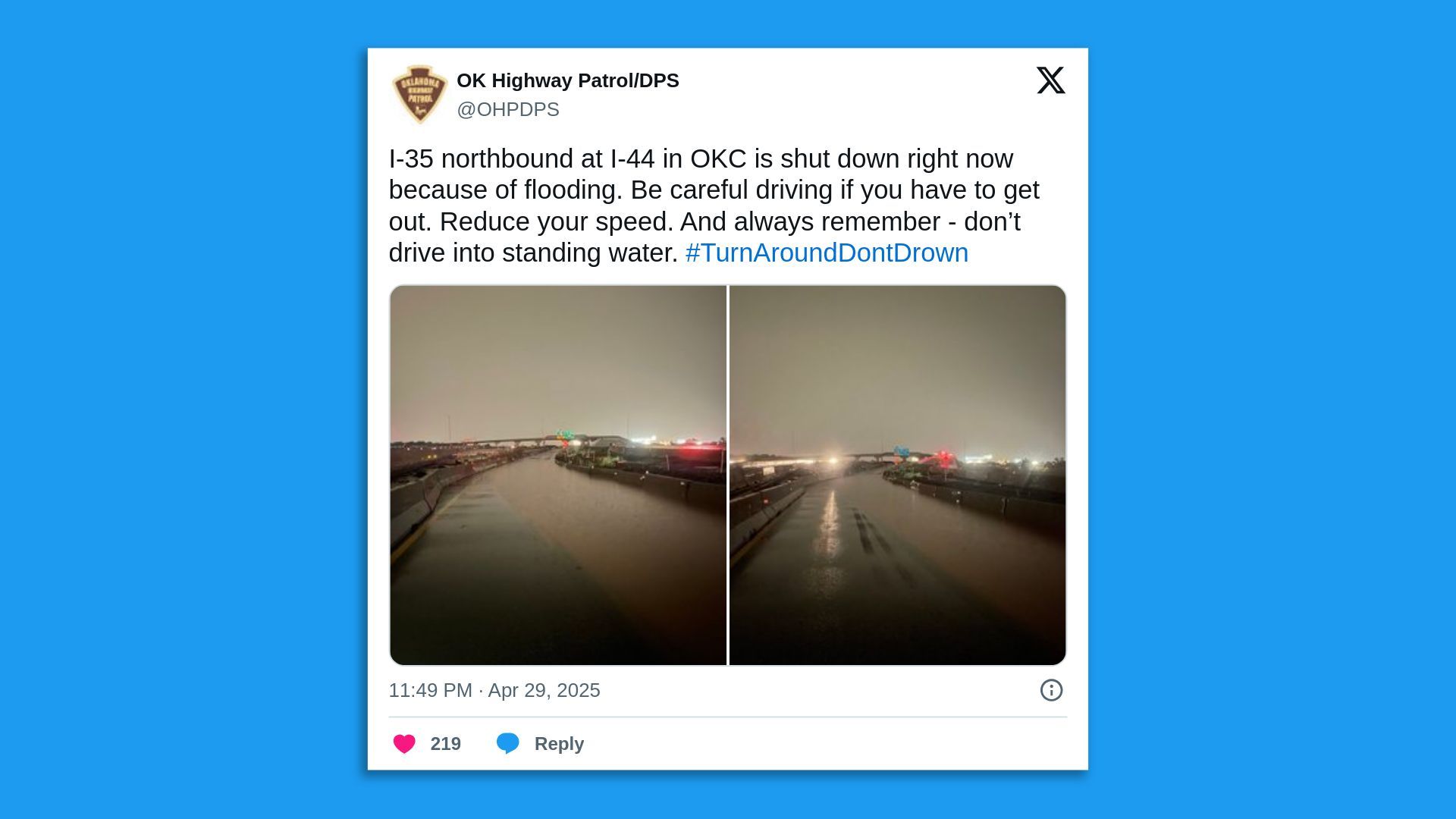
Screenshot: Oklahoma Highway Patrol and Department of Public Safety/X
The south-central U.S. is facing a "heightened" risk of flash flooding into Thursday following days of deadly storms across a region that's spanned from Texas to the Northeast, the National Weather Service warns.
The big picture: More rounds of thunderstorms were expected Thursday across Oklahoma and north Texas, with the NWS warning of risks for large hail in addition to flooding and it said "strong winds may accompany any storms from east Texas northeast through the lower Great Lakes."
Situation report: Severe weather has already killed several people, with two deaths reported during flooding in Oklahoma on Tuesday night and multiple roads remained closed into Wednesday night.
- Storms in southwestern Pennsylvania killed at least three people on Tuesday and an estimated 269,000 people were still without power on Thursday morning.
Threat level: "A stalled frontal boundary interacting with upper-level disturbances ejecting from the southern Rockies" could cause more heavy rainfall and severe thunderstorms across the south-central U.S. into early Thursday, per an NWS forecast update.
- "The heaviest rain threat will be confined to portions of southeastern Oklahoma into northeastern Texas and western Arkansas where a moderate risk of flash flooding remains in place," the NWS said.
- "An enhanced risk of severe thunderstorms is also embedded within this general area. A slight risk of severe thunderstorms and flash flooding is expected for a larger portion of the south-central U.S. into tonight."
What's next: Showers and embedded severe thunderstorms were expected to shift east into the Mid-Mississippi, Ohio, and Tennessee valleys on Thursday.
- "Damaging winds, hail, and an isolated tornado are the primary concerns from any severe storms."
Between the lines: Climate change is making heavy precipitation events more extreme and frequent, studies show.
Go deeper: Rainstorms are getting more intense amid climate change
