Axios Generate

April 07, 2025

🥞 Good morning! We've got a look at a mold-breaking new climate initiative and then plenty on the tariff fallout, all in just 1,168 words, 4.5 minutes.
🌵 Calling all New Mexico-based readers: Join Axios journalists on Wednesday, April 16, in Santa Fe for an event exploring the state's clean energy efforts.
- It will feature N.M. energy secretary Melanie Kenderdine, New Mexico Oil & Gas Association CEO Missi Currier & more. RSVP.
🎸 Exactly 45 years ago, Tom Petty & The Heartbreakers released a perfect single that's today's intro tune...
1 big thing: The provocative new push for "climate realism"
An ambitious new effort to reframe the U.S. approach to climate is taking a sledgehammer to shibboleths on the left and the right.
Why it matters: The Climate Realism Initiative warns of massive threats to the U.S., while arguing the country's past approach focused on the wrong things.
The big picture: The initiative "says two things that almost never get uttered in the same sentence," said Varun Sivaram, director of the new Council on Foreign Relations program.
- "I think climate is a grave national security threat on the level of all-out war," he said ahead of today's launch event.
- "On the other hand, I don't actually think that spending a trillion dollars on reducing American emissions expensively and not very intelligently is the right policy response."
Driving the news: Sivaram, a former top aide to Biden-era U.S. climate diplomat John Kerry (among other gigs), just penned an essay that sets the stage for the seven-figure program.
It warns of "fallacies" including:
- Thinking that Paris temperature targets are achievable.
- Thinking that cutting U.S. emissions can make a meaningful difference, noting the U.S. will be roughly 5% of future cumulative emissions this century.
- Believing that climate change poses manageable risks to U.S. prosperity and security.
What's next: His piece argues U.S. policymakers should brace for warming of at least 3°C this century. The country must prepare for the migration, security and resilience ramifications.
Other parts of the "realism" doctrine that centers U.S. economic and security interests include:
- Focusing on industries where the U.S. will have an edge, like next-gen geothermal, advanced nuclear, and solid-state batteries — and work to disseminate this tech globally.
- Elevating climate as a top national security priority.
- Developing and testing geoengineering.
The doctrine also says advanced economies should use trade tools that penalize nations with large, fast-rising emissions.
State of play: It brings together established names in wonk-world, such as David Hart, Lindsay Iversen and Alice Hill.
- Sivaram tells me the approach isn't pegged to the Trump administration, which largely rejects the problem of climate change.
- "Tomorrow, the Trump administration is probably not going to make a complete about-face and agree that climate poses deep national security threats to the United States," he said, though he adds that some work will continue quietly.
- But in the long run — and even within the next couple years — the initiative's framing can "make climate palatable to administrations of both parties," he said.
The bottom line: Sivaram stressed in our interview that he was speaking and writing for himself and that different scholars taking part will have different views.
- But overall, the new program isn't interested in tinkering at the margins on policy and the overall theory of the case.
2. 🛢️Oil prices ride a highway to the danger zone
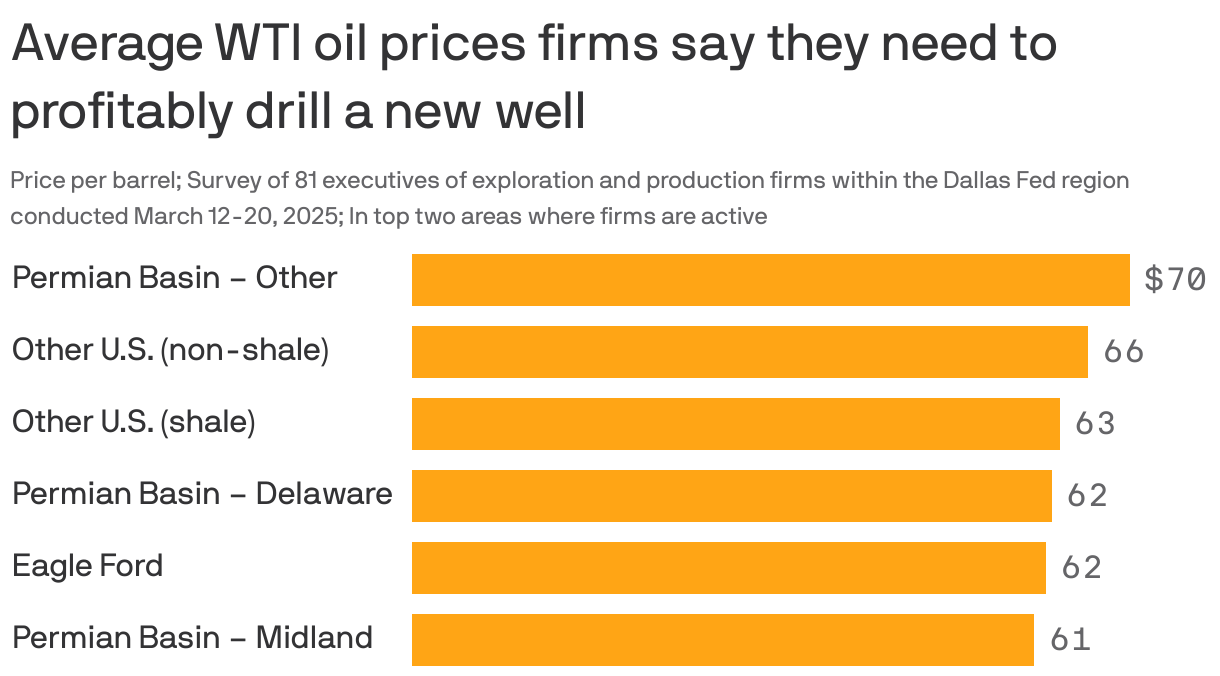
This chart ☝️ helps explain why a prolonged trade war could slow or even halt U.S. oil production growth despite President Trump's goal of juicing output.
Why it matters: U.S. prices have fallen to levels where producers can no longer profitably drill new wells in major regions, per the latest Dallas Fed corporate survey.
- It includes the Midland and Delaware basins, the most prolific parts of the mammoth Permian basin.
State of play: The potential demand hit from new tariffs combined with new OPEC+ barrels have pushed prices to four-year lows.
- The U.S. benchmark WTI is down to $60.87 this morning and spent some time in the $59 range.
Yes, but: Lots of things influence production decisions, like estimates of how long a price slump will last, hedging strategies and more.
Flashback: Even before Trump's April 2 tariff announcement, DOE's independent stats arm was projecting just modest U.S. output growth in 2025 and 2026 (albeit from record levels).
Catch up quick: Oil companies' share prices have taken a hit since the tariff and OPEC+ announcements.
- For instance the SPDR S&P Oil & Gas Exploration and Production ETF, a fund of U.S. producers, is down 18% over the last week.
- Producers like Occidental Petroleum, ConocoPhillips, EOG Resources, Chevron and others are down double-digit percentages since Trump's announcement.
What we're watching: Demand projections following the tariff rollout and retaliation from other countries.
- Goldman Sachs just further cut its 2025 growth estimate to just 300,000 barrels per day, per Reuters and others.
- "The scale of the sell-off suggests the market is pricing in a significant demand hit as recession fears grow," ING said in a note.
3. ⚠️ Low-carbon energy's twin threats: tariffs and budget talks

The escalating trade war is also taking a toll on low-carbon energy companies already facing jeopardy as Republicans weigh pulling back IRA tax subsidies.
Threat level: Share prices of various players in the renewables and battery sector have tumbled since Trump's April 2 rollout rocked global markets.
- But it's company-specific, depending on their supply chain exposure to the most heavily tariffed places.
- And there are a number of "mitigating factors," Morgan Stanley Research said in a note.
"Most importantly, some large developers have been proactively importing critical components for 2025-2027 projects ahead of tariff implementation," they write.
- And rising U.S. electricity demand gives developers leverage to seek higher power purchase costs, Morgan Stanley said.
The big picture: "The relative tariff increase is much greater for batteries than it is for solar," the research firm BloombergNEF said in a note.
- Stationary storage and EV deployment face more tumult than onshore wind and solar, while clean tech manufacturing will be "heavily disrupted," they write.
Zoom in: The iShares Global Clean Energy ETF fell only modestly, while the Invesco Solar ETF is down over 7%.
- But some specific companies in the wider low-carbon power and mobility space have been hit much harder.
State of play: The tariffs come amid other U.S. headwinds for low-carbon sectors as the White House pulls or slows support and Congress weighs the IRA's fate.
What we're watching: Atlas Public Policy this morning unveiled a new analysis of the effect of removing IRA incentives for EV purchasing, charging infrastructure and clean tech manufacturing.
- One finding: Through 2024, announced EV-related manufacturing investments in Michigan, Georgia, North Carolina, Nevada and Tennessee total $109 billion.
4. 🍎 On my screen: apples-to-apples energy data
This is helpful: The think tank Resources For the Future just dropped its latest comparison of long-term global energy projections and scenarios.
Why it matters: Outlooks from energy companies, global bodies like IEA, and consultancies are a mishmash of measurement units, definitions and methods.
- So making apples-to-apples sense of these look-aheads at the supply mix, demand, emissions and more is a cool service.
What we're watching: One finding is that projected LNG export capacity in 2040 and 2050 might substantially outstrip need, or undershoot it, depending on global climate progress.
- "In 2040 and 2050, LNG demand meets or exceeds existing capacity in Evolving Policy and Reference scenarios but falls well short in Ambitious Climate scenarios," it finds.
- But that's just a sliver of the analysis, so check out the whole thing.
📧 Did a friend, colleague or an AI chatbot send you this newsletter? Welcome, please sign up.
🙏 Thanks to Chris Speckhard and Chuck McCutcheon for edits to today's edition, along with the brilliant Axios Visuals team.
Sign up for Axios Generate