
Axios Generate

November 19, 2024

☕️ Morning! We're coming at you today with a tight 1,083 words, a 4-minute read. But first...
❓Ben here with a question: Anyone watching "Landman," the new Paramount+ oil drama set in the Permian Basin?
- I'm digging it, with some reservations, but curious what you think. Please respond to this email with your thoughts!
🚨Situational awareness: The G20 nations issued a communique today, calling for a climate finance agreement at COP29. But they did not explicitly restate COP28's outcome to transition "away from fossil fuels."
🎵 At this moment in 1996, Blackstreet (featuring Dr. Dre) ruled the Billboard Hot 100 with an R&B classic that's today's intro tune...
1 big thing: Recycling can reduce mining — but there's not enough of it
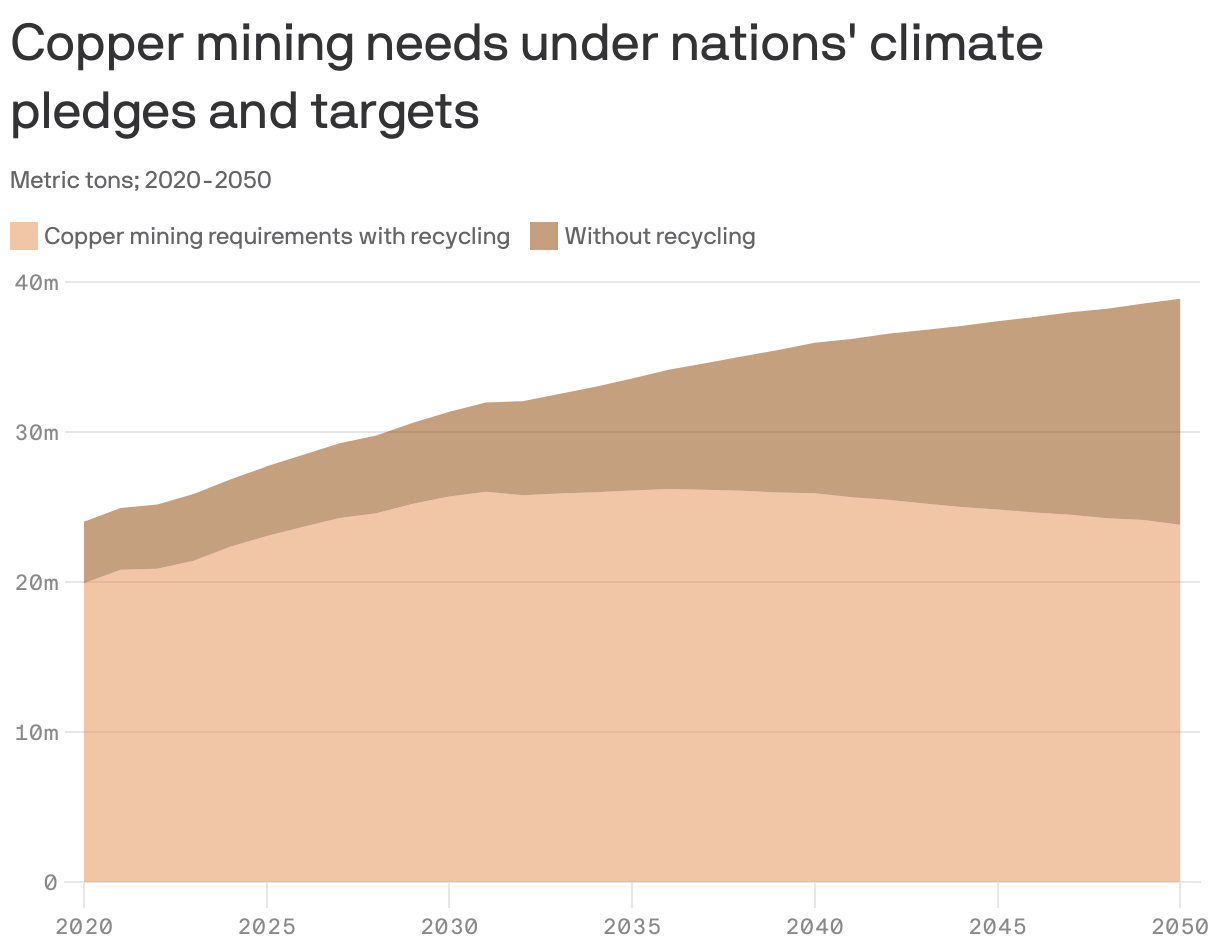
Recycling can hugely reduce mining needed for low-carbon tech, but for now it's not keeping pace with rising mineral use, new analysis shows.
Why it matters: EVs, renewables and grid expansions demand growing amounts of copper, nickel, lithium, cobalt and more.
- But all that mining has ecological drawbacks. And climate tech supply chains bring geopolitical risk as China dominates mineral processing.
📢 Driving the news: A new International Energy Agency report tries gaming out how much extraction growth can be offset with recycling.
- In a scenario in which nations actually make good on their climate pledges, "a successful scale-up of recycling can lower the need for new mining activity by 25‑40% by 2050," IEA finds.
- Around $600 billion of new mining investment would still be needed through 2040 — but it's 30% higher still without recycling.
Zoom in: In this hypothetical case, recycling cuts new mine development needs by 40% for copper (see above) and cobalt.
- For lithium and nickel, it's 25% by 2050.
Friction point: Recycling isn't on pace to turn these projections into reality.
- The report sees "vast potential" for expansion with the "right incentives," even as it lauds growing amounts occurring already.
- Current efforts include the EU's plan to have recycled materials make up at least 25% of the bloc's strategic raw materials by 2030. Faster permitting is part of the policy.
🔭 What we're watching: IEA finds that long-term policy certainty can provide the "confidence investors and recyclers need to commit to new projects."
- It offers lots of ideas, like cutting trade barriers on recycled goods and wider use of "traceability," to name just two.
🍰 Bonus: Cobalt recycling potential
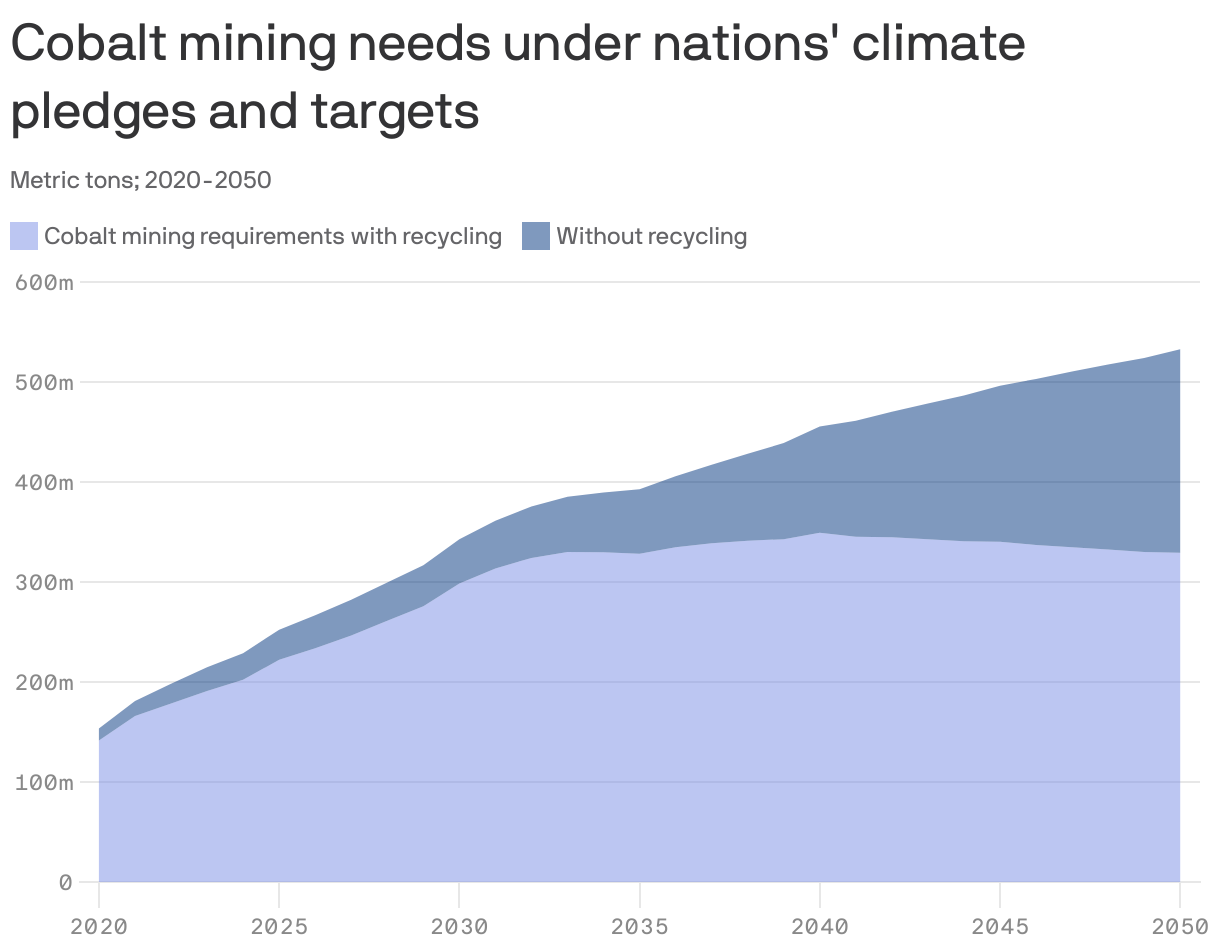
As you can see, a lot more cobalt is likely needed regardless, but recycling can still be a game-changer.
🖼️ The big picture: Significant amounts are already happening.
- IEA's report notes production of recycled battery metals — including cobalt — have recently seen rapid growth, "albeit from a low base."
- "The market value of recycled battery metals also experienced nearly 11-fold growth between 2015 and 2023, with more than half of this growth occurring in the last three years."
2. 🛣️ Trump's transportation pick could bring a U-turn
Trump 2.0's Transportation Department probably won't share Biden officials' focus on EVs, mass transit and other climate-related efforts.
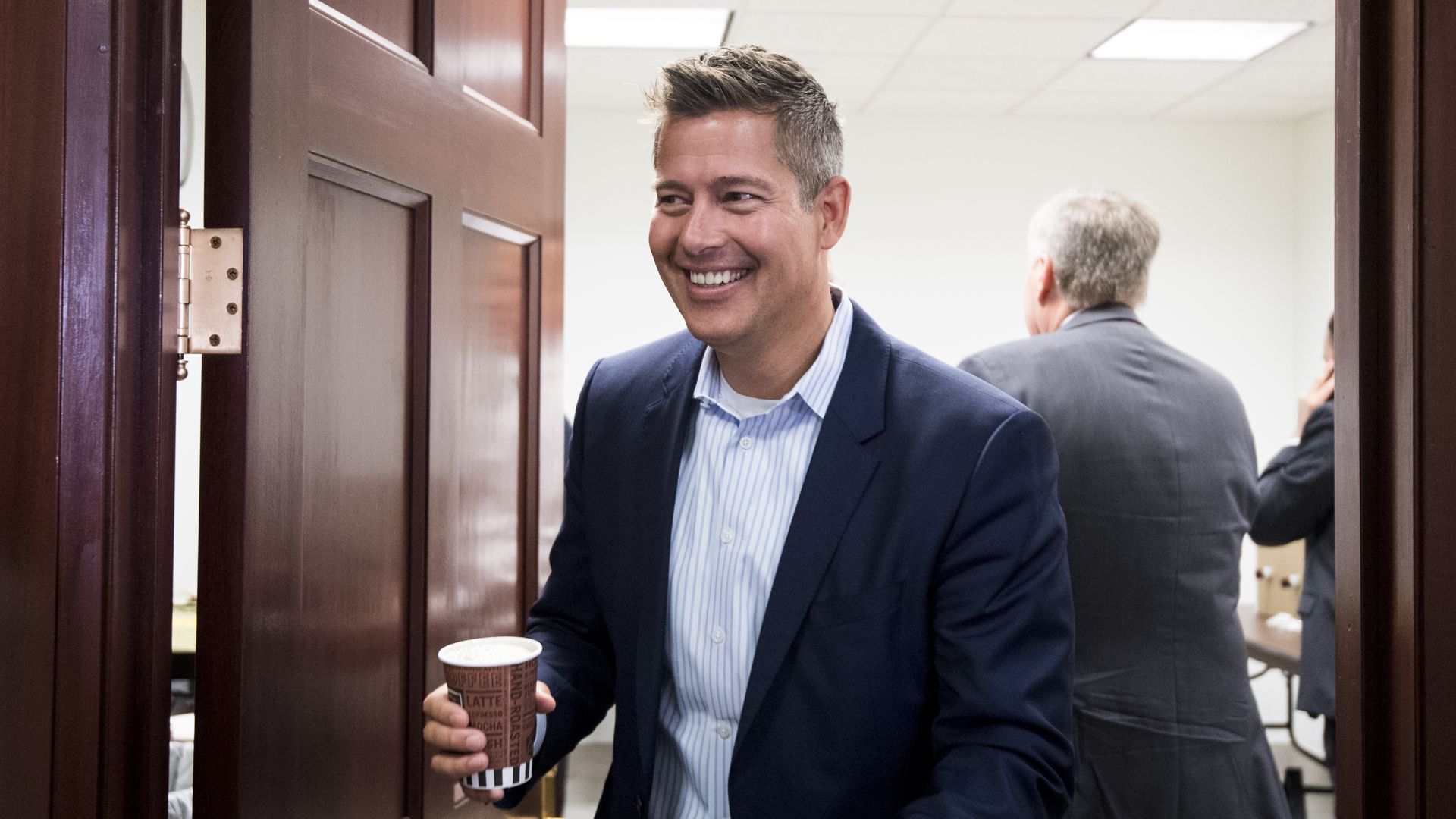
🏎️ Catch up quick: Trump will nominate Fox Business host and former Wisconsin GOP House member Sean Duffy for the post.
- "He will prioritize Excellence, Competence, Competitiveness and Beauty when rebuilding America's highways, tunnels, bridges and airports," last night's announcement states.
Why it matters: The agency controls billions of dollars in funding, and transportation is the country's largest source of CO2 emissions.
What they're saying: "I suspect he'll provide substantially fewer competitive grant funds to projects that support low-carbon transportation, like transit, pedestrian improvements, and bike ways," Urban Institute transit expert Yonah Freemark tells me via email.
- The League of Conservation Voters noted that his 2% score from the group was the lowest of any prospective nominee so far.
The other side: Duffy will bring a "Golden Age of Travel, focusing on Safety, Efficiency, and Innovation," the transition team announcement states.
👀 What we're watching: The fate of Biden-era initiatives under the 2021 infrastructure law and IRA that have unused funds, like the Low Carbon Transportation Materials Program.
- DOT also crafts vehicle mileage rules.
- They work in tandem with EPA CO2 regs that Trump officials call an ill-conceived thumb on the scale for EVs.
3. West Coast braces for bomb cyclone with heavy rain, high winds

The West Coast is bracing for days of heavy rainfall from a bomb cyclone forming today.
Threat level: The rapidly intensifying storm, taking shape in the northeastern Pacific Ocean, will direct a strong atmospheric river at southwestern Oregon and Northern California for several days.
- The National Weather Service has issued a slew of watches and warnings ahead of the storm.
- The forecast office in Eureka, Calif., noted that an atmospheric river producing heavy rainfall will end up "parking itself" over northwestern California starting tonight and lasting through the weekend.
- That's raising flooding concerns for urban areas as well as rivers and streams over time — and the flooding could be significant.
Context: Human-caused climate change is causing atmospheric rivers to carry more moisture and be capable of producing more rain and snow.
- Studies show future atmospheric river events are likely to heighten this trend.
The latest computer model projections show rainfall amounts that could reach 15 to 20 inches, or even higher, along the coast. The highest totals will be in elevated areas.
- In addition, power outages are possible as winds gust to 70 mph or higher at times.
Zoom in: Even stronger winds, of up to 100 mph, are likely off the coast of Vancouver Island and west of Washington state, as the bomb cyclone reaches its peak intensity by tomorrow before drifting off the coast while slowly weakening into the weekend.
- The low pressure area will more than qualify as a bomb cyclone due to its rapid rate of intensification.
4. 👟 Catch up quick on oil and gas
🚦 The NYT and Reuters both have helpful looks at BP and Shell slowing down their diversification into low-carbon areas and renewing focus on the traditional lines.
- What they're saying: "If you look at the relative shareholder returns, the market's been sending a very clear signal that it wants energy companies to focus on their core competencies," Mark Viviano, a managing partner at energy investment firm Kimmeridge, tells the NYT.
💵 Brazilian state oil giant Petrobras "plans to boost spending on new oil drilling and other projects by almost 9% to $111 billion in the next five-year plan," Bloomberg reports.
- The intrigue: Brazil hosts next year's UN climate summit, where countries will again face pressure to begin a transition from fossil fuels.
📫 Senior Republicans are pressing the FTC for info about conditions imposed on approval of the Exxon-Pioneer and Chevron-Hess mega-deals, Fox Business reports.
- State of play: "Recent cases suggest that the FTC under your leadership is pursuing settlements not because there is harm to competition, but due to political pressure from Democrats in Congress," House Judiciary Committee Chair Jim Jordan and Sen. Mike Lee wrote to FTC chair Lina Khan, per Fox.
- What we're watching: Whether the inquiry turns up new info on the FTC barring top Hess and Pioneer execs from the boards of the merged companies.
5. 💬 Quote of the day
"Unfortunately, the potential and elegance of pollution pricing runs into the reality that normal people generally hate the idea."— UC Berkeley resource economist James Sallee
That's from his new post on "green subsidies" like the IRA winning the policy debate over carbon pricing — and some of the problems in tow.
📨 Did a friend, colleague or even a frenemy send you this newsletter? Welcome, please sign up.
🙏 Thanks to Chris Speckhard and Chuck McCutcheon for edits to today's edition, along with the brilliant Axios Visuals team.
Sign up for Axios Generate