
Axios Generate

January 23, 2024
π Off we go! This edition has a Smart Brevity count of 943 words, 3.5 minutes.
πΌ On this date in 1976, the late David Bowie released the album "Station to Station," which provides today's intro tune...
1 big thing: Why replacing fossil fuel revenue is hard

Illustration: Shoshana Gordon/Axios
It will take far more than renewables growth to sustain communities facing local revenue loss if strong climate policies curtail fossil fuel production and use.
Driving the news: New research from Resources For the Future and the University of Michigan explores how different forms of energy provide revenues in 79 counties across 10 states, Ben writes.
Why it matters: Limiting climate change will require moving away from fossil fuels. Yet they provide vital tax revenue and other money streams for services like schools, roads, and safety.
The intrigue: Wind and solar increasingly do too β with more to come as they grow. But these things often aren't fungible.
- "[T]he geographically dispersed nature of wind and solar means that these alternatives would need to cover implausibly large portions of fossil fuelβdependent counties to replace the revenues they currently generate," the working paper states.
The big picture: In areas with rather low fossil revenue dependence, wind and solar are a viable replacement, the study's authors note.
- But for highly fossil-reliant areas, state or federal support for essential services is needed "under any deep decarbonization scenario." These areas also need "new economic drivers."
Catch up fast: Various policies already aim to help areas facing energy transition.
- For instance, the 2022 climate law provides extra tax incentives for "clean" projects in "energy communities."
Yes, but: Lead author Daniel Raimi of RFF tells me programs through the 2021 infrastructure law, 2022 climate law, and executive moves are helpful but insufficient for several reasons.
- One is that they're rather coal-focused, while oil and gas are a much larger public revenue source.
The bottom line: "This is a whale of an issue βΒ and we've just got a handle on the fin," Raimi said in a statement.
2. Charted: fossil and renewable revenues
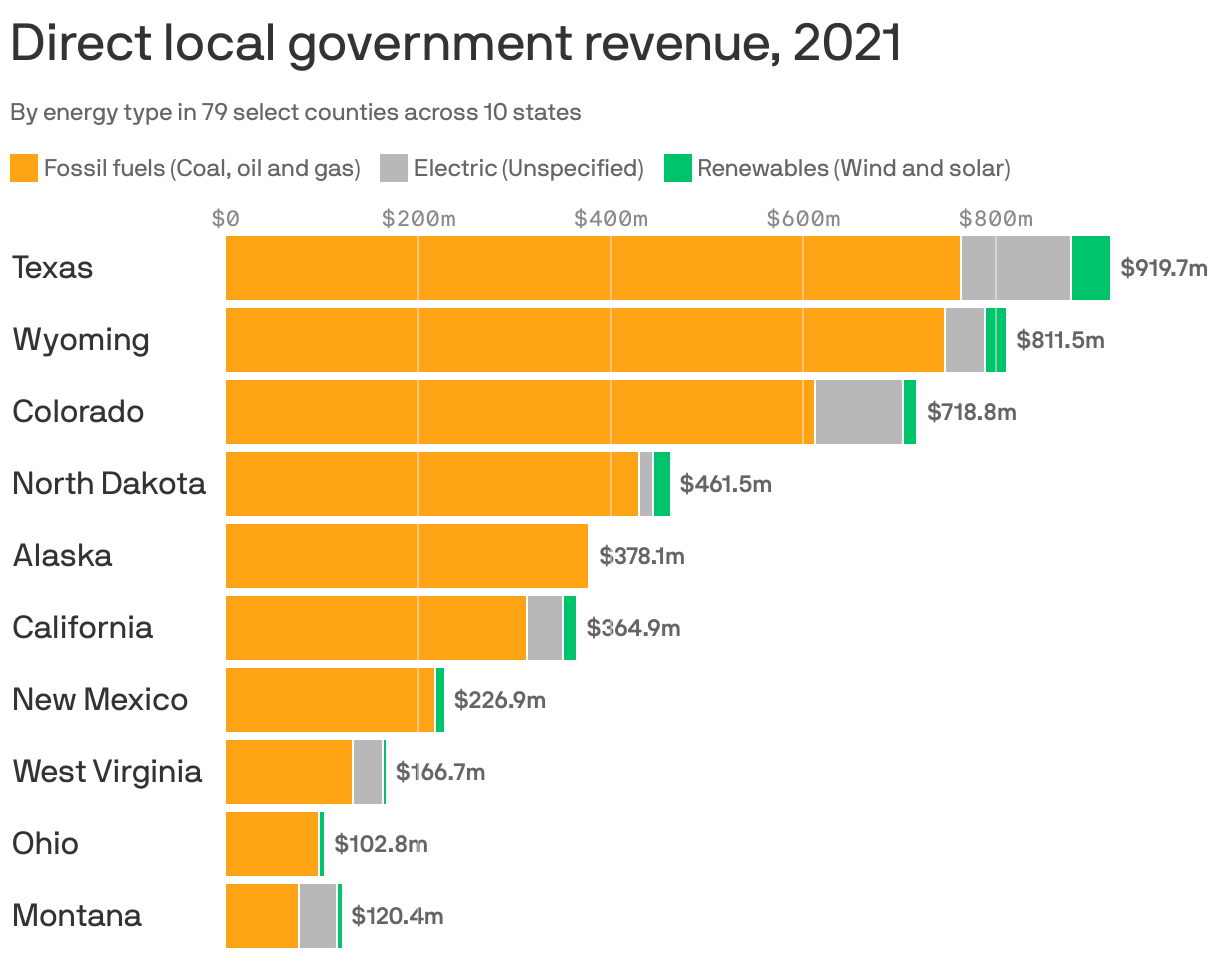
The above chart shows annual fossil fuel, wind and solar revenues across 79 counties in the RFF paper we cover above, Ben writes.
Zoom in: The U.S. remains highly reliant on fossil fuels β especially oil and gas β so those revenues are currently much larger.
- Fossil fuels generated over $10,000 per capita in government revenue in six counties analyzed, and over $1,000 in 28.
- The highest amount of per-capita revenue from wind and solar was around $1,000 β and only 11 counties were above $100, the paper finds.
- Fossil fuels account for more than half of property tax revenues in 15 counties and more than 10% in 47 counties.
3. ππ½ββοΈ Catch up fast on business: batteries, oil, investment

Illustration: Allie Carl/Axios
π’οΈ TotalEnergies unveiled two deals this morning that show its ongoing diversification into electricity markets and tech, Ben writes.
- Driving the news: The oil and gas giant is acquiring German battery storage developer Kyon Energy for $98 million upfront and more linked to development targets. The deal is part of TotalEnergies' power market expansion in Europe's largest economy.
- Meanwhile: The company and renewables firm European Energy are partnering to develop offshore wind in Denmark, Finland and Sweden. Go deeper.
π Reuters reports that "The state-owned Abu Dhabi National Oil Company said on Monday it would allocate $23 billion for decarbonisation and lower-carbon projects, up from a previous $15 billion target."
- Yes, but: The group Oil Change International, in a statement, called Adnoc's climate pledges a "joke" at a time when it's investing heavily to boost fossil fuel production.
π€ Via CNBC, "Motor fuels distributor Sunoco said on Monday it would acquire oil and gas transportation service NuStar Energy in an all-stock deal valued at about $7.3 billion, including assumed debt."
4. Notes from a redrawn energy map
Illustration: AΓ―da Amer/Axios
Newly published data points underscore how much Russia's attack on Ukraine has reshaped the global energy trade map, Ben writes.
State of play: Sanctions against Russia's coal exports have shaken up flows, a recent primer from the Energy Information Administration shows.
- The EU and some other countries have shunned Russian coal, but shipments to China and certain other Asian markets have grown.
π Zoom in: China, South Korea, Turkey and India together absorbed 47% of Russia's coal exports from August 2021 to July 2022.
- That soared to 80% from August 2022 to July 2023.
- Specifically, shipments to China (the world's largest coal consumer) surged 73% between those two periods.
π’οΈ Meanwhile: Reuters spotted an inflection point.
- "Russia leapfrogged Saudi Arabia to become China's top crude oil supplier in 2023 ... as the world's biggest crude importer defied Western sanctions to purchase vast quantities of discounted oil for its processing plants."
ππ½ββοΈ Catch up fast: The crisis also shook up gas, with Moscow largely halting flows to Europe, while LNG exports to the bloc from the U.S. and elsewhere have risen.
The bottom line: The war has redrawn the energy map.
5. NASA, startup charge up battery tech

Archer's Midnight electric vertical takeoff and landing aircraft. Photo courtesy of Archer
Air taxi developer Archer Aviation is collaborating with NASA on advanced battery technology, Axios' Joann Muller reports.
Why it matters: The future of advanced air mobility, including electric planes and vertical takeoff and landing aircraft (eVTOLs) like Archer's Midnight aircraft, will require more powerful and efficient batteries.
Driving the news: The collaboration will kick off with a project focused on developing high-performance battery cells for electric aircraft, and potentially spacecraft.
- NASA will test the safety, energy and power performance of Archer's battery cell and system design using one of the world's most advanced high speed X-ray facilities: the European Synchrotron Radiation Facility.
- The goal: understand how the cells function while being subjected to extreme abuse.
What's next: NASA will share the results publicly as a way to push progress across the entire industry and keep the U.S. at the forefront of aviation, Archer said.
6. π¬ Quote of the day
"Utilities over time have learned they don't want to be first movers ... Let someone else be the first, second and third mover."β Guggenheim Partners' Shahriar Pourreza to the WSJ about power companies backing off U.S. offshore wind plans.
π¬ Did a friend send you this newsletter? Welcome, please sign up.
π Thanks to Chris Speckhard and Javier E. David for edits to today's edition, along with the talented Axios Visuals team.
Sign up for Axios Generate

Untangle the energy industryβs biggest news stories