Axios Generate

May 22, 2025

😮 A lot has happened on the policy front since our last edition! But we'll catch you up and look forward, all in just 1,318 words, 5 minutes.
🎶 Exactly 10 years ago, Wiz Khalifa (featuring Charlie Puth) ruled Billboard's Hot 100 with today's lovely intro tune...
1 big thing: Capitol Hill wants to get tougher on Russian oil and gas

More Senate Republicans are pushing for tough sanctions on Russian energy, and soon — but it's unclear if President Trump will ever share their zeal.
Why it matters: Russian exports of oil, gas and other commodities provide lots of cash for the Kremlin's war on Ukraine.
Driving the news: Sens. Lindsey Graham (R-S.C.) and Richard Blumenthal (D-Conn.) are up to 81 co-sponsors of their Sanctioning Russia Act of 2025, they said yesterday.
- The bill would impose 500% tariffs on U.S. imports from countries that buy Russian oil, gas and other goods.
- That would hit China, which has boosted Russian oil imports as the EU has shunned Russian barrels.
State of play: Graham and Blumenthal, in a statement, said that if Russia continues to avoid serious peace negotiations, it "can expect decisive action" from the Senate.
- The bill would "hold China accountable for propping up [Vladimir] Putin's war machine by buying cheap Russian oil from the shadow fleet," they said.
- "Without China's economic support, Putin's war machine would come to a grinding halt."
Yes, but: It's not clear if Trump will ever support tough new sanctions on Russia — and that seems needed for Senate GOP leadership to bring it up.
- Majority Leader John Thune is a co-sponsor of the bill, but signaled Monday he'll take his cues from Pennsylvania Avenue.
- "If the White House concludes that tougher sanctions are in order, we're here for it," he told reporters. His office did not respond to Axios' request for comment yesterday. The White House did not comment either.
New Hampshire Sen. Jeanne Shaheen, the Foreign Relations Committee's top Democrat, told Axios' Hans Nichols yesterday: "We need to make it very clear to Vladimir Putin that we are going to increase the pressure on Russia, to get them to the table to resolve the war in Ukraine."
Friction point: Some GOP Senate Republicans don't want to wait and "feel that they may have to make a move to hurry Trump along in the talks," Semafor reported yesterday.
- Reuters reports that "Ukraine will ask the EU next week to consider big new steps to isolate Moscow, including seizing Russian assets and bringing in sanctions for some buyers of Russian oil."
- The EU already unveiled expanded sanctions on Russia's "shadow fleet" of oil tankers earlier this week.
Reality check: ClearView Energy Partners points out that the Trump administration has been signaling a "dovish posture" as it seeks to pause the Russia-Ukraine war.
- Secretary of State Marco Rubio and other Trump officials appear to be using Graham's bill as a "'bad cop' foil to the President's more amicable outreach," ClearView said in a note.
- But the research firm isn't ruling out a Senate "stampede" toward passage with a veto-proof majority.
Catch up quick: Russia's invasion has closed off some markets for Kremlin-backed energy, but Moscow's revenues remain robust despite falling since 2022.
- Russia's fossil fuel export revenues last month were $662 million per day, per the Centre for Research on Energy and Clean Air, which carefully tracks the topic.
What we're watching: The White House-Capitol Hill interplay.
- "Graham's conversations with the White House about this legislation have been continuous and consistent," a Senate GOP aide granted anonymity to discuss the negotiations told Axios.
2. ⏭️ What's next in the battle over the IRA

The House narrowly approved the GOP's "one big beautiful bill" early this morning after changes that included even deeper cuts to IRA tax credits.
Why it matters: The 11th-hour changes will only intensify furious lobbying of GOP senators to keep more of the Democrats' 2022 climate law intact.
Catch up quick: The last version passed today would move up the end of the investment and production tax credits to phase them out for projects that come onto the grid after 2028.
The intrigue: Projects that begin construction 60 or more days after enactment of the bill would be ineligible, meaning that many in the pipeline today wouldn't get the incentives.
- The new proposal would also include a carveout for advanced nuclear and nuclear expansion projects, which would only see the credit go away for projects that begin construction after 2028.
- Still, that's quicker than the timeline for most nuclear projects under consideration.
What they're saying: The new version "represents among the most restrictive interpretations we have heard speculated and the closest to 'complete' gutting of bill we've ever seen," Jefferies analysts said in a note.
What we're watching: Low-carbon energy groups will make a Trump-themed pitch to Senate GOP members. They'll argue that scuttling projects will cost jobs in red areas and erode U.S. "energy dominance."
- House Republican leaders called the IRA a "green new scam" stuffed with wasteful subsidies.
- "We remain skeptical that Senate will accept accelerated ITC/PTC phaseout timelines, even with 'extensions' given to nuclear," TD Cowen Washington Research Group analysts wrote this morning.
The bottom line: Whatever the Senate produces is likely to be less aggressive on the IRA than the House plan, but specifics remain a huge question mark.
3. 🎭 Bonus Capitol Hill drama: the EPA waiver showdown

Senate Republicans last night passed procedural measures that clear the way for looming votes to effectively scuttle California rules that mandate sharp increases in EV sales.
What's next: Votes to overturn EPA's waivers that enable California — and states that follow its lead — to set its own emissions rules.
State of play: Republicans are ignoring opinions from the Government Accountability Office and Senate parliamentarian.
- Weeds alert: the whole thing is about whether EPA waivers can be nixed using special resolutions that are immune from filibuster.
Friction point: Democrats have called it the "nuclear option," warning Republicans are setting a new precedent for what kind of rules can be undone by Congress.
- Republicans argue it is a unique case and that GAO is inappropriately trying to interfere with what lawmakers are able to repeal through the Congressional Review Act.
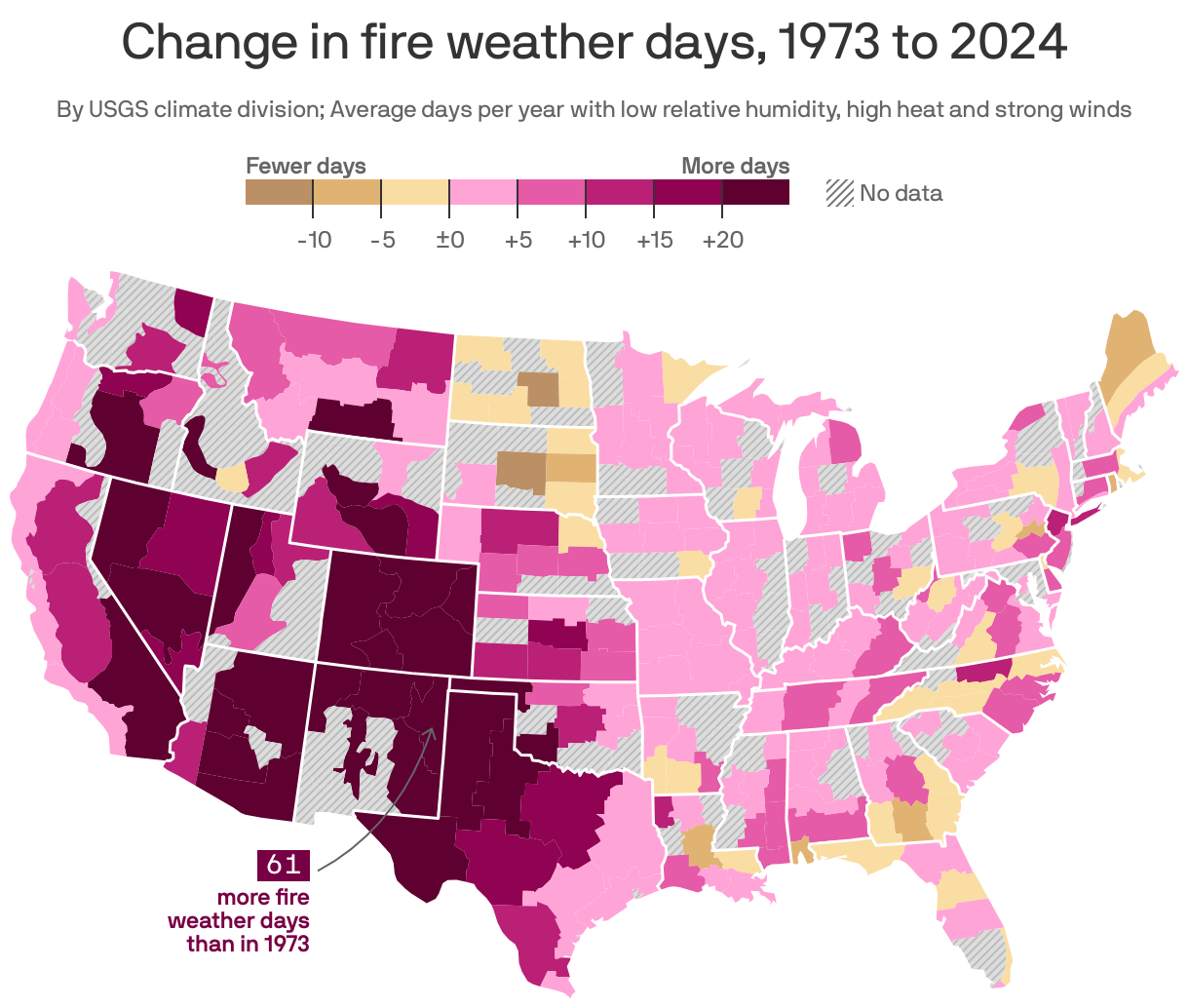
4. 🇺🇸 Mapping the rise of U.S. "fire weather"

Hot, dry and windy weather that helps wildfires spread is becoming more common across much of the U.S. amid climate change, a new analysis finds.
Why it matters: What used to be several months of "fire season" is stretching in some places into a yearlong phenomenon, straining fire departments and others tasked with containing wild blazes.
Driving the news: The number of "fire weather" days rose by 37 in the Southwest and 21 in the West on average between 1973 and 2024, per an analysis from Climate Central, a climate research group.
How it works: The report defines a "fire weather day" as one with temps of at least 45°-55°F (depending on the season), relative humidity within 5% of regional thresholds, and sustained wind speeds of 15 mph or more.
- All this must be happening together during at least two hourly measurements on a given day.
The bottom line: Human activities — like unattended campfires and sparks from power lines — start the vast majority of blazes.
- But no matter how fires start, "fire weather" can give them the push they need to spread and grow.
5. 🛢️ Quote of the day: shale stress edition
"One wonders if there is a price that would worry President Trump about the future of the US oil industry, but WTI in the $50s did not seem to elicit discernible West Wing anxiety."— RBC Capital Markets' Helima Croft in a note
"President Trump appears to be prioritizing a lower inflation/interest rate environment over accelerating US oil output," she writes.
- The comments come as analysts see U.S. output growth slowing to a trickle or even falling slightly amid lower prices, tariff uncertainty and just modest demand growth.
6. 🧮 Tech number of the day: 1.24 million tons of CO2
That's the amount of CO2 that startup Exomad Green has pledged to remove over 10 years in a new deal with Microsoft.
Why it matters: It's the largest biochar removal deal in history by volume, the companies said.
- Biochar removal involves heating biomass without oxygen to very high temps.
- Bolivia-based Exomad Green then adds it to soil, which it says boosts soil health. Charm Industrial, another biochar player, injects it underground.
- Go deeper on the Microsoft deal via S&P Global Commodity Insights.
📧 Did a friend, colleague or an AI chatbot send you this newsletter? Welcome, please sign up.
🙏 Thanks to Chris Speckhard and Chuck McCutcheon for edits to today's edition, along with the brilliant Axios Visuals team.
Sign up for Axios Generate