Axios Generate

February 04, 2025

🥞 Welcome back! Read on for the latest changes under Trump 2.0 and much more, all in just 1,361 words, 5 minutes.
🎶 This week marks 15 years since the brilliant Sade released the album "Soldier of Love," which provides today's intro tune...
1 big thing: Africa energy dealmaking imperiled by USAID reorg
The Trump administration's review and likely reorganization of the U.S. Agency for International Development could impede — among other things — USAID's successful record of energy dealmaking throughout Africa to expand electricity access.
Why it matters: By potentially ending humanitarian assistance and climate resilience and adaptation programs, the U.S. military could get pulled into responding to more future crises.
- Experts tell Axios that axing the agency completely, or even significantly downsizing it, would have security implications when it comes to climate change.
The intrigue: The U.S.-led Power Africa program, aimed at boosting electricity across the continent, has maintained bipartisan support.
- It has expanded both renewable and fossil fuel electricity generation in African nations, via a technology-agnostic approach.
- "It's in everybody's interest to make sure that we help the 600 million people get access to electricity," said a former Power Africa official who served in both the Obama and first Trump administrations.
- The former official — who spoke to Axios on condition of anonymity — cited the number of people in Africa without electricity.
- "Otherwise, we're going to have more than just climate catastrophes, but we're going to have all kinds of economic catastrophes, security catastrophes," the ex-official said.
USAID's on-the-ground presence throughout Africa also helps U.S. companies get more business there, the former official said.
Catch up fast: USAID, an independent agency now potentially moving within the State Department, conducts a variety of projects in climate-vulnerable locations such as Africa, Central America and parts of Asia.
- These include programs to boost the resilience of agricultural production and infrastructure to extreme weather events.
Friction point: Secretary of State Marco Rubio said yesterday that USAID needs reform.
- "It's supposed to respond to policy directives of the State Department and it refuses to do so," said Rubio, who said he would be the agency's acting administrator.
Zoom in: Curtailing USAID is "going to add substantially to the instability in these volatile regions, because vulnerable populations will be doing without," Sherri Goodman, a senior fellow at the Wilson Center and board chair at the Council on Strategic Risks, told Axios.
- "Instability morphs, as we've seen in certain regions where insufficient governance, you don't have access to the basics, and there's a vacuum created and that also allows for other malign actors to come in," she said.
- Goodman said it's a choice between paying "a little bit now" to help make regions "more resilient to food and drought shocks, or pay more later by having to send American sons and daughters into conflict areas."
A pullback in foreign aid could also benefit China, which may step into the void to offer its aid and earn more favor in Africa and elsewhere, Goodman and others said.
2. 🌡️ January surprises with global temperature record
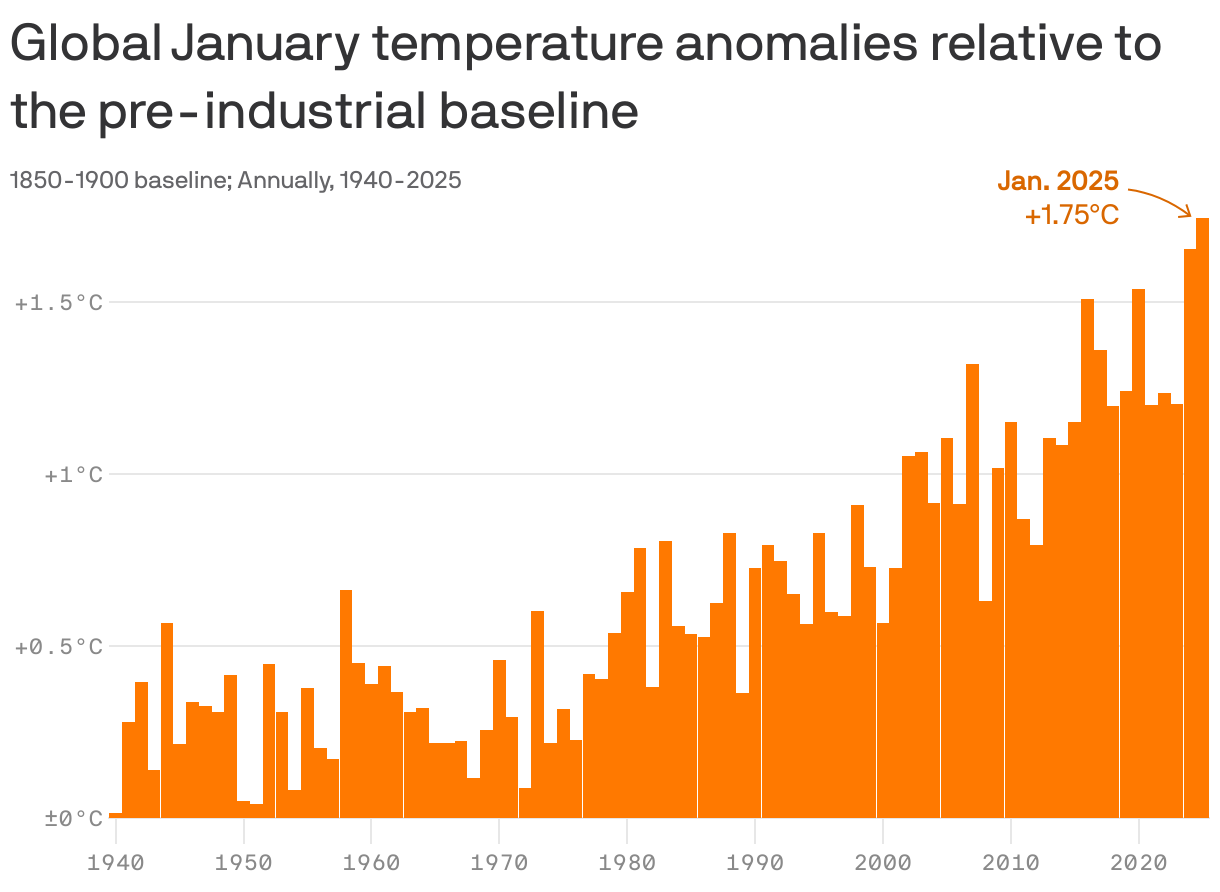
The planet just had its hottest January on record by a considerable margin, in a surprise finding to climate scientists.
Why it matters: A La Niña event is active in the tropical Pacific Ocean, which would typically cool the globe slightly. Yet that doesn't appear to be the case — at least not yet.
Zoom in: That the opposite is occurring suggests either a fluke or — combined with the record hot conditions in 2023 and again last year — something more mysterious.
- Climate scientists are investigating multiple factors that may be causing the climate to warm at a faster rate than just a few years ago, from changes in marine shipping fuels to the massive eruption of an undersea volcano.
- So far, there's been no way to fully explain the 2023 and 2024 records, but the expectation is that this year will be a top 5 hottest year — just not first place.
Yes, but: February appears poised for unusually cold temperatures across much of the Northern Hemisphere, which should lower global temperatures somewhat, according to climate scientist Zeke Hausfather, writing on Substack.
What they're saying: "An unexpected record to start things off may presage higher temperatures this year than many of us thought," Hausfather wrote.
3. 💵 Funding freeze sparks fears at DOE clean energy office

Invoices worth tens of millions of dollars are piling up at DOE's Office of Clean Energy Demonstrations, deepening some employees' fears that the Trump administration seeks to dismantle existing programs.
Why it matters: The freeze of already-obligated IRA and infrastructure law funding complicates the all-of-the-above bipartisan message of newly confirmed Energy Secretary Chris Wright.
- OCED, created by the infrastructure law, oversees a $27 billion portfolio that includes hydrogen, carbon capture, industrial decarbonization, advanced nuclear, energy storage and projects in rural and remote communities.
Several department employees who spoke to Axios believe OCED's overseers are looking for the poorest projects in its portfolio to give Wright options to eliminate or reprogram funding for President Trump's priorities.
Zoom in: Office employees have been called into meetings to justify how projects are in line with the president's policies, according to people familiar with the matter and memos obtained by Axios.
- DOE leadership has required staff and funding recipients to scrap community benefits plans, a required component of DOE applications that includes workforce development.
Unlock the whole story, and if you need smart, quick intel on energy and climate policy for your job, get Axios Pro Policy.
4. 🛢️Oil retreats amid tariff whiplash
Oil prices are around their lowest level in a month, with Brent around $74 this morning, as markets digest the latest thrust-and-parry over trade barriers.
State of play: Overnight China announced 15% tariffs on U.S. coal and LNG starting this coming Monday, per a finance ministry statement.
- U.S. crude oil, agricultural machinery, large-displacement cars and pickup trucks would face 10% tariffs.
- President Trump yesterday delayed levies on Canada and Mexico for at least a month.
Why it matters: Trade battles between the world's largest economies are bearish for oil.
- China absorbs only a small share of U.S. energy exports, and the overall penalties announced overnight aren't a sledgehammer.
- But the possibility of escalation hangs over the market.
The bottom line: "The tit-for-tat measures out from China may not stop at just the 10% tariffs on crude oil from the U.S. which can also see a deliberate attempt to weaken the yuan if the U.S. fires back with more tariffs on China exports to the U.S.," OANDA analyst Kelvin Wong said via Reuters.
5. 🏃Catch up quick: Sputtering projects edition
New Jersey officials are suspending plans to support a major offshore wind project, partly blaming federal policy changes.
Why it matters: Effects of the U-turn under Trump 2.0 are becoming more apparent and specific.
Driving the news: The state's public utility board, in a statement on the Atlantic Shores project, cited "Shell backing out as an equity partner ... and backing away from the American clean energy market, as well as uncertainty driven by federal actions and permitting."
State of play: The project, a venture between EDF and Shell, had already received key federal approvals.
- But President Trump's anti-wind executive order, in addition to barring new leasing, demands a review of existing leases.
- The sector is already facing financial hurdles that have canceled or delayed multiple projects.
Of note: For the record, Shell has said it formally remains a partner in the JV but reiterated it's taking a more selective approach to renewables.
The bottom line: Atlantic Shores said it's discouraged but touted the project's advantages, like its "mature interconnection plan" and supply chain investments.
- It didn't rule out a revival at some point.
🔋Meanwhile, the battery company Kore Power is scuttling a planned factory in Arizona.
- The company won draft approval in 2023 for an $850 million DOE loan for the project.
- A spokesperson declined to comment on whether the decision was linked to the political change in Washington. The Arizona Republic has more.
What's next: Kore is selling the site but "exploring other opportunities to expand its domestic manufacturing that have led to this pivot," it said.
Go deeper: The NYT and Canary Media have more on stalled projects.
6. 🗳️ Number of the day: 59
That's the number of senators who voted to confirm Chris Wright as energy secretary yesterday evening, including seven Democrats and Maine independent Angus King.
What we're watching: Many things, of course, including:
- Whether he'll bring clarity to the future of funding under the big infrastructure and climate laws.
- How quickly he might start approving new LNG export licenses.
- His role and influence on the new National Energy Council.
📧 Did a friend, colleague or an AI chatbot send you this newsletter? Welcome, please sign up.
🙏 Thanks to Chris Speckhard and Chuck McCutcheon for edits to today's edition, along with the brilliant Axios Visuals team.
Sign up for Axios Generate


/2025/02/03/1738626080353.gif?w=3840)