
Axios Generate

April 04, 2024
🐣 Good morning! Today we've got 1,213 words, 4.5 minutes.
💃 At this moment in 1977, T-Connection ruled Billboard's dance chart with today's unstoppable intro tune...
1 big thing: Small group, big CO2 emissions
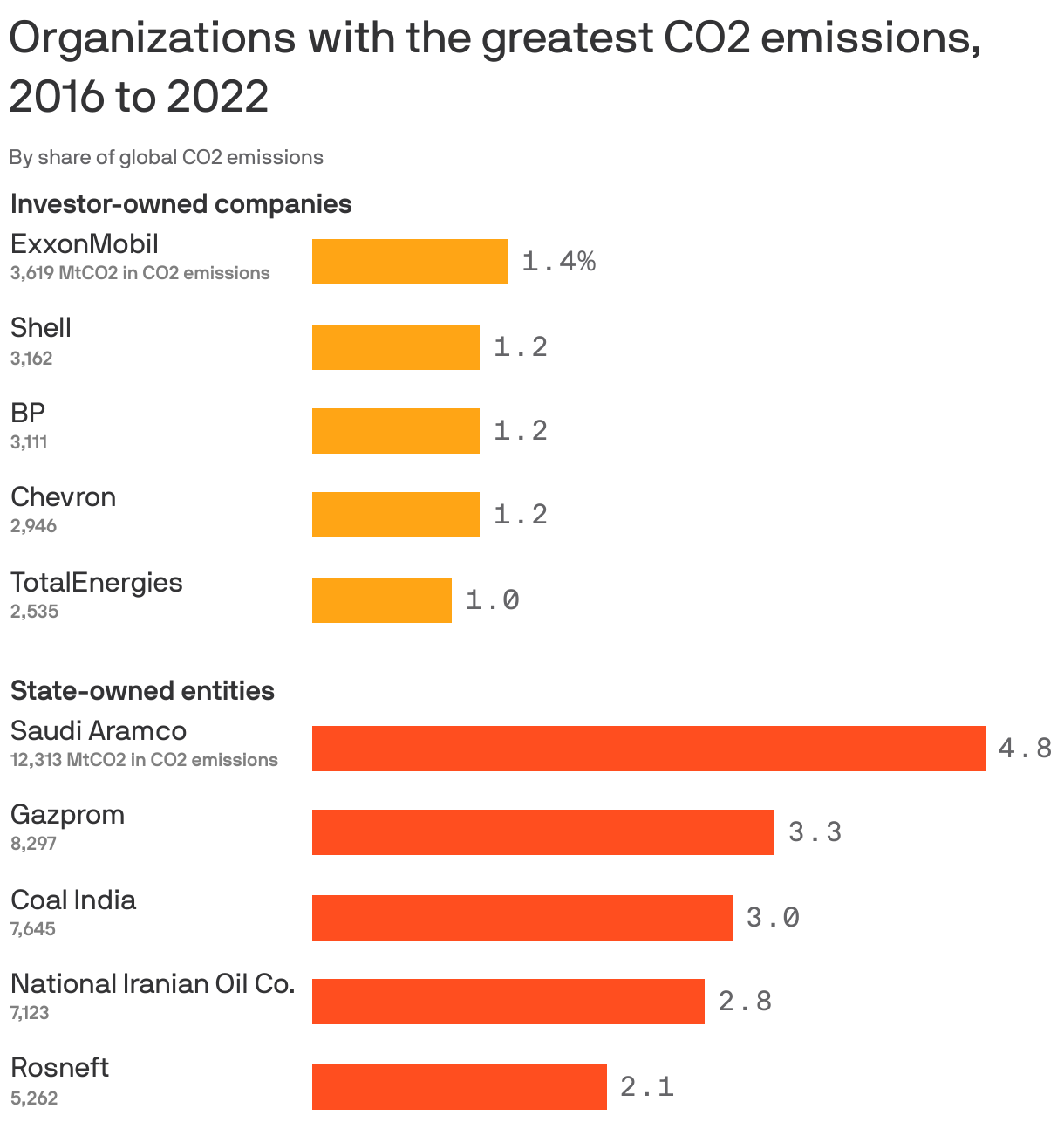
Just 57 fossil fuel and cement producers are linked to 80% of global fossil fuel carbon dioxide emissions since the Paris Agreement was signed in 2015, new data finds.
Why it matters: Many producers, be they state-owned entities or investor-owned oil companies, have been expanding production and emitting more CO2, Andrew writes.
Zoom in: The report, from the London-based think tank InfluenceMap, updates the Carbon Majors database, which was published by Richard Heede of the Climate Accountability Institute in 2014.
- The database quantifies how the world's biggest oil, gas, coal and cement producers contributed to global carbon emissions between 1854 and 2022.
Driving the news: The majority of fossil fuel companies showed higher production in the seven years after the Paris Agreement compared with the seven-year period before it, the report finds, led by state-owned companies.
- Researchers found the increase in production since 2016 has been dominated by Asia, where coal production significantly influences emissions.
The intrigue: The new data makes clear how most of the global CO2 emissions since 2016 are from a small number of high emitters that are not slowing their production in a manner more consistent with Paris guidelines.
Stunning stat: Since 1854, just 19 fossil fuel and cement entities contributed 50% of global CO2 emissions worldwide, InfluenceMap found.
Between the lines: Of the state-owned companies, the biggest emitters were Saudi Aramco, with a global share of 4.8% of CO2 emissions since 2016; then Gazprom and Coal India, the data shows.
What they're saying: "We're seeing an increase in concentration in terms of a smaller number of producers being linked to an even larger portion of global fossil CO2 emissions," InfluenceMap program manager Daan Van Acker told Axios.
2. Biden team awards $20B in "green bank" push

Illustration: Annelise Capossela/Axios
Biden officials just unveiled organizations that will receive $20 billion designed to flow into tens of thousands of "clean" energy and pollution-cutting projects nationwide, Ben writes.
Why it matters: The "Greenhouse Gas Reduction Fund" is the largest single non-tax investment in the 2022 climate law.
The big picture: The EPA-led program is staking nonprofits that will, in turn, seek to build and sustain a wide network of community finance institutions. They will provide low-cost loans and other aid.
- It's often called a "green bank" initiative, and it's designed to mobilize private capital levels that far exceed the taxpayer dollars.
- At least $14 billion of the $20 billion announced today is reserved for low-income and rural areas, neighborhoods of color, "energy communities" (like regions with closed coal mines), and more.
How it works: One GGRF program is the $14 billion National Clean Investment Fund. Grants EPA and the White House announced today under that umbrella include:
- Almost $7 billion for the Climate United Fund to focus on segments including consumers, small businesses and farms, and schools.
- $5 billion for the longstanding Coalition for Green Capital to "leverage the existing and growing national network of green banks."
- A third coalition, Power Forward Communities, will receive $2 billion to focus on decarbonized, affordable housing.
Yes, but: Republicans say EPA is ill-equipped to handle the huge fund effectively and have floated legislation to repeal it.
What's next: Vice President Kamala Harris and EPA boss Michael Regan will tout the funding today in North Carolina — a key swing state.
3. 🏃🏽♀️ Catch up quick: Forests, banks, solar power
🌳 Forest loss declined in Brazil and Colombia last year but increased in other key regions, per new data showing persistently worrying global trends, Ben writes.
- Why it matters: The world is far off track on halting and reversing forest loss by 2030, a key pledge at the 2021 UN climate summit. These areas provide critical CO2 sinks and wildlife habitat.
- The big picture: Tropical regions lost 3.7 million hectares of primary forest in 2023, akin to 10 soccer fields vanishing per minute, according to the University of Maryland and the World Resources Institute.
- Threat level: "Last year's destruction resulted in 2.4 gigatons of carbon dioxide emissions, which is roughly equivalent to half of what the burning of fossil fuels in the United States produces each year," the NYT reports.
🔍 Citigroup and the Royal Bank of Canada will disclose ratios of "clean" energy to fossil fuel finance in a deal with NYC Comptroller Brad Lander on behalf of three city pension funds.
- Why it matters: Along with an earlier agreement with JPMorgan, it will open a new window into the energy-related activities of some of the world's largest banks. Reuters has more.
☀️ Via the Financial Times, "The EU has launched two investigations into Chinese solar panel manufacturers that Brussels said have benefited from market-distorting subsidies."
4. Watching the detectives: inside the GOP probe of IEA

Illustration: Maura Losch/Axios
Senior Republicans are trying to pressure the International Energy Agency into moderating its work on the energy transition, Axios Pro's Jael Holzman reports.
Why it matters: The IEA fight is, at its core, about whether projections from the influential oil security and research group are reliable.
- The intergovernmental body has recently said Paris Agreement climate targets are still within reach and that fossil fuel use may peak this decade.
Catch up quick: House Energy and Commerce Chair Cathy McMorris Rodgers and Senate Energy and Natural Resources ranking member John Barrasso recently wrote a blistering letter to IEA head Fatih Birol.
- "Excessive focus on an 'energy transition' … has led the IEA to veer away from objectively informing and educating policymakers," it alleges.
Behind the scenes: The Biden administration's decision to pause new permits for LNG export terminals helped prompt the letter, GOP staffers said.
- GOP lawmakers have "a lot of concerns about funding" the IEA, per one Republican staffer who requested anonymity to speak candidly.
- The staffer said Republicans prefer the Energy Information Administration, the Energy Department's independent stats and analysis arm.
- He said EIA doesn't "look at wishful thinking or wishful scenarios."
Unlock to the whole story — and vital daily scoops and analysis — by talking to our sales team about Axios Pro: Energy Policy.
5. "Misconceptions" about 2025 energy possibilities

Illustration: Shoshana Gordon/Axios
Gaming out post-election policy would be fraught even with results in hand, but one new analysis is helpful for thinking about 2025 and beyond, Ben writes.
The big picture: A slice of TD Cowen Washington Research Group's report explores "misconceptions" about what may occur.
- They call the odds of Inflation Reduction Act repeal "overstated," even if Republicans run the table and gain full control of D.C.
- But the authors see potential for limited changes, including EV provisions.
Yes, but: Which risks are "understated"?
- A GOP White House revising IRA implementing policy to narrow access to tax credits for climate-friendly power and EVs — something that doesn't require Congress.
Elsewhere, the report calls the risk of trade-related disruption understated, regardless of who wins the White House.
- They see "clean energy and transport value chains becoming collateral damage" from higher U.S.-China tensions.
- The risk is "more acute" if Donald Trump wins, due to "aggressive" campaign rhetoric and "indifference to negative impacts" in those areas.
What we're watching: 2025 deadlines on the debt ceiling, the budget, and expiration of Trump-era tax cuts will be "forcing events" for energy policymaking maneuvers, TD Cowen said.
6. 🛢️ Quoted: Exxon vs. Chevron edition
"If I'm right, a $60 billion deal could effectively depend on the meaning of a single word. That's the stuff of dreams for lawyers."— Bloomberg's Javier Blas, writing about the dispute over Chevron's plan to buy Hess, including its Guyanese holdings in a huge Exxon-operated field
📬 Did a friend send you this newsletter? Welcome, please sign up.
🙏 Thanks to Chris Speckhard and Javier E. David for edits to today's edition, along with the brilliant Axios Visuals team.
Sign up for Axios Generate

Untangle the energy industry’s biggest news stories