Axios Generate

June 30, 2025

🐣 Good morning! This week will be wild as Congress rushes to complete the budget bill that pares back climate tech incentives.
- We'll dive into Capitol Hill action, breaking fusion news and more, all in just 1,194 words, 4.5 minutes.
🎧 This week in 1978, the late disco queen Donna Summer released a perfect single that's today's intro tune...
1 big thing: Why wind and solar hit a brick wall in Congress
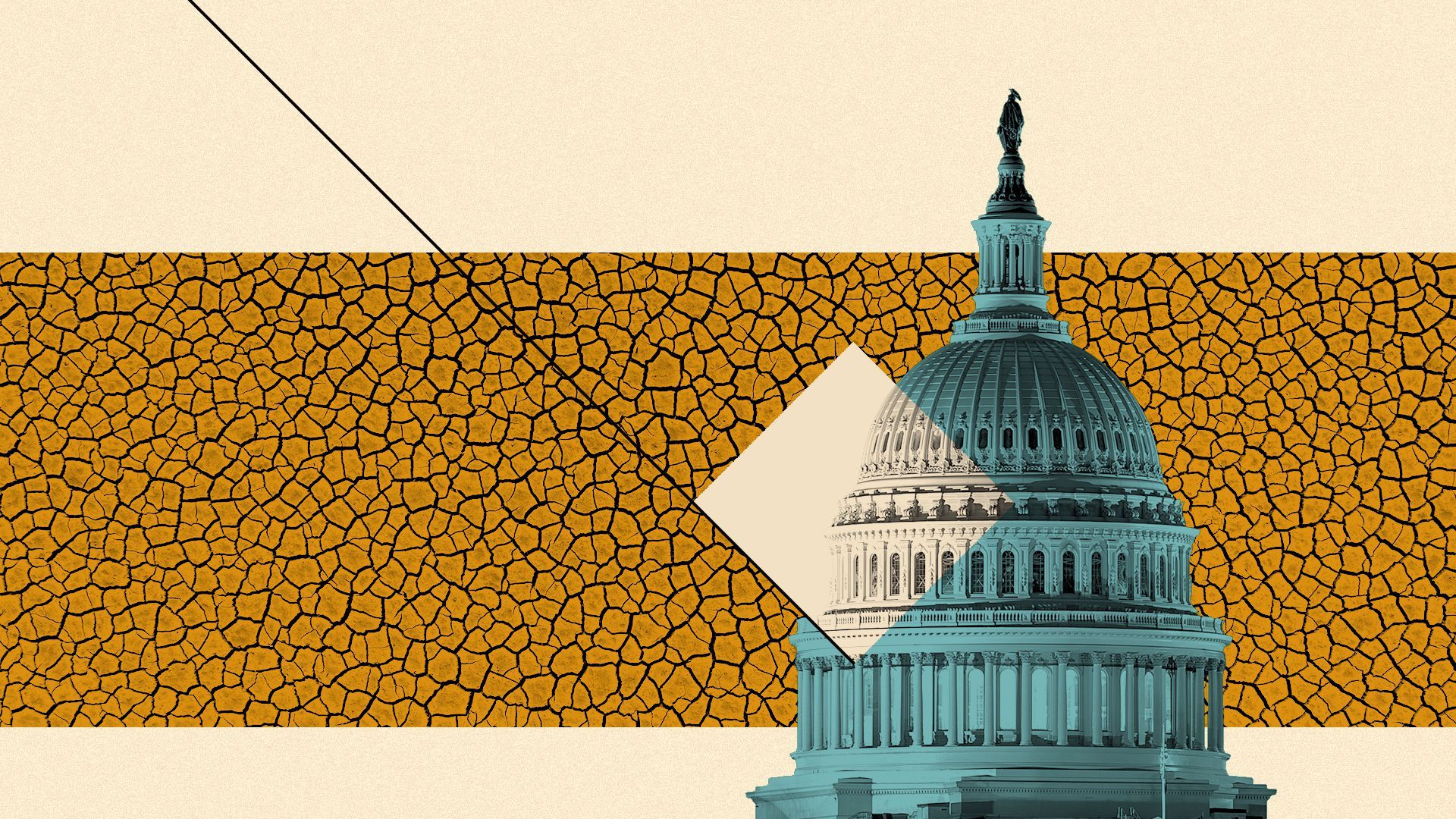
Investments in red states and Trump-friendly messaging are proving no match for a perfect political storm that's blowing apart federal support for wind and solar.
Why it matters: While the GOP budget bill spares incentives for some kinds of tech, it quickly ends the main tax credits for those two sources — and adds new taxes.
- Analysts say the provisions will sharply cut project growth.
Catch up quick: The Senate plan cuts off investment and production tax credits for wind and solar projects that don't begin operating by the end of 2027.
- And a surprise addition late Friday imposes new taxes on many future projects that use materials traceable to China.
State of play: Despite hopes for friendlier terrain than the House, the Senate bill got progressively worse for the industry, despite analyses showing jeopardy for red state investments and jobs.
- While renewables have enough GOP support in the narrowly divided House and Senate to give backers leverage, it wasn't atop the political radar.
- "I think the biggest problem for the clean energy credits is that they are a lower priority for the moderates than Medicaid in the Senate and SALT in the House," Jeff Navin, a partner at clean-tech lobbying and advisory firm Boundary Stone Partners.
Friction point: "The Freedom Caucus is going to have to swallow compromises on those issues, and they need something in return. The clean energy credits are something they want gutted, regardless as to their impact on the deficit," Navin told me via email.
Between the lines: Political temperament matters, too.
- "In addition to being political moderates, the moderate are moderate by deportment. They want to work things out, to be part of an agreement," Alex Flint, a former senior GOP Senate aide, tells me via email.
- "On the other hand, the far right are combative — they don't like government and are ungovernable — so, to date, they have been a bigger threat to a deal," adds Flint, executive director of the Alliance for Market Solutions.
The big picture: Another factor? It's President Trump's GOP.
- Trump is especially against wind power, which he's been criticizing sharply for years. Politico reported that Trump directly urged Senate Majority Leader John Thune to quickly end solar and wind incentives.
- The dynamic for EVs is similar, with Trump campaigning on pledges to scuttle federal support.
The intrigue: Some other kinds of clean tech have backing from the oil and gas industry, like hydrogen (which won a limited reprieve), geothermal and carbon capture.
- Wind and solar also had opposition in the ferocious lobbying fight over the bill. The NYT looks at the crosscurrents and zooms in on fossil fuel advocate Alex Epstein's role (though he opposes the new tax on projects).
The bottom line: The overlapping political problems and lobbying headwinds were simply too much — even as clean tech industries have ditched climate messaging and played up their contribution to Trump's "energy dominance" goal.
2. ☀️ Sizing up the Senate's new renewables tax
Analysts are taking initial stabs at how new taxes on wind and solar projects in the Senate's budget bill could affect the sector.
Why it matters: The provision comes in addition to quickly phasing out existing tax incentives for those renewables.
- The surprise new tax on projects with components or products linked to China surfaced in a revised bill late Friday night.
What they're saying: "We estimate that this new tax on wind and solar would increase the cost of wind and solar by 10-20% (depending on the pace of cost reductions for these technologies) — which comes on top of losing the tax credits," the Rhodium Group said in a quick take on the new provision.
- Princeton's Jesse Jenkins similarly estimates that in addition to quickly ending existing credits, the new provision could raise taxes on utility-scale solar projects by 18%.
- He also sees new tax increases of 13.5% for rooftop solar and 11% for wind projects.
The other side: GOP Senate Finance Committee Chairman Mike Crapo, on the Senate floor last night, praised the wider bill.
- "We stop penalizing fossil fuels in favor of unreliable and expensive green energy, and instead support consistent energy sources, making energy affordable again," he said.
What we're watching: Potential amendments on the tax and other provisions as senators debate on the floor today.
3. 🤝 Google strikes fusion power deal
Breaking: Google inked a power purchase deal with Commonwealth Fusion Systems and boosted its investment in CFS, which hopes to produce commercial-scale energy early next decade.
Why it matters: It's Google's first energy procurement deal with a fusion company.
- It shows how Google — and other hyperscalers — are eyeing a suite of technologies to help meet AI's voracious power needs.
State of play: The agreement announced this morning is for 200 megawatts of power from CFS' planned reactor in Chesterfield County, Virginia.
- It also gives Google rights to power offtake from additional CFS reactors.
- And Google is growing its stake in CFS, which it first started funding in 2021, but the companies aren't disclosing terms.
- CFS, an MIT spin-out founded in 2018, has raised over $2 billion.
The big picture: Google has been doing renewables purchase deals since 2010.
- It has branched out to other sources, too, like geothermal and batteries.
- That now includes advanced nuclear, with separate support for deploying small modular reactors in the future.
What we're watching: One of the tech giant's north stars is operating on zero-carbon power around the clock.
- "In 2024, we achieved approximately 66% global average carbon-free energy across our data centers and offices," Google said in a report last week.
The bottom line: Google calls fusion a bet worth taking, despite uncertainties, head of advanced energy Michael Terrell told reporters Friday.
- "Yes, there are some serious physics and engineering challenges that we still have to work through to make it commercially viable and scalable, but that's something that we want to be investing in now to realize that future," he said.
4. 🎒 Millions of kids attend school in "urban heat zones"


Most K-12 public students in the biggest U.S. cities attend schools in extreme urban heat zones, a new analysis finds.
Why it matters: The heat island effect can make some neighborhoods notably warmer than others, especially during heat waves.
- Many schools lack adequate air conditioning, jeopardizing students' health and learning abilities in periods of extreme heat.
Stunning stats: About 76% of public K-12 students in the 65 most populous U.S. cities attend schools where the heat island effect increases temperatures by at least 8°F, per a new analysis from Climate Central.
Threat level: Some districts had early dismissals, canceled classes, or even ended the school year early amid the recent heat wave, The Hill reports.
- "Tens of thousands of public schools" need new or upgraded HVAC systems to meet increased cooling needs, per a 2024 Center for American Progress report.
- Urban heat islands are more common in lower-income and non-white neighborhoods, researchers have found.
What's next: Some cities are trying to alleviate heat islands — by planting trees and using reflective road paint, for example — albeit with mixed results.
5. 💬 Quote of the day: COP30 drama edition
"Anyone who wants a trade deal with Trump can't show up touting their climate credentials."— Mohamed Adow, director of Power Shift Africa, speaking to Bloomberg
That's part of a wider look at the political and financial crosscurrents facing November's annual UN climate summit in Brazil.
📧 Did a friend, colleague or an AI chatbot send you this newsletter? Welcome, please sign up.
🙏 Thanks to Chuck McCutcheon and Chris Speckhard for edits to today's edition, along with the brilliant Axios Visuals team.
Sign up for Axios Generate


/2025/06/28/1751110310814.gif?w=3840)