Axios Generate
July 08, 2025

✅ Tuesday. We'll get rolling with some tech news and then roam widely around the beat, all in just 1,333 words, 5 minutes.
🎧 At this moment in 2006, Nelly Furtado and Timbaland ruled the Billboard Hot 100 with today's irresistible intro tune...
1 big thing: A double-barrel pitch to hyperscalers — power and CO2 removal

Arbor, a startup that promises both CO2 removal and clean baseload power, just announced $41 million in offtake deals as it courts hyperscalers' growing energy needs.
Why it matters: The contracts for 116,000 tons of CO2 removal between 2028 and 2030, for buyers working through the Frontier consortium, comprise Arbor's biggest deal yet.
- It's one of the "anchor agreements" that will help the 3-year-old startup finance and build its first commercial-scale plant near Lake Charles, Louisiana, CEO Brad Hartwig tells me.
Driving the news: Buyers include Stripe, Google, Shopify, McKinsey, Autodesk, H&M and various others.
- The new deal follows a much smaller agreement with Microsoft last year.
How it works: Arbor is a bioenergy with carbon capture (BECCS) startup, using waste biomass that will initially come from forest management.
- But it's an evolution of BECCS, with 99% capture and high efficiency, a blog post states.
- Its process first gasifies biomass, then burns that gas in a special furnace with pure oxygen ("oxy-combustion"), producing water but also "supercritical" CO2 that drives a turbine.
- This simplifies and reduces CO2 capture costs, and the water can be used for irrigation or data center cooling, Arbor and Frontier said.
Reality check: First-of-a-kind hardware systems often don't survive the journey to commercial deployment or scale.
- But Hartwig sees Arbor's system among the energy sources that stand to benefit from the AI boom.
- "Demand for carbon-free energy is just accelerating at rates that are completely unprecedented, and we have a pretty unique technology stack that can deliver 24/7, carbon-free energy that is cheap and firm," he tells Axios.
What we're watching: "We've gotten a lot of interest from a whole host of folks, from hyperscalers to regulated utilities looking to develop projects for matching supply with load for data centers," Hartwig said.
The intrigue: I asked Hartwig whether Trump 2.0's reversal of climate policies creates headwinds, and he argued the opposite, citing "real interest in baseload power that can add to grid resilience."
- He also said behind-the-meter deployments are possible, avoiding the need for transmission or waiting in interconnection queues.
State of play: "Its compact design features an 18 MW turbine about the size of a car engine, allowing for efficient scaling and cost reductions," the announcement states.
- Its modular system and oxy-combustion tech don't produce exhaust or pollution, avoiding the cost of adding separate CO2 capture units.
- Scaling the technology provides an eventual pathway toward getting under $100/ton of removal, the post states.
- The tech also works using natural gas, which would provide power with CO2 capture, but it's not removal without the biomass.
The bottom line: "The demand from AI is a big part of helping pull technologies like ours across the development valleys of death, to get a new technology into the world," Hartwig said.
2. 🚗 On my screen: EV charging pollution

Elevated levels of fine particulates around EV fast-chargers are a "previously overlooked source of air pollution," a new peer-reviewed analysis finds.
Why it matters: Fine particulate matter harms people's respiratory and cardiovascular systems.
- Engineering controls and rules around this pollution are needed as fast-charging expands, UCLA researchers say in their paper in Environment International.
The big picture: It analyzed air quality around 50 chargers in LA County and compared it to urban sites nationwide.
- The results showed fine PM concentrations of 7.3 to 39.0 micrograms per cubic meter at chargers, compared to 3.6 to 12.4 in the non-charger sample.
How it works: The likely culprit is "particle resuspension" from chargers' power cabinets.
- Fine PM previously deposited on surfaces is kicked up mechanically through the conversion of alternating current to direct current, and from cooling fans.
The bottom line: "[M]anaging particle resuspension is crucial for improving air quality and protecting public health as transportation electrification advances," the paper states.
3. 👞 The next IRA shoe just dropped
/2025/07/08/1751969079060.gif?w=3840)
President Trump ordered the Treasury Department to take a hard line on the new budget law's phaseout of solar and wind credits.
Why it matters: His new executive order could make it even harder to access incentives under the law, which now requires projects to start construction within a year and begin operating by the end of 2027.
Driving the news: The memo yesterday demands that Treasury "strictly enforce" the construction deadline by "preventing the artificial acceleration or manipulation of eligibility," among other provisions.
- It also calls on Treasury to enforce provisions that thwart credits if projects have certain corporate or supply chain ties to China.
Catch up quick: Trump pledged tough executive actions to help ensure House conservatives voted for the Senate-passed bill, which took a slightly softer approach.
What they're saying: Trump's move on the construction deadline has the "obvious intent of raising that standard to impede credit access," TD Cowen Washington Research Group said in a note.
- The overall order seeks to impose constraints that are similar to the initial, more aggressive House plan, it writes.
What we're watching: Lobbying and potentially legal battles as Trump seeks restrictive implementation of the new law.
4. 🎽 Catch up quick on oil and gas
🇱🇾 Shell and BP are weighing new opportunities in Libya "as international oil majors step up their return to the North African country more than [a] decade after it collapsed into civil war," the FT reports.
🆕 BP appointed former Shell CFO Simon Henry to its board as it pivots back toward emphasis on its core oil and gas business. Bloomberg has more.
🏁 Chevron is "laying the groundwork to swiftly close" its acquisition of Hess ahead of a looming arbitration decision on Exxon's challenge over assets in Guyana, Reuters reports.
5. 🏃 Catch up quick on policy: DOE, Texas, coal

⚡ The Trump administration predicted yesterday that the risk of blackouts could become 100 times greater if planned fossil-fuel power plant closures remain on schedule.
- Why it matters: The Energy Department report lays the statistical groundwork to continue its efforts to keep coal and natural gas plants open beyond their scheduled shutdown dates.
- The other side: The DOE study "appears to exaggerate the risk of blackouts and undervalue the contributions of entire resource classes, like wind, solar, and battery storage," said Caitlin Marquis, managing director at the industry group Advanced Energy United.
- Go deeper: Unlock more coverage of the report, and if you need smart, quick intel on energy and climate policy for your job, get Axios Pro Policy.
📝 Chuck Schumer, the Senate's top Democrat, is asking the Commerce Department's inspector general to probe whether National Weather Service staffing shortages "contributed" to the loss of life in the Texas floods.
- The other side: Trump officials have pushed back on questions about NWS performance and accused critics of politicizing the disaster.
⛏️ Via AP, the Interior Department "took a first step toward reopening vast areas of public lands" to new coal leasing in Wyoming and Montana.
6. 🤷 Musk is gonna Musk

Elon Musk's empire isn't exactly crumbling, but it looks increasingly vulnerable as his falling out with President Trump intensifies.
- 📉 Tesla shares fell another 6.8% yesterday after Musk said he'd launch a new political party, the America Party.
- 🧯They're now down 14% since he first publicly blasted the "big, beautiful bill" in early June, which quickly spiraled into a full split with the administration.
Between the lines: Investors who were counting on favorable regulatory treatment for Tesla and a continued flow of government contracts for SpaceX now have reason to question where they stand.
- 🤖 Now is a critical time: Tesla just began rolling out robotaxis, a service it deems critical to its future, and faces mounting global competition from the likes of Chinese EV maker BYD.
💰 The bottom line: Musk is personally out nearly $20 billion — at least on paper — since breaking with Trump last month, and his investors are out more than $100 billion.
- Musk recently declared he was effectively done with politics and would refocus on his companies — but that pivot didn't last long.
7. 🧮 Number of the day: -39%
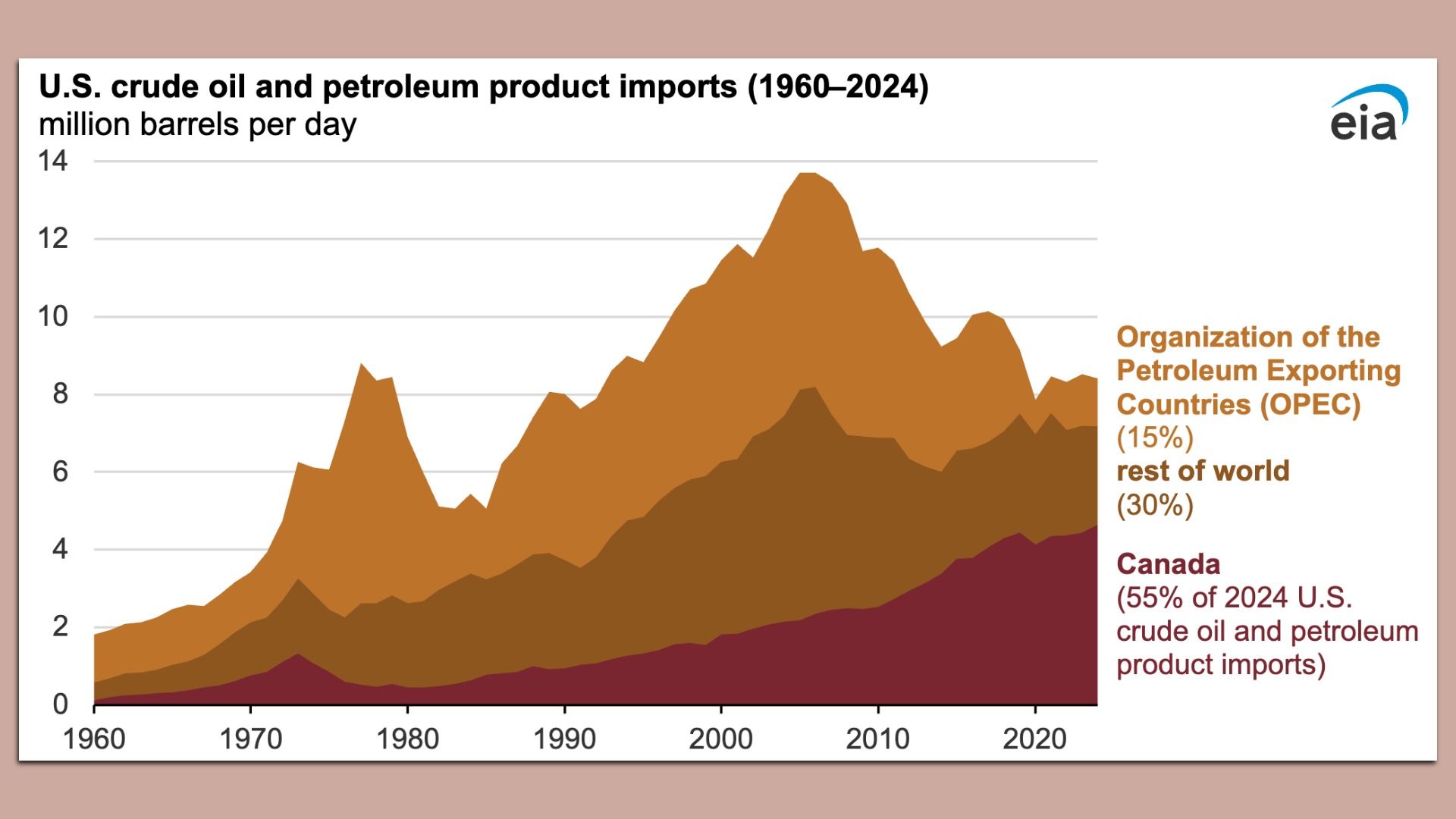
That's the decline in U.S. crude oil and petro-product imports from 2006 through 2024 as domestic output surged, per this EIA primer.
The big picture: Widening the lens, imports met 17% of total U.S. energy needs last year, the lowest since 1985, as traditional and renewable domestic sources alike set a record.
📧 Did a friend, colleague or an AI chatbot send you this newsletter? Welcome, please sign up.
🙏 Thanks to Chuck McCutcheon and Chris Speckhard for edits to today's edition, along with the brilliant Axios Visuals team.