Axios Generate

May 20, 2025

👀 Today we've got an exclusive look at new power projections, a quick breakdown of huge news in the renewables world, and plenty more. It's all a quick 1,211 words, 4.5 minutes.
🎙️ Bulletin: EU officials today unveiled what they called their largest-ever package of sanctions against Russia's "shadow fleet" of oil tankers.
🎶 Happy 35th birthday to Soul II Soul's album "Vol. II: 1990 – A New Decade," which provides today's intro tune...
1 big thing: An exclusive look at the evolving U.S. power future
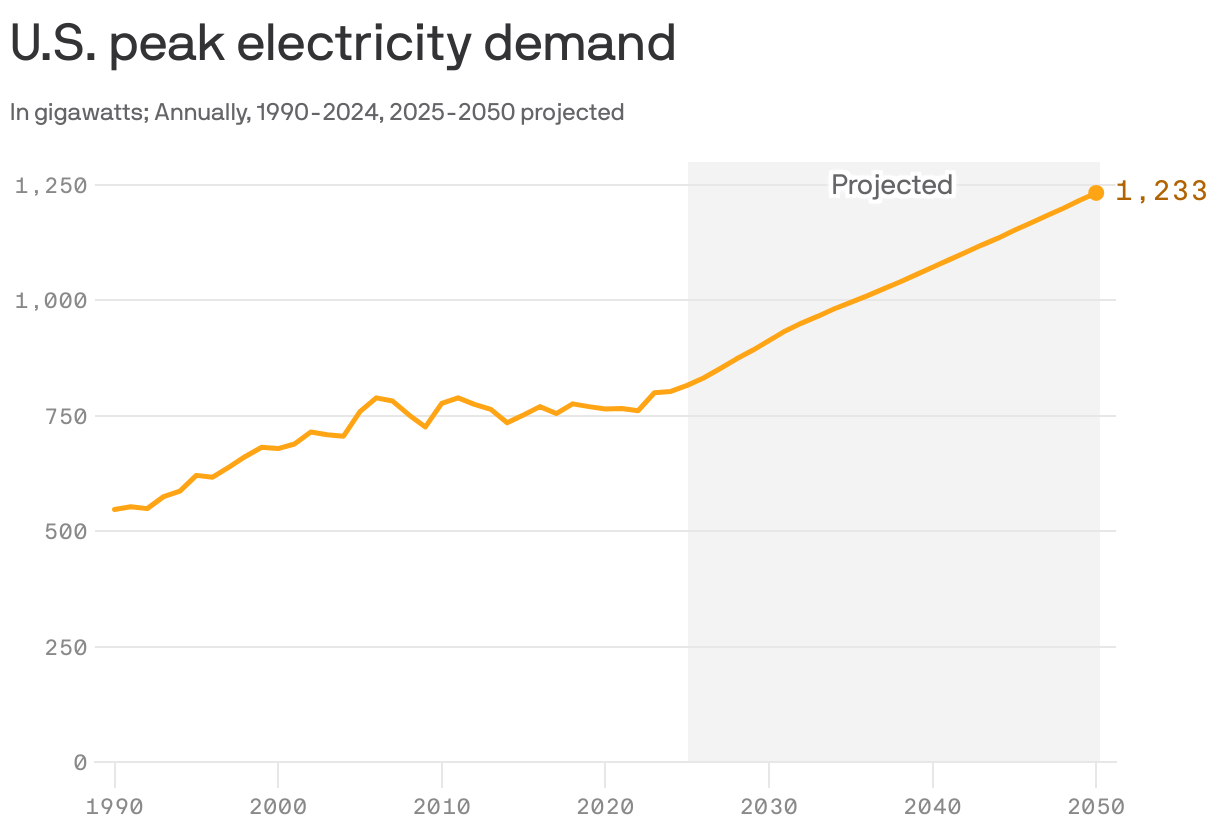
First look: U.S. electricity needs are slated to rise 25% by 2030 and 78% by 2050 compared to 2023, sinus-clearing estimates from the consulting firm ICF seen first by Axios show.
Why it matters: The projections — which also show rising demand peaks where grid strains are most acute — are higher than a number of other studies.
- It underscores how companies and regulators must scramble to keep pace with the changing landscape.
- AI and cloud-computing growth, new manufacturing, crypto-mining, EVs and broader electrification are all pushing needs higher.
The big picture: A wide array of fuels and demand management approaches are needed to meet the country's power appetite, it argues.
- "Meeting this demand will take a coordinated effort from across the energy sector on an 'all-of-the-above' strategy that invests in a broad mix of solutions," Anne Choate, ICF's executive VP for energy, environment and infrastructure, said in a statement.
- The report also offers ideas for industry and regulators to improve their planning.
Threat level: The consumption surge could raise retail rates by 15% to 40%, depending on the market, ICF finds.
- Demand management, efficiency and behind-the-meter tech (think home solar and storage) will be key to mitigate price spikes, ICF said.
- "Broad promotion of these programs could help meet 10% or more of electricity demand by 2030 compared to 8% in 2025."
Stunning stat: On the generation side, new power-producing capacity additions need to rise to roughly 80 gigawatts per year from 2025-2045 — around double the pace of the past five years.
The intrigue: Forecasts are changing fast.
- The report notes that the U.S. Energy Information Administration's 2025 annual outlook saw a 12% demand rise in 2030 in their "high" economic growth case and 9% in their "reference" case.
- But adding newer data from regional grid planners — including PJM, ERCOT, MISO and parts of SERC — paint a very different picture, ICF said.
- The ICF numbers are eye-popping and above some other analyses too, but not unprecedented.
State of play: "The Dominion service territory within PJM, Southern Company service territory within SERC, and ERCOT West zone in West Texas are among the areas expected to have the highest growth," ICF finds.
- What's driving it varies. In California, 35% of the increase through 2040 is EVs, building electrification and data centers.
- In Texas, new "large loads" like crypto-mining are a bigger deal. In PJM, the huge mid-Atlantic and Midwest region, it's a combo of new manufacturing (including semiconductors), data centers, building electrification, EVs and more.
Yes, but: "Uncertainty abounds," with variables including...
- AI's future efficiency.
- Effects of tariffs on U.S. manufacturing.
- The fate of federal energy tax subsidies.
- How much behind-the-meter tech is used at large new demand centers.
What we're watching: Whether other analysts produce updated estimates consistent with ICF.
2. 🔍 Trump's offshore wind reversal: what we know
By now you've probably read that Trump officials just lifted the stop-work order on Equinor's Empire Wind project off New York's coast.
- So let's look at how it went down and what it means going forward.
Why it matters: The April order sent shock waves through the industry, raising the prospect that other big projects already under construction might face jeopardy.
State of play: Some early nuggets from the Interior Department's dramatic reversal...
💼 There's been lots of diplomatic action around the Norwegian multinational's project.
- Finance Minister Jens Stoltenberg "raised the situation with the U.S. administration," Equinor CEO Anders Opedal said in a wider statement.
- There was "ongoing dialogue" with National Economic Council director Kevin Hassett and Treasury Secretary Scott Bessent, Stoltenberg told Bloomberg.
🤔 It might be about natural gas, too. Interior Secretary Doug Burgum, on X last night, said, "I am encouraged by [New York] Governor Hochul's comments about her willingness to move forward on critical pipeline capacity."
- "The deal could revive plans to build a gas pipeline from Pennsylvania's drilling fields which was blocked on environmental grounds in 2020," Reuters reports.
🎭 There was high drama. Molly Morris, president of Equinor Renewables Americas, had told news outlets earlier in May that the company might imminently cancel the project, citing $50 million in weekly costs.
3. 🚗 A new poll shows Tesla's sinking rep

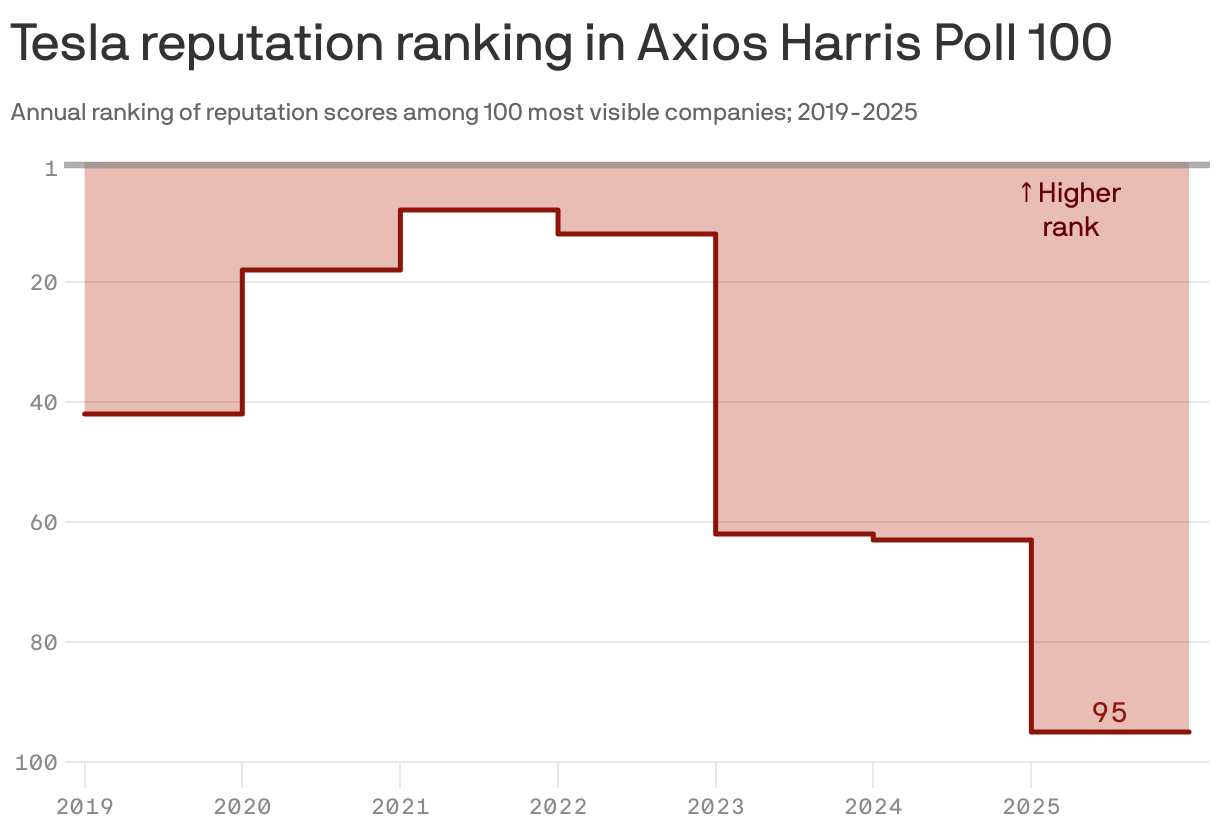
Tesla Motors and SpaceX saw their brand reputations crater in the past year, according to new Axios Harris Poll 100 survey results.
Why it matters: Elon Musk's polarizing political activism appears to have come at the expense of his largest companies, as Republicans expressed more favorable opinions than did Democrats.
By the numbers: Tesla was in 8th place in the 2021 reputation ranking of America's 100 most visible companies, but last year tumbled to 63rd and now is near the very bottom at 95th.
- Six other automakers place higher, with the highest being Toyota at No. 6 and the lowest being Ford at No. 62.
4. 👟 Catch up quick on policy: LNG, IRA, EPA

✅ The Energy Department said it has "completed the final hurdles left over" from the Biden-era pause on new LNG export approvals, allowing it to "fully return to regular order."
- Why it matters: The agency posted its formal response to comments on the late 2024 Biden team analysis, and says what's now a "complete record" shows that exports are in the public interest.
- What we're watching: Whether the bureaucratic box-checking helps insulate approvals from legal challenge.
🥊 The future of IRA energy incentives hangs in part on a fight this week between GOP hardliners and moderates.
- Why it matters: House Republicans, who promised for months to approach the IRA with a scalpel, appear increasingly willing to use a sledgehammer.
- Driving the news: Conservatives say they're angling to amend the reconciliation package to further curtail clean energy credits before the bill hits the House floor this week.
- Go deeper: Unlock the whole story, and if you need smart, quick intel on energy and climate policy for your job, get Axios Pro Policy.
💰 Via Politico, "A panel of appellate judges on Monday appeared skeptical of EPA's reasons for terminating $20 billion in Biden-era climate grants, but it indicated the dispute could end up in a different court.
5. 🏃 Catch up quick on tech: CO2 removal, EVs, lithium

🤝 Breaking: Carbon removal developer CO280 inked a 450,000-metric-ton offtake deal with JPMorganChase, at under $200 per ton, for CO280's project at a Gulf Coast pulp and paper mill.
- Why it matters: CO280 has now sold all the removal credits from the planned project following separate deals with Microsoft and the Frontier consortium, a rep said.
🚐 Indigo Technologies is preparing to raise a $300 million Series C to build electric delivery vans and taxis equipped with a motor and suspension in every wheel, Axios Pro Deals scooped yesterday.
- Why it matters: The startup is skipping individual buyers to chase fleet customers — a pivot shaped by earlier EV startup failures.
- Go deeper: Unlock the whole story, and for a steady diet of scoops and smart analysis, talk to our sales team about Axios Pro Deals.
🇨🇱 Mining giant Rio Tinto is investing nearly $1 billion as part of a joint venture with Chile's Codelco to develop a major lithium deposit there.
- Why it matters: The FT reports that it's the "biggest foreign investment in the [country's] sector since Santiago semi-nationalised its lithium mining industry two years ago."
6. 🧮 Number of the day: -30%
That's how much Honda is trimming planned investments in electrification through 2031.
- Why it matters: The auto giant cited a "slowdown in the expansion" of EV markets. Full strategy announcement.
📧 Did a friend, colleague or an AI chatbot send you this newsletter? Welcome, please sign up.
🙏 Thanks to Chris Speckhard and Chuck McCutcheon for edits to today's edition, along with the brilliant Axios Visuals team.
Sign up for Axios Generate


/2025/05/20/1747740238028.gif?w=3840)