
Axios Generate

September 27, 2022
๐ Off we go! Today's newsletter has a Smart Brevity count of 1,259 words, 5 minutes.ย
๐ Today: Join Axios Pro Climate Tech reporter Alan Neuhauser at 12:30pm ET for a virtual event with Energy Department Loan Programs Office head Jigar Shah. Register.
๐ถ This week in 1994, Massive Attack released their sophomore album "Protection," which provides today's intro tune...
1 big thing: Fierce Hurricane Ian takes aim at Florida
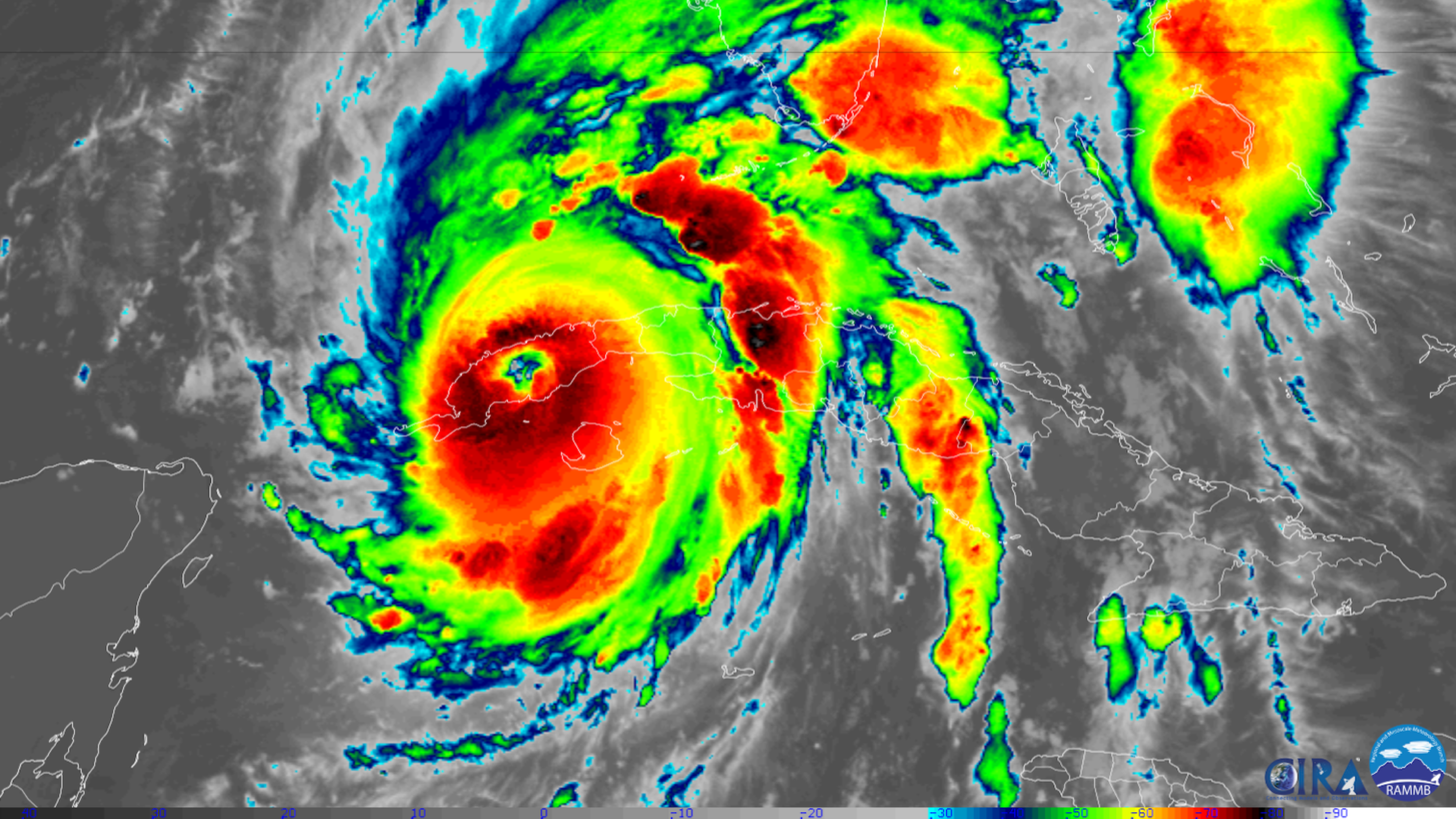
Satellite image of Hurircane Ian, at Category 3 intensity, over western Cuba this morning. (CIRA/RAMMB)
Hurricane Ian rapidly intensified overnight, reaching Category 3 intensity, with a further ramp-up to a Category 4 forecast by this evening, Andrew writes.
The big picture: The storm's track, toward a major hurricane landfall in southwest Florida, near Tampa, and an anticipated slowdown in its forward speed during the next few days, make this an especially dangerous event.
- This includes power outages that may be extended for more than a week in some areas, due to the duration of hurricane-force winds.
Threat level: One of the biggest threats is storm surge flooding at the coast, which has prompted mandatory evacuations in some areas.
- A storm surge warning is in effect for a heavily populated stretch of coastline that includes Tampa Bay, Fort Myers, Naples, Port Charlotte, St. Petersburg and Sarasota.
- The National Hurricane Center highlighted the risk of a โlife-threatening storm surge,โ particularly between Fort Myers and Tampa Bay, this morning.
- A storm surge of up to 10 feet of water above normally dry ground is forecast in Tampa Bay.
Climate change-related sea level rise is making surge-related flooding more damaging. Population growth along the coast is another threat amplifier.
Context: Hurricane Ian has been rapidly intensifying over extremely warm sea surface temperatures in the Caribbean that are running above average for this time of year.
- Climate change favors more instances of rapidly intensifying storms such as Hurricane Ian, due to the combination of warming seas and a warmer atmosphere that can carry additional amounts of water vapor.
- Several studies have shown this, including one in Nature in 2019 that found the Atlantic has seen more rapidly intensifying storms between 1982 and 2009, which the study stated was unlikely to be due to natural factors alone. Other research has come to similar conclusions.
- Climate change is also linked to an increase in rainfall from tropical storms and hurricanes.
Hurricane Ian is taking an uncommon path.
- The history of major hurricanes crossing the coast within 115 miles of Tampa shows the most recent direct hit in Tampa occurred 101 years ago, with a major hurricane landfall in Sarasota last occurring in 1944.
- The Tampa metro region has grown tremendously since these storms, going from tens of thousands of residents in 1921 to 3.2 million today.
- If the storm hits further south, the most recent analog might be Hurricane Charley in 2004, which caused $14 billion (in 2004 dollars) in damage.
Yes, but: The NHC cautions that there is still above-average uncertainty over the path of the storm after 48 to 72 hours from now, and slight changes in storm movement will have major consequences for where the storm strikes.
The bottom line: Florida is in for a potentially historic storm that could cause billions in damage.
2. The ripple effects of Europe's energy crisis


Russia's unprovoked war on Ukraine is creating a huge drag on the global economy, and the commodity shock driven by the crisis is a big reason, the OECD said, Ben writes.
Driving the news: The organization projects global growth at 3% this year (sticking with a downgraded estimate from June), but their latest outlook sees that slowing next year to 2.2%, far below their last guess.
Why it matters: "Inflationary pressures are broadening out beyond food and energy almost everywhere, with businesses throughout the economy passing through higher energy, transportation and labour costs," it finds.
Zoom in: The chart above shows the surge in European natural gas prices and the electricity cost surge in Germany, Europe's largest economy. Power prices have also surged elsewhere in the bloc.
Threat level: While energy prices have eased somewhat and EU countries have boosted gas storage, the analysis sees downside risks including more energy and food price spikes.
If more hoped-for gas supplies from outside Europe don't materialize, countries fail to cut consumption, and winter is especially cold, there's a risk many EU countries could fall into recession. Go deeper.
3. ๐๐ฝโโ๏ธCatch up fast on tech: EVs, CO2 data, storage

Illustration: Sarah Grillo/Axios
๐ Hertz and BP's charging arm plan to install a "national network of EV charging solutions for Hertz and its customers," they said this morning, Ben writes.
- Why it matters: For Hertz, it's part of a deepening push into EVs. Hertz last week said it would buy 175,000 EVs from GM, which follows prior deals announced with Tesla and Polestar.
- The intrigue: For BP, it's the latest move in its diversification outside its core oil and gas business. This plan unites Hertz and the company formerly known as Amply Power, which BP acquired last year and has rebranded as BP Pulse.
๐งฎ The carbon accounting platform Sweep has rolled out "Sweep for Finance," a tool tailored specifically for banks and other financial institutions to track emissions from their portfolio companies and help reduce them.
- Why it matters: Financial players are under increasing pressure to make their assets greener โ and show their work. For instance, brewing SEC regulations will impose new emissions reporting mandates.
๐ผ The Swiss direct air capture company Climeworks has registered U.S. lobbyists for the first time, retaining the clean energy-focused firm Boundary Stone Partners, a filing shows.
- What's next: Boundary Stone's work is expected to include "at-scale deployment of DAC, carbon dioxide removal, federal permitting, [and] establishment of voluntary carbon markets," it states.
๐ฐ Hammerhead Resources, a Calgary-based oil and gas developer, has entered into a SPAC merger with Decarbonization Plus Acquisition Corp. IV that values Hammerhead at roughly $1 billion.
- What's next: Hammerhead says it plans to invest roughly $176 million in CO2 capture and storage between 2023 and 2029.
4. ๐ The permit bill's first test arrives today

Illustration: Annelise Capossela/Axios
The Senate is slated to take a procedural vote today on a government funding package that includes Sen. Joe Manchin's proposal to speed up permitting for fossil fuel and clean energy projects, Ben writes.
What we're watching: It's unclear whether the plan has anywhere near the 60 needed votes to move into formal floor debate.
- "[I]t appears increasingly unlikely that the stopgap [funding] bill will advance with the permitting overhaul bill in tow," the NYT reports.
- Some progressive Democrats on both sides of Capitol Hill have balked at the proposal, and Manchin (D-W.Va.) will need a substantial number of Republicans to back the plan.
The intrigue: One thing that caught my eye was Rep. Sean Casten (D-Ill.), a climate hawk, voicing support despite some misgivings.
- "If we do not rapidly increase the rate of transmission deployment then we will not reach the full emissions reduction potential of the Inflation Reduction Act," he said in a statement.
- Meanwhile, the U.S. Chamber of Commerce, which has some sway with Republicans, called it "thoughtful legislation that makes material improvements to the permitting process."
5. Growing cities and growing climate risk
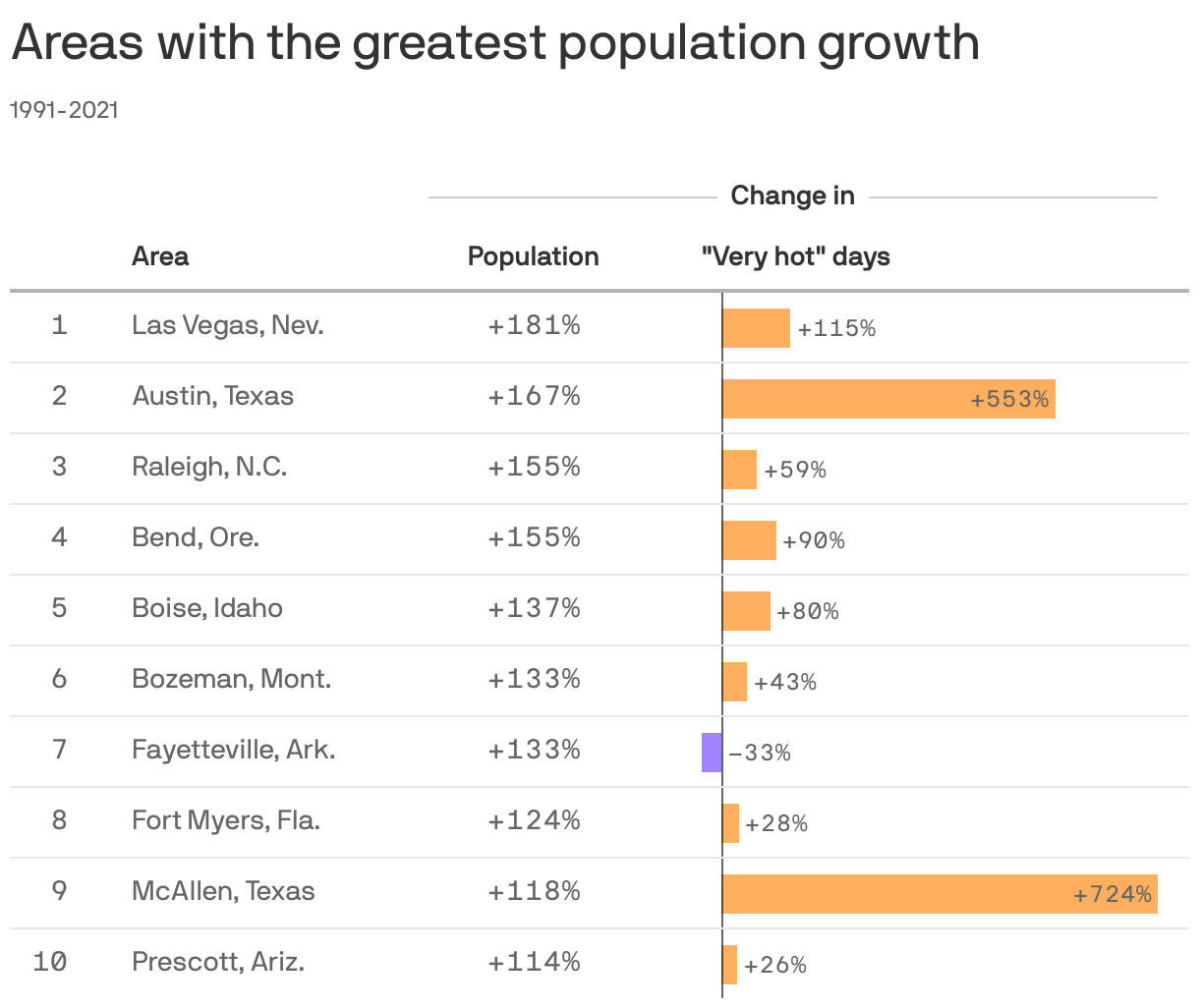
Almost all of the fastest-growing major metro areas across the U.S. are getting significantly hotter, and many are also at risk for other major natural disasters, Axios' Alex Fitzpatrick reports.
Why it matters: These long-term population trends will strain cities' water supplies, power grids and other utilities, and put lots of people at risk of heat-related health issues.
Zoom in: Nine out of the 10 of the fastest-growing U.S. urban areas have seen an increase in the number of "very hot" days between 1991 and 2020.
We defined "very hot" as days with a high temperature in the top 5% ever recorded for that particular city.
By the numbers: Las Vegas, Austin and Raleigh grew the fastest between 1991-2020, and have had increases in "very hot" days of 115%, 553% and 59%, respectively.
McAllen, Texas, has seen a staggering 724% hike in "very hot" days while its population grew by 118%.
What's next: Some cities, like Phoenix, are hiring "chief heat officers" and finding creative ways to keep the mercury down
๐ฌ Did a friend send you this newsletter? Welcome, please sign up.
๐Thanks to Mickey Meece and David Nather for edits to today's newsletter. We'll see you back here tomorrow!
Sign up for Axios Generate

Untangle the energy industryโs biggest news stories


