Axios Generate

March 27, 2025

🥲 Today's theme is mixed emotions, which oil execs have about Trump 2.0 policies. We explore this and plenty more, all in 1,133 words, 4.5 minutes.
📻 This week in 1986, Pet Shop Boys released their stunning debut album "Please," which provides today's intro tune...
1 big thing: The oil patch and Trump — it's complicated
Executives in heart of the U.S. oil patch offered a brutal — if anonymous — verdict on Trump 2.0 trade policies and the uncertainty they create for producers.
Why it matters: The Dallas Fed's latest survey highlights problems facing the White House's simultaneous push for a drilling surge, new tariffs, and lower costs.
- The overall industry is greeting Trump with a mix of elation and concern.
Driving the news: "'Drill, baby, drill' is nothing short of a myth and populist rallying cry. Tariff policy is impossible for us to predict and doesn't have a clear goal," said one exec quoted anonymously in the survey.
- "Uncertainty around tariffs and trade policy continues to negatively impact our business, both for mid- to long-term planning and near-term costs," said another, using the "u" word that surfaced a lot.
- Several said tariffs will raise steel costs, while others said the push for lower prices collides with a major oil output boost (a reminder U.S. production is already at record levels and still rising).
Threat level: "There cannot be 'U.S. energy dominance' and $50 per barrel oil; those two statements are contradictory," said one respondent.
- President Trump wants lower prices, and Energy Secretary Chris Wright told the FT he hopes shale producers could boost output even at $50 per barrel.
- But Wright says officials aren't targeting a specific price and that markets dictate it.
Catch up quick: The quarterly survey typically gets responses from 130-160-ish execs with companies in the Dallas Fed region — including the prolific Permian Basin.
- The comments capture vibes. But it has harder data on firms' price predictions, breakeven costs for existing wells, and plenty more.
- A majority of respondents see U.S. prices at $65-75 at the end of 2025.
- The Q1 edition finds a slight rise in industry activity but also a jump in the "uncertainty index" and that cost increases sped up.
Yes, but: A bunch of caveats here! The survey has praise for Trump moves, such as policies that are bullish for gas demand.
- And it specifically captures the views of onshore producers and service companies who largely operate on private lands.
- The wider industry embraces moves like renewed LNG export approvals, fewer regulations, more access to federal onshore and offshore regions, and more.
State of play: Taylor Rogers, a White House spokesperson, noted that Trump met last week with a large group of industry execs "who are eager to unleash American energy after four years of Biden's radical climate agenda."
- "For the first time in four years, representatives of the oil and gas industry were welcomed back to the White House," Rogers said.
- Tariffs weren't discussed at the meeting, a White House official previously told Axios.
The bottom line: Trump is unlikely to greatly speed up slow U.S. oil production increases — especially if trade wars crimp demand growth.
- But steps like expanded leasing in the Gulf of America (renamed by the U.S. from the Gulf of Mexico) and frontier areas in Alaska can lay the groundwork for big projects that take many years to come to fruition.
2. 🍰 Bonus: charting regulatory costs


This chart from the Dallas Fed survey shows that for many companies, regulatory costs aren't a massive part of their operating expenses.
Yes, but: They certainly affect the economics of oil and gas wells, especially if prices are projected to be around breakeven costs.
- For the whole Dallas Fed region — which includes Texas and parts of New Mexico and Louisiana — firms need an average WTI price of $65 per barrel to profitably drill new wells.
- But it varies by location, company size and more.
What we're watching: How Trump 2.0 efforts to pare back regulations, which the sector generally applauds, ultimately sway output decisions.
3. 📉 DOE mulls sweeping cuts to energy programs

The Energy Department is considering significant cuts to renewable energy, grid, and hydrogen grants, documents obtained by Axios show.
Why it matters: The documents outline hundreds of millions of dollars' worth of grants from the bipartisan infrastructure law and the agency's budget that could be peeled back.
- The proposals — in response to directives from President Trump and Elon Musk's DOGE to slash spending — appear to largely target blue states.
Driving the news: DOE is eyeing more than $900 million worth of cuts at the Office of Energy Efficiency and Renewable Energy, according to a spreadsheet.
- That would come mostly — but not entirely — from grants headed to blue states, including state and local governments, companies and universities.
The latest: The Office of Clean Energy Demonstrations, among the most targeted DOE portfolios, could eliminate all nine of its carbon capture demonstration and pilot projects, according to a third document.
- More than 60% of the industrial decarbonization demonstration projects are to be cut, according to the list.
The OCED document also suggests keeping three hydrogen hubs in Appalachia, Texas and the northern Midwest while cutting the other four.
- As Politico reported, that would essentially mean keeping the hubs in red states and nixing those that went to blue states.
Unlock the whole story, and if you need smart, quick intel on energy and climate policy for your job, get Axios Pro Policy.
4. 🌡️ March heads for second-warmest title
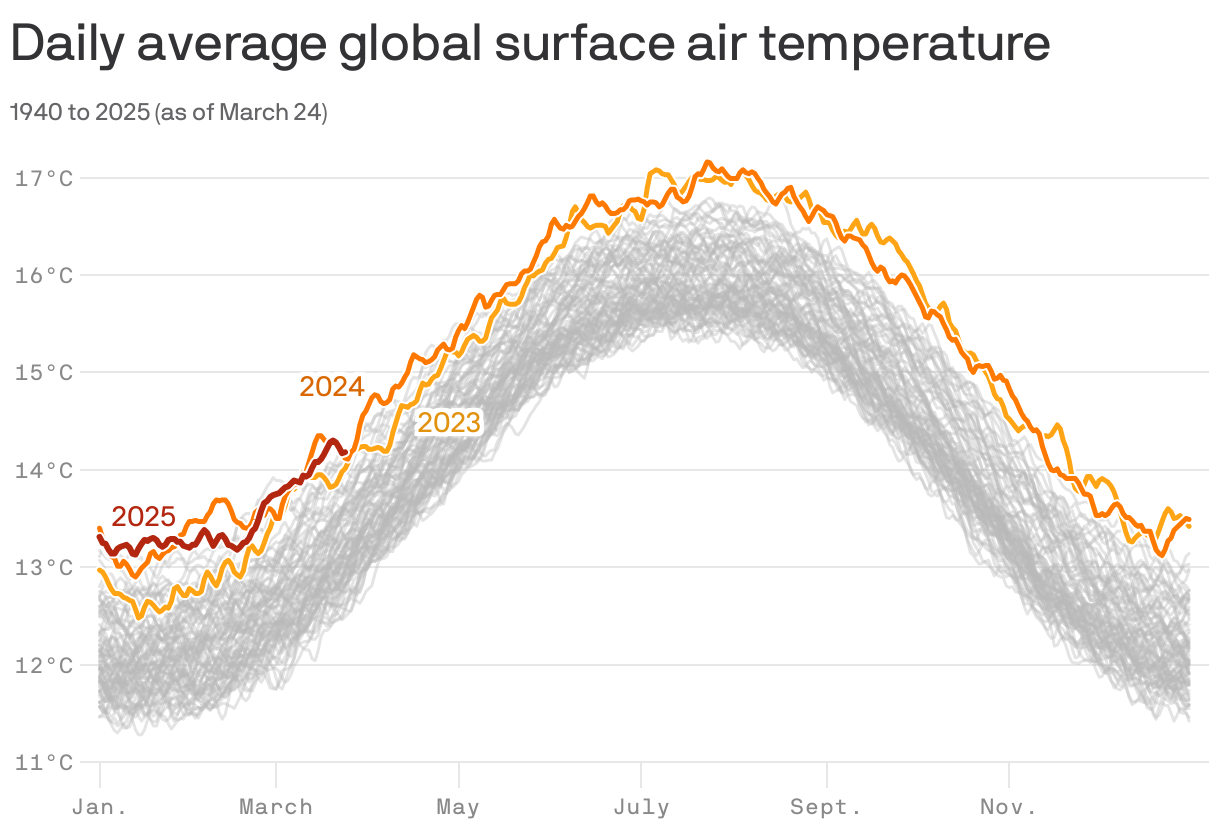
After the third-warmest February on record, global average surface temperatures have rebounded somewhat, with March likely ranking number two, preliminary data shows.
Why it matters: A La Niña event in the tropical Pacific is close to ending, which suggests the planet could see a slight bump up in global average temperatures during the rest of 2025.
- Many climate scientists don't expect this year to outdo the record warmth seen during 2023 and 2024, though some are warning of accelerated warming rates in recent years that could lead to surprises.
Zoom in: Global average temperatures are fueling extreme weather and climate events, including a deadly, record-breaking wildfire in South Korea.
- In addition, two separate and severe marine heat waves have led to serious coral bleaching events in both western and eastern Australia
5. 🚘 The EV makers avoiding Trump's new auto tariffs


President Trump's increased tariffs on imported vehicles will hit foreign automakers the hardest, though domestic automakers General Motors and Ford will also face a significant impact.
Why it matters: Experts expect automakers to raise prices to make up for at least part of the cost.
- The exact percentage increase will depend on each automaker's willingness to absorb tariffs, but analysts believe the average new vehicle price will increase by several thousand dollars.
What we're watching: The fuel and emissions fallout.
"[E]ven as rising fleet fuel economy and growing electric vehicle penetration crimp gasoline demand, higher purchase prices resulting from the tariffs could keep older, less-efficient cars driving longer on U.S. roads," ClearView Energy Partners said in a note this morning.
6. 🧮 Number of the day: -76%
That's the overall decline in sustainability-related terms — including climate and clean energy — surfacing on S&P 500 earnings calls over the past three years, per a new Bloomberg analysis.
📧 Did a friend, colleague or an AI chatbot send you this newsletter? Welcome, please sign up.
🙏 Thanks to Chris Speckhard and Chuck McCutcheon for edits to today's edition, along with the brilliant Axios Visuals team.