Axios Generate

August 08, 2022

🍩 Welcome back! This morning we're all about the action on Capitol Hill.
Today's edition, edited by Mickey Meece, has a Smart Brevity count of 1,005 words, 4 minutes.
📬 Did a friend send you this newsletter? Welcome, please sign up.
🎶 At this moment in 1998 the Beastie Boys ruled the Billboard album charts with "Hello Nasty," so we'll visit outer space with today's intro tune...
1 big thing: Why the climate bill's passage matters — and what's next

Illustration: Annelise Capossela/Axios
Congress is poised to pass the most important climate bill in U.S. history, the first step in a yearslong effort to transform the measure into a massive, real-world expansion of clean energy, Ben and Andrew write.
The big picture: If the House approves the Senate-passed bill unchanged, sending it to President Biden's desk, it has a plausible chance of slashing domestic emissions and resetting the dynamic in global climate talks.
Catch up fast: The Senate yesterday approved Democrats' energy, tax and health care plan on a party-line vote.
- That means the bill cleared its biggest hurdle — the same chamber where the last sweeping climate bill imploded in 2010.
- The measure is expected to pass the House and head to Biden's desk within days.
- It would invest roughly $370 billion in renewables, electric vehicles, hydrogen, clean energy equipment manufacturing, home efficiency, and other climate programs.
A few takeaways...
U.S. emissions may fall a lot. Energy analysts who favor strong climate action say the plan should bring the U.S. within shouting distance of Biden's pledge under the Paris Agreement: cutting domestic greenhouse gas emissions in half compared to 2005 levels by 2030.
It could change the tenor of global climate talks. The likely enactment of legislation to back up America's commitments would boost U.S. credibility to persuade other countries to take actions of their own.
But it's not the be-all, end-all. The U.S. will still come up short of the 2030 Paris pledge without complementary executive, state and local policies, per multiple analyses.
U.S. climate policy strongly favors carrots over sticks. The biggest climate provisions are major new or wider tax incentives rather than firm emissions targets with penalties.
- The separate bipartisan infrastructure law is also a cash infusion for programs on EV charging, transmission, and demonstrating emerging technologies.
- Meanwhile, a clean power mandate for utilities couldn't get past Sen. Joe Manchin (D-W.Va.), carbon pricing proposals have little traction, and a recent Supreme Court ruling will likely limit the breadth of executive regulations.
It's a complicated moment for activists. The bill mandates new oil-and-gas drilling auctions on federal lands and waters, despite Biden's campaign pledge to thwart new fossil fuel development in those areas.
It's complicated for the oil industry, too. Giants BP and Shell support the bill. But industry lobbying groups — the American Petroleum Institute and the American Exploration & Production Council — have criticized the corporate tax policies as a brake on investment.
2. Charted: The role of U.S. emissions
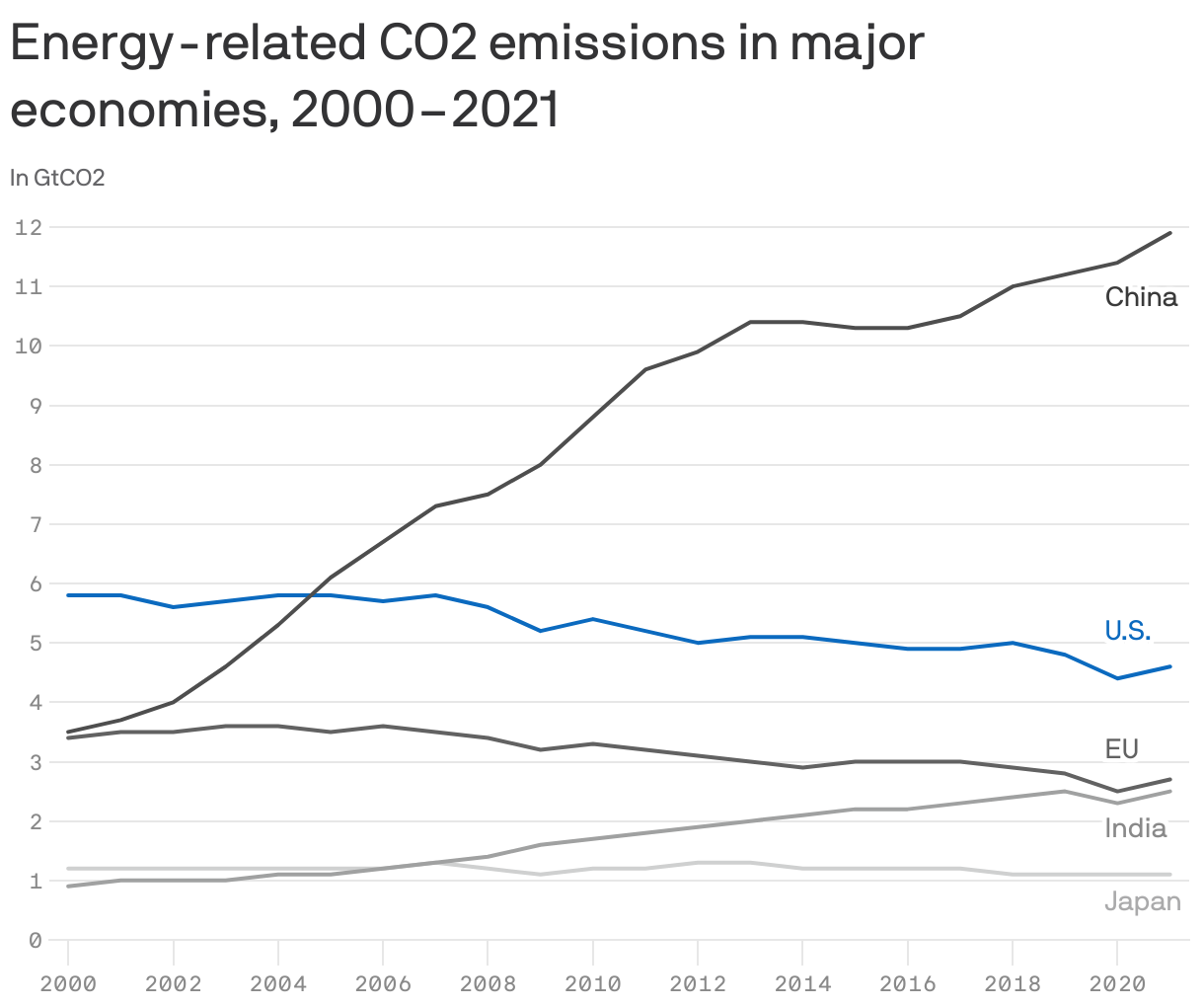
The U.S. is the world's second-largest carbon emitter behind China and the largest historical source of planet-warming gases, Ben writes.
Why it matters: The pathway of U.S. CO2 emissions is consequential in its own right and affects the country's leverage in global climate talks.
3. The climate bill's international ripple effect

Illustration: Rae Cook/Axios
Passing the bill is likely to slow the erosion of U.S. credibility on climate action and improve the odds of success for the next round of United Nation climate talks, Andrew writes.
Why it matters: The Senate vote and likely House passage of the bill bolster the credibility of America's emissions targets ahead of the next major climate summit in Egypt later this year.
- For the Glasgow Summit, the Biden administration committed to cutting emissions by 50% to 52% below 2005 levels by 2030. However, these have been resting on inadequate executive actions.
The big picture: The Paris Agreement rests on voluntary international commitments, which makes it more important for countries to translate their proposals into domestic law rather than relying on political promises alone.
Context: A development Down Under could add to the bill's influence.
- Australia — a longstanding holdout on stringent climate action, is poised to enact legislation committing to a 43% cut in its emissions below 2005 levels by 2030, and to net zero by 2050.
Yes, but: There's new turbulence with China, the world's top emitter, given its suspension of climate talks with the U.S. in the wake of House Speaker Nancy Pelosi's trip to Taiwan.
- Also, the boost to U.S. goodwill may be limited by the lack of promised international climate aid to developing countries, a core sticking point in the climate talks, David Waskow of the World Resources Institute told Axios via email.
4. The Senate climate logjam eases
Photo Illustration: Eniola Odetunde/Axios. Getty Images photos: Rudy Sulgan and Anton Petrus
Of the three branches of government, Congress has long been the biggest obstacle to enacting sweeping legislation to address human-caused global warming, Andrew writes.
- The Senate in particular has stood as the dam that would have to break in order to enact economy-wide climate policies.
Why it matters: The Senate’s long-running, steadfast resistance to voting for sweeping climate policies, helps show why Sunday’s vote is such a historic event.
Context: The past helps explain how some are viewing the Democrats’ climate bill as a relatively modest measure, while others are hailing it as a major achievement. (And h/t to Rob Meyer, who explores this in greater detail for The Atlantic.)
The big picture: The Senate’s obstinate role evolved despite the fact that it was a Senate committee hearing in 1988 that first brought the issue to national attention.
- The Senate chamber that hosted yesterday’s vote is the same one where a resolution co-sponsored by a different West Virginia Democrat, Sen. Robert Byrd, passed on a unanimous vote in 1997.
- It effectively rejected the Kyoto Protocol, which would have mandated carbon emissions reductions.
- The Senate hasn't been a complete climate wasteland though, with the passage of the American Recovery Act in 2009 that boosted cleantech investment and hydrofluorocarbons (HFCs) emissions cuts in 2020, for example.
The bottom line: The Senate dam has broken, for now.
5. Quote of the day
@bobkopp (Twitter)
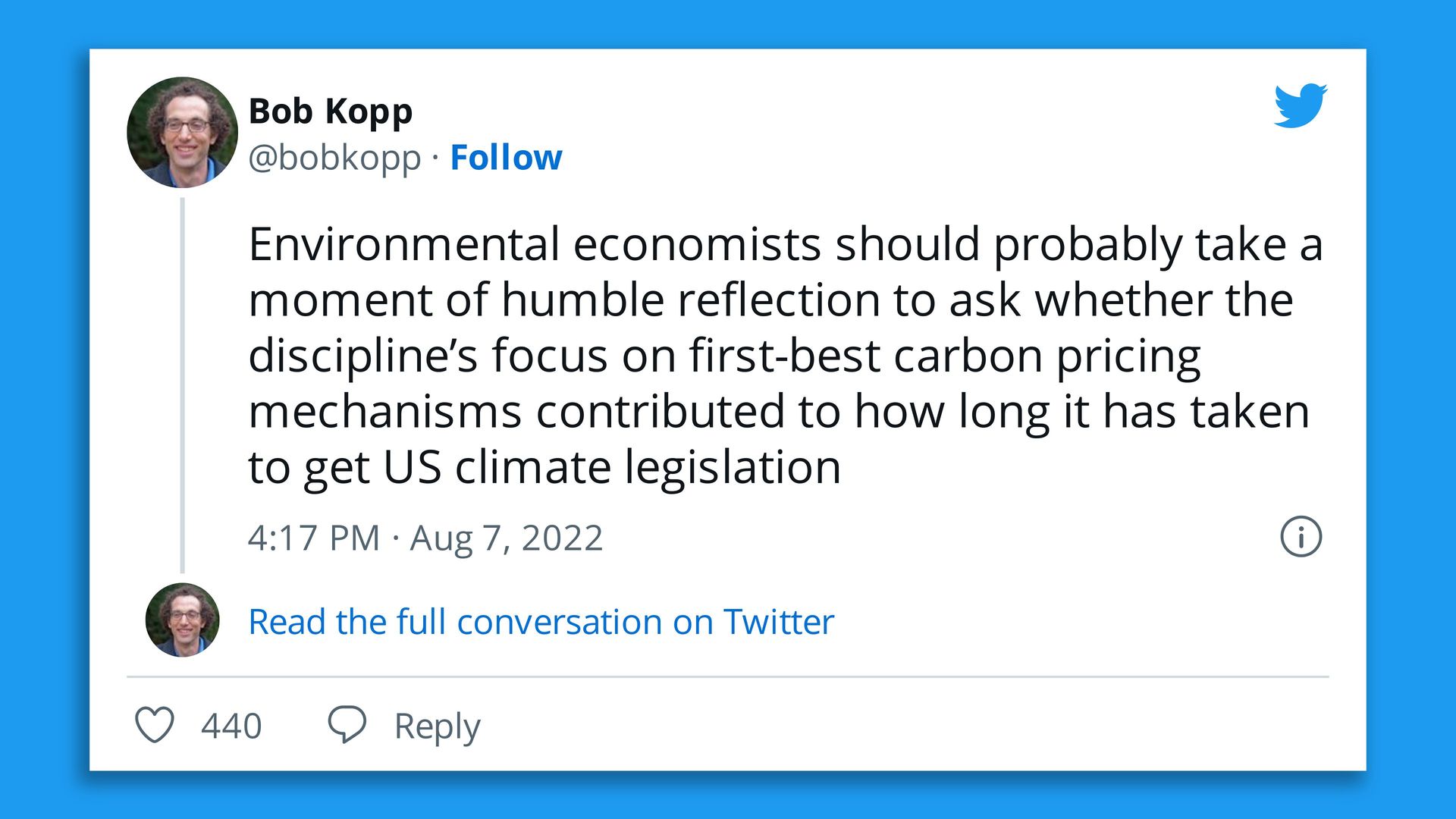
That's Bob Kopp, a Rutgers climate scientist, adding to the reflection that follows the passage — or defeat — of significant bills.
Why it matters: The investment-focused Senate deal is the latest sign that carbon pricing — that is, carbon taxes or emissions trading — doesn't have political legs in the U.S., and maybe never quite did.
Yes, but: ClearView Energy Partners, in a note, points out that the bill's fee on oil-and-gas industry methane emissions "would deliver a federal price on greenhouse gases (GHGs), albeit a narrow one."
🙏Thanks for reading and see you back here tomorrow.