Axios Generate

September 02, 2025

🍁 September is starting with a crisp breeze of news and analysis, all in just 1,298 words, 5 minutes.
📻 This week marks 35 years since the late George Michael released "Listen Without Prejudice Vol. 1," which provides today's intro tune...
1 big thing: The escalating fight over DOE's take on climate science

Breaking: Dozens of climate scientists just dropped a detailed rebuttal of the Energy Department's contrarian climate report, alleging "pervasive problems" with the work.
Why it matters: DOE's July report informs EPA's planned repeal of the "endangerment finding" — the legal underpinning of federal emissions regulations.
- The response could easily find its way into litigation over EPA's plan.
Driving the news: Texas A&M's Andrew Dessler and Rutgers' Robert Kopp organized the response.
- DOE's report "does not meet standards of quality, utility, objectivity and integrity appropriate for use in supporting policy making," the two write.
- The section-by-section response — which alleges numerous errors and omissions — runs over 430 pages, with 80+ contributors.
- They're submitting it as part of the formal record on EPA's proposed repeal and the DOE report.
Catch up quick: DOE's "critical review" of greenhouse gas impacts is authored by five scientists known for splitting with mainstream climate researchers.
- It gets into the "greening" and agricultural benefits of higher CO2 levels; disputes whether climate change is making hurricanes more intense; and disagrees with many scientists on the potential lower bound of expected warming from doubling CO2 concentrations, among many divides.
- "Climate change is a challenge — not a catastrophe. But misguided policies based on fear rather than facts could truly endanger human well-being," Energy Secretary Chris Wright said in the foreword.
Between the lines: Dessler said the rebuttal contributors have no specific policy goals as a group.
- "When I read the DOE report, I saw a document that does not respect science," he tells Axios via email. "Instead, I saw a document that's a mockery of science."
- "And I thought to myself, I can't let this go without a response," Dessler said.
- He and the dozens of scientists behind today's document say DOE fell badly short on topics like health risks; claims that models overestimate warming; and the relationship between climate change and forest fires, to name just a few.
Zoom in: Even in areas of broad agreement, it alleges misleading framing.
- Take the notorious RCP8.5, an increasingly implausible scenario that assumes runaway CO2 increases for decades and massive temperature rise.
- DOE's report slams what it calls academics' over-reliance on it and framing as a business-as-usual scenario.
- "In cases where researchers have used RCP8.5 as a simple prediction of future emissions — this critique is valid," the rebuttal states.
- But it challenges the claim that the UN's influential climate science body has misused it, for instance.
What we're watching: The rebuttal's role in court if the endangerment finding repeal is finalized.
- It "will be in front of the judges," Michael Gerrard, the founder of Columbia's Sabin Center for Climate Change Law, tells Axios in an email.
- "EPA will need to respond to the report in detail as part of its final decision on the endangerment finding. If EPA's response is inadequate, that will become one basis of the inevitable litigation challenging the revocation of the endangerment finding," he said.
2. 🚨 The stakes of the new Russia-China pipeline deal
Russia and China inked a legally binding deal to build the big Power of Siberia 2 gas pipeline, and plan to boost shipments through existing lines, Russian news agencies reported based on Gazprom comments.
Why it matters: It's a diplomatic win for Moscow, especially after losing much of the European gas market since invading Ukraine, and follows years of unsuccessful negotiations and Chinese reluctance.
Yes, but: Power of Siberia 2 doesn't appear fully set in stone yet, multiple news agencies reported, noting specific commercial terms remain unclear.
What they're saying: China is choosing Russian gas over U.S. LNG, said Anne-Sophie Corbeau, a gas analyst with Columbia University's energy think tank.
- "Vladimir Putin went to Alaska, but still signed with China," Corbeau tells Axios via email.
- Corbeau, in a LinkedIn post, called the Russia-China deals a "major blow to the LNG industry right before the largest expansion ever seen."
The intrigue: Middle East conflict has given China concerns over the stability of supplies from the region, boosting Beijing's interest in the deal, the WSJ reported in June.
The bottom line: The Russia-China energy alliance is strengthening.
- China has already expanded imports of Russian oil.
3. 🍁 Where fall is warming the most

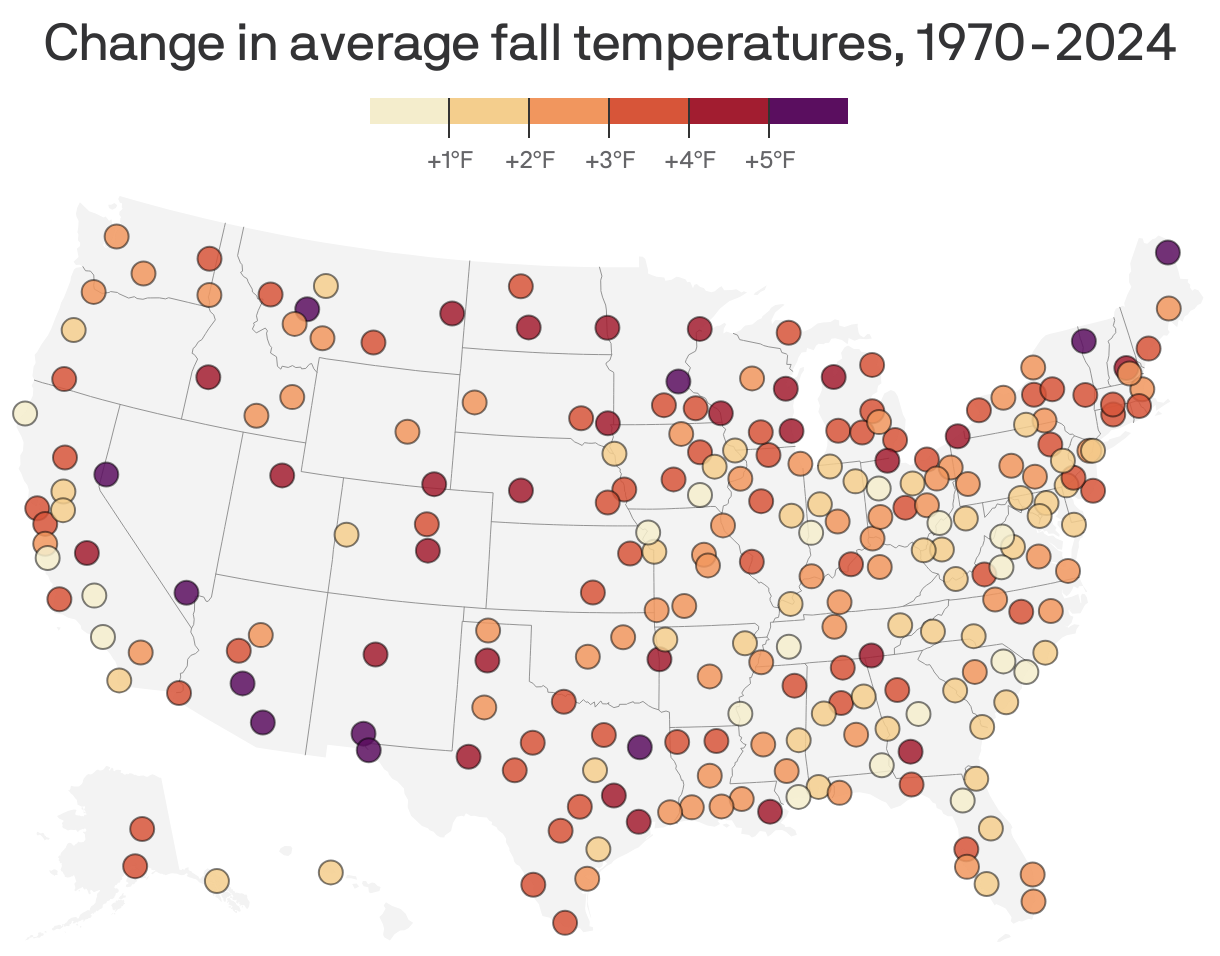
Average fall temperatures are rising almost universally nationwide, a new analysis finds.
Why it matters: Warmer falls could increase cooling demand (and cause bigger bills and more strain on the electric grid), affect growing and allergy seasons, and have health impacts for vulnerable groups.
Driving the news: Between 1970 and 2024, average fall temperatures rose in 98% of the 243 cities analyzed in the report from Climate Central, a climate research group.
- Among cities with an increase, temperatures rose an average of 2.8°F.
Zoom in: Reno, Nev. (+7.7°F); El Paso, Texas (+6.5°F) and Las Vegas (+6.2°F) saw the biggest increases over the covered period.
- Only three of the examined cities had a decrease: Gainesville, Fla.; Macon, Ga. and Harrisonburg, Va., all dropping by -0.2°F.
How it works: Climate Central's report is based on NOAA data and defines "fall" as the entirety of September, October and November (meteorological fall).
- Astronomical fall, on the other hand, doesn't start till Sept. 22.

4. 👀 Three new policy moves that help explain Trump
A trio of separate steps exemplifies the energy and climate likes and dislikes of the Trump team. Here's what happened Friday...
⚖️ 1. Trump attorneys showed more cards in their litigation against New York state's "climate superfund" law that seeks compensation from energy companies for climate harms.
- Why it matters: The New York law is among the most aggressive, and disputed, state climate policies. It seeks billions of dollars from fossil fuel producers.
- The latest: "The U.S. Constitution and a century of precedent require that federal law govern the control of interstate and global air pollution," DOJ lawyers write in support of a summary judgment motion in a New York federal district court.
🛑 2. The Transportation Department scuttled $679 million for port and terminal infrastructure that would have supported offshore wind projects.
- Why it matters: It expands Trump officials' moves against planned offshore wind development and even projects already underway. Go deeper.
👍 3. DOE gave final approval for Kimmeridge's planned Commonwealth LNG project in Louisiana to export to major markets, a key step toward getting it built.
- The big picture: The U.S. presently operates eight large-scale LNG export projects, with several more under construction or expansion.
5. 🧁 Bonus policy note: Seven-figure permitting push
The American Petroleum Institute launched a seven-figure ad buy today that pushes lawmakers to pass a comprehensive permitting overhaul.
Why it matters: The powerful group sees a need for legislative changes even amid White House moves to speed permits for oil and gas infrastructure.
Driving the news: The Beltway-focused buy spans digital ads (like this one), cable TV, streaming, podcasts and physical displays.
- "America has the energy to meet demand, but red tape is blocking the infrastructure to deliver it while China races ahead," API president and CEO Mike Sommers said in a statement.
What's next: Placements include podcasts like the NYT's "The Daily" and "Ruthless," a popular conservative show, and ads at DCA airport and an I-395 billboard.
6. 💬 Quote of the day: data center flexibility edition
"We've got 50 to 100 gigawatts of latent AI demand in the pipeline. It's just not going to get built unless you have this capability of flexibility."— Varun Sivaram, founder and CEO of Emerald AI, talking about data center flexibility on the Catalyst podcast
The pod goes deep on a topic we're all going to hear more about: the ability to shift AI data center compute loads — both geographically and timewise.
📧 Did a friend send you this newsletter? Welcome, please sign up.
🙏 Thanks to Chuck McCutcheon and Chris Speckhard for edits to today's edition, along with the brilliant Axios Visuals team.