Exclusive: Electricity demand to rise 78% by 2050, study says

Add Axios as your preferred source to
see more of our stories on Google.
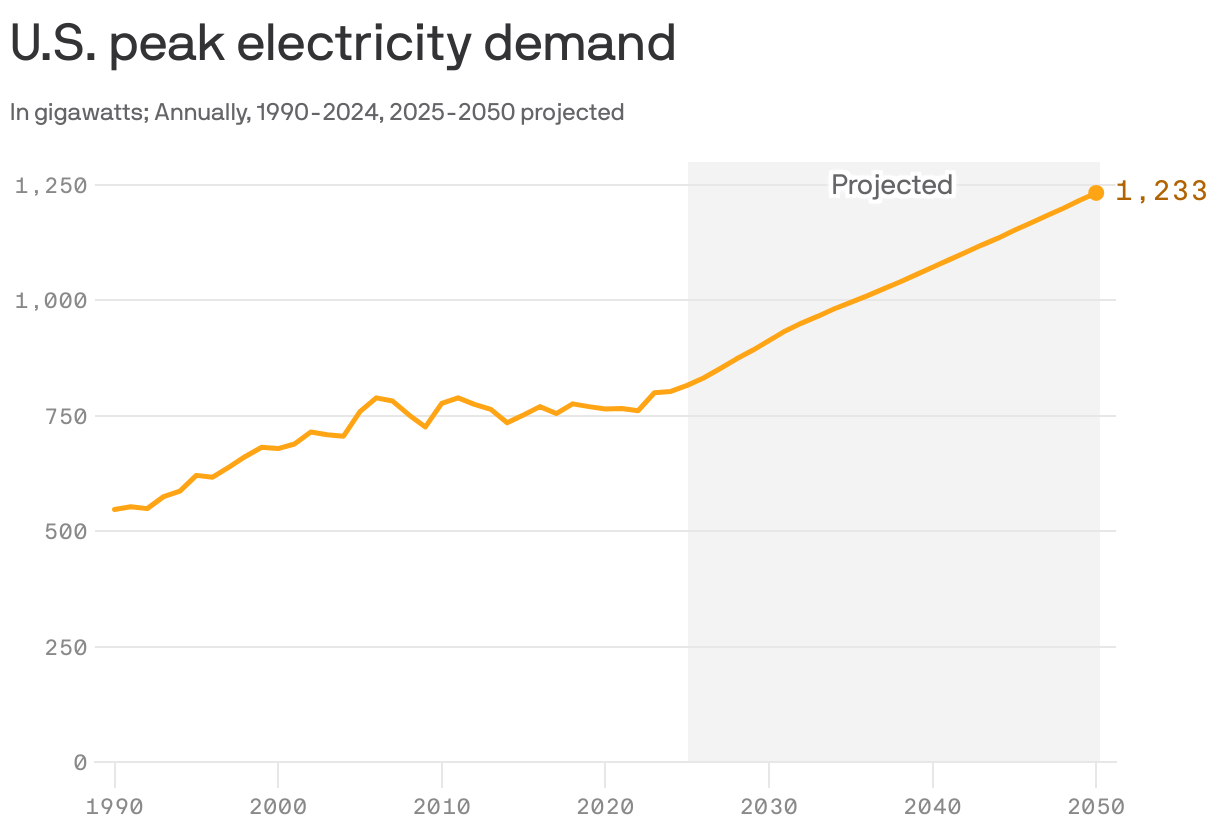
U.S. electricity needs are slated to rise 25% by 2030 and 78% by 2050 compared to 2023, sinus-clearing estimates from the consulting firm ICF seen first by Axios show.
Why it matters: The projections are higher than a number of other studies. It also estimates sharply rising demand peaks where grid strains are most acute, as the chart above shows.
- It underscores how companies and regulators must scramble to keep pace with the changing landscape.
- AI and cloud-computing growth, new manufacturing, crypto-mining, EVs and broader electrification are all pushing needs higher.
The big picture: A wide array of fuels and demand management approaches are needed to meet the country's power appetite, it argues.
- "Meeting this demand will take a coordinated effort from across the energy sector on an 'all-of-the-above' strategy that invests in a broad mix of solutions," Anne Choate, ICF's executive VP for energy, environment and infrastructure, said in a statement.
- The report also offers ideas for industry and regulators to improve their planning.
Threat level: The consumption surge could raise retail rates by 15% to 40%, depending on the market, ICF finds.
- Demand management, efficiency and behind-the-meter tech (think home solar and storage) will be key to mitigate price spikes, ICF said.
- "Broad promotion of these programs could help meet 10% or more of electricity demand by 2030 compared to 8% in 2025."
Stunning stat: On the generation side, new power-producing capacity additions need to rise to roughly 80 gigawatts per year from 2025-2045 — around double the pace of the past five years.
The intrigue: Forecasts are changing fast.
- The report notes that the Energy Information Administration's 2025 annual outlook saw a 12% demand rise in 2030 in their "high" economic growth case and 9% in their "reference" case.
- But adding newer data from regional grid planners — including PJM, ERCOT, MISO and parts of SERC — paint a very different picture, ICF said.
- The ICF numbers are eye-popping and above some other analyses too, but not unprecedented.
State of play: "The Dominion service territory within PJM, Southern Company service territory within SERC, and ERCOT West zone in West Texas are among the areas expected to have the highest growth," ICF finds.
- What's driving it varies. In California, 35% of the increase through 2040 is EVs, building electrification and data centers.
- In Texas, new "large loads" like crypto-mining are a bigger deal. In PJM, the huge mid-Atlantic and Midwest region, it's a combo of new manufacturing (including semiconductors), data centers, building electrification, EVs and more.
Yes, but: "Uncertainty abounds," with variables including...
- AI's future efficiency.
- Effects of tariffs on U.S. manufacturing.
- The fate of federal energy tax subsidies.
- How much behind-the-meter tech is used at large new demand centers.
What we're watching: Whether other analysts produce updated estimates consistent with ICF's.
