Axios Generate

March 08, 2022

☕ Good morning. Today's Smart Brevity count is 1,340 words, 5 minutes.
⛽ Situational awareness: U.S. average regular gasoline prices reached a new record today. Go deeper
👀 Bloomberg reporters say the White House could announce a ban on U.S. imports of Russian oil as soon as today.
🎧 Ben discussed pump prices on the Axios Today podcast. Listen here
1 big thing: The delicate energy balancing act

Illustration: Lazaro Gamio/Axios
The Biden administration is walking a tightrope when it comes to addressing the climbing price of gas in ways that square with the administration’s climate policies, Andrew writes.
Driving the news: The White House is caught between the need to address the high price of gas, which today hit a national record, and its ambitious climate agenda.
- For the short term, this is leading the administration to engage governments it had shunned, such as Venezuela, or criticized, like Saudi Arabia, to secure additional supplies.
- At the same time, top officials are adamant their policies are not impeding the domestic production of oil and gas, but that the clean energy transition is the only way to truly become energy independent in the long run.
Why it matters: Whether the public blames the Biden administration's energy policies for the high price of gas could have steep political costs for Democrats.
Zoom in: The energy industry has been emphasizing the need for policy changes in order to increase the amount of oil and gas drilling at home.
- This is a position the White House, and its environmental allies reject, noting that oil production has already increased under Biden and is projected to hit a record high in 2023.
- But to a typical customer filling up their SUV at a gas station, incredulous at the cost, it may make intuitive sense that policies like canceling the Keystone Pipeline, a move Biden took early in his presidency, is a culprit.
- White House officials have taken to Twitter to defend Biden’s energy agenda and the need for a clean transition.
- "The suggestion that we are not allowing companies to drill is inaccurate," press secretary Jen Psaki said during Monday's press briefing. "The suggestion that that is what is hindering or preventing gas prices to come down is inaccurate."
Between the lines: Nikos Tsafos, an energy and climate specialist at the Center for Strategic and International Studies, told Axios the White House and Republicans are locked in a political argument when they should be focused on squaring off against Russia.
- “I think we're tying ourselves in a knot with the talking points,” Tsafos said. “You know, I don't understand why it's so difficult for the White House to say, we need more U.S. oil produced right now.”
- This would still be consistent with its climate agenda, he told Axios.
Charting Europe's thirst for Russian oil
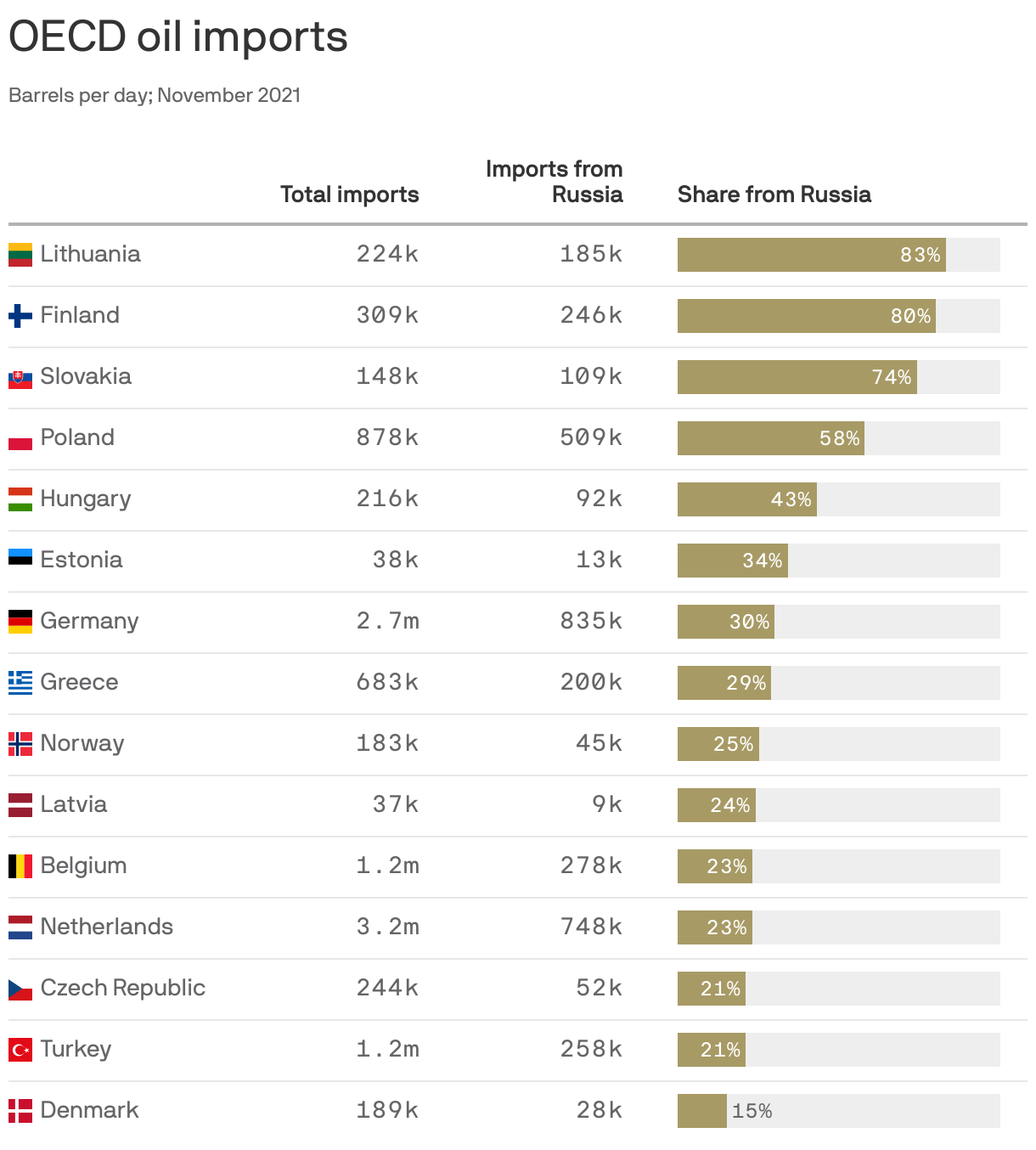
This chart shows the top 15 countries in Europe in terms of their share of combined crude oil and petroleum products from Russia, Ben and Andrew write.
Why it matters: Heavy demand for those barrels helps explain the reluctance to cut off or directly sanction Russian oil, though the response to the crisis is already crimping supplies.
2. Troubling signs in the Amazon rainforest

An environmentally protected in Brazil. Photo: Jonne Roriz/Bloomberg via Getty Images
A new study reveals evidence that over three-quarters of the Amazon rainforest is losing resilience and may be approaching a critical tipping point, Andrew and Axios' Jacob Knutson write.
Why it matters: This loss in the ability to bounce back from disturbances such as logging or fires, as detected by satellite observations gathered between 1991 and 2016, indicates the Amazon may be nearing a transition into a dry savannah.
The Amazon rainforest is a crucial bastion of biodiversity and a massive absorber of planet-warming carbon dioxide.
How it works: The researchers derived these findings from a statistical analysis of satellite images of Amazon vegetation and said the resilience loss stems largely from deforestation for agricultural production and climate change.
"We haven’t crossed the tipping point yet, so there is hope,” co-author Niklas Boers, a climate scientist at the Potsdam Institute for Climate Impact Research, told reporters.
3. EU to float plan to ditch Russian energy — fast

Photo illustration: Shoshana Gordon/Axios. Photo: Alexei Nikolsky\TASS via Getty Images
The European Commission is slated to release a strategy today aimed at cutting reliance on Russian energy, Ben writes.
Why it matters: The plan seeks a very rapid break from Russian natural gas, which accounts for roughly a third of European imports.
The Financial Times and Politico report it will aim to cut those imports by two-thirds within the first year alone.
How it works: The plan relies on a combination of boosting reliance on other suppliers, efficiency, filling up storage more quickly, speeding up renewables, and perhaps boosting coal use in the short-term, per multiple reports.
What they're saying: Frans Timmermans, a top EC climate official, briefed reporters yesterday.
"In a sign of the bloc's determination to shift away from Russia, Timmermans said it might make sense for some countries to boost coal in the short term if combined with an accelerated rollout of clean energy," Politico reports.
Timmermans touted more aggressive renewables deployment in a speech yesterday.
Bonus: Kerry sees crisis speeding energy transition

Photo illustration: Aïda Amer/Axios. Photo: Christopher Goodney/Bloomberg via Getty Images
HOUSTON — U.S. special climate envoy John Kerry predicted the Russian invasion of Ukraine will serve to accelerate movement toward low-carbon energy, Ben writes.
What they're saying: I asked Kerry, on the sidelines of the CERAWeek conference yesterday, whether it will create headwinds.
- "I think it is going to speed it up," he said, adding he saw evidence in a closed-door meeting he had just exited.
- "We just had a meeting of 20 CEOs and I asked them point-blank, I said, does this mean, in your judgment, that there needs to be an acceleration of creating independence on energy, and therefore putting out more renewables, and hands went up, a majority, around the room."
Catch up fast: If it's a catalyst, it's not one anyone wanted. The former secretary of state, in remarks to the conference, called the attack a "sobering" moment that "violates all the norms of behavior that we have all struggled to establish globally."
4. Shell vows complete break with Russia
Shell said this morning it will "withdraw from its involvement in all Russian hydrocarbons," including spot purchases of Russian crude oil.
The U.K.-based giant apologized for its recent buy of a Russian cargo at a steep discount.
5. Big Oil's carbon split on display in Houston

Illustration: Aïda Amer/Axios
HOUSTON — CEOs of multinational oil-and-gas giants Exxon and TotalEnergies gave remarks at a major industry gathering here that underscore Big Oil's differing diversification strategies across the Atlantic, Ben writes.
What they're saying: Exxon CEO Darren Woods touted Exxon's emphasis on carbon capture, hydrogen and biofuels.
"We are a company that has a real long history in frankly, manipulating hydrocarbon molecules to make products that the world needs," Woods said at the CERAWeek by S&P Global conference.
- "And if you think about the technology that we have been using and will use in this space, it's is continuing to manage hydrocarbon molecules and leveraging the skills that we've developed over the years," he said.
The other side: Patrick Pouyanné cited TotalEnergies' moves into areas including renewable power, electricity services, batteries and EV charging that TotalEnergies and other European majors like BP and Shell are increasingly pursuing.
- "The transition is a matter of two types of new products: new molecules, on which obviously an oil-and-gas company, some DNA, it's biofuels, biogas, hydrogen, and the strategic move we have decided that we will become an electricity and renewable producer and supplier," he said.
Of note: Traditional fossil fuels remain the dominant business lines of all the majors.
6. New money for carbon capture in Asia

Illustration: Eniola Odetunde/Axios
Korean industrial giant SK Group is pouring $100 million into 8 Rivers Capital, which bills itself as “a full-service Net Zero solutions provider,” Axios' Alan Neuhauser reports.
- The move will also establish an 8 Rivers-SK joint venture that will focus on decarbonization in Korea and other Asian markets.
Why it matters: It reflects how major corporations are willing to spend big to find ways to decarbonize beyond renewables and storage.
- The $100 million from SK Group will go toward developing and deploying carbon capture, hydrogen production, direct air capture, and other technologies, CEO Cam Hosie told Axios.
Between the lines: The announcement comes Western European leaders grapple with how to rapidly reduce their reliance on Russian natural gas exports.
Meanwhile, countries in Asia are building hundreds of new coal-fired power plants to meet surging demand.
7. Quote of the day
"The global economy could soon be faced with one of the largest energy supply shocks ever."— Goldman Sachs analysts in a new note
Why it matters: It cites a "growing realization that imposed sanctions could meaningfully and sustainably reduce Russian exports."
Thanks for reading!