Axios Future of Mobility

May 27, 2026

👋 Hi again! Aren't these short weeks great?
🤯 My head nearly exploded last week trying to absorb Stellantis' five-year turnaround strategy for its 14 global brands.
- What stuck with me, though, is how the company's expanding partnerships with Chinese rivals could be an indication of what's to come for other automakers. So let's dig into the risks and rewards of that decision.
1,634 words, a 6-minute read.
1 big thing: Stellantis embraces Chinese partnerships

Every Western automaker is scrambling in response to the growing dominance of faster, more advanced Chinese competitors, but Stellantis stands apart: Instead of trying to beat them, it's joining forces with them.
Why it matters: The company's expanding ties with Chinese partners could be a practical survival strategy — or a desperate sign of surrender by the maker of Jeep, Ram, Fiat and Peugeot vehicles.
State of play: Chinese cars, once considered cheap copycats, have quickly become the industry benchmark, stunning the rest of the global auto industry.
- They're cheaper, and yet more technologically advanced, and Chinese companies are developing them in half the time it takes Western carmakers.
- After slaying foreign brands at home, Chinese companies are now swarming export markets, including Europe, while closing in on the U.S.
Friction point: Western automakers have been fighting to preserve their competitive independence, even as China's gravitational pull on the industry has grown impossible to ignore.
- Crippling pressure from China has intensified automakers' efforts to reduce development costs and replicate supply chains in their home markets.
- Ford created a secret skunkworks project in California to make a low-cost EV platform to match China's best — but even there, it had to license battery technology from a Chinese company.
- And major European carmakers have struck limited technology deals with Chinese companies to avoid falling behind, notes the Financial Times.
Stellantis' new strategy goes further than anyone else's, however — becoming a closely watched test of collaboration with the enemy.
Zoom in: Stellantis already owns 21% of Chinese EV company Leapmotor, and has a 51% stake in a joint venture to sell Leapmotor's vehicles outside of China.
- Now, as part of a broader turnaround strategy unveiled last week, Stellantis plans to build Leapmotor EVs at two underused factories in Spain — the first time a European manufacturer has opened its doors to a Chinese competitor.
- Stellantis is also expanding a partnership with Dongfeng, one of China's largest state-owned automakers, with a plan to build two Peugeot and two Jeep models in China that will be sold locally and exported to other markets.
- And it's forming a similar 51%-owned joint venture with Dongfeng to sell Dongfeng products in Europe, potentially building them at a third underused plant in France.
Threat level: Stellantis' $70 billion strategy has multiple elements, but expanding cooperation with its Chinese partners could be the most consequential.
- While it gains access to affordable EV platforms and vehicles to fill its underutilized factories, Stellantis risks cannibalizing its own brands, both in Europe and other markets, experts say.
What they're saying: "I see this as capitulation dressed up as an elegant strategy," says longtime China automotive expert Michael Dunne, CEO of Dunne Insights.
- "In my view, it's surrender. They're no longer capable of competing against them, so they're joining them."
Reality check: It could be just the beginning of a power shift.
- China's Xpeng is in talks with Volkswagen about buying a factory in Europe, while Nissan is negotiating with Chery and other Chinese carmakers about sharing an underutilized factory in the U.K, according to the FT.
What we're watching: Vilosa said Stellantis could bring Chinese-branded vehicles to Mexico and potentially Canada, but said "it's not possible" in the U.S.
The bottom line: Time will tell whether Stellantis' strategy is a template for struggling legacy automakers — or a warning that China has already won the EV cost and technology battle.
2. Zoom out: U.S. affordability drive
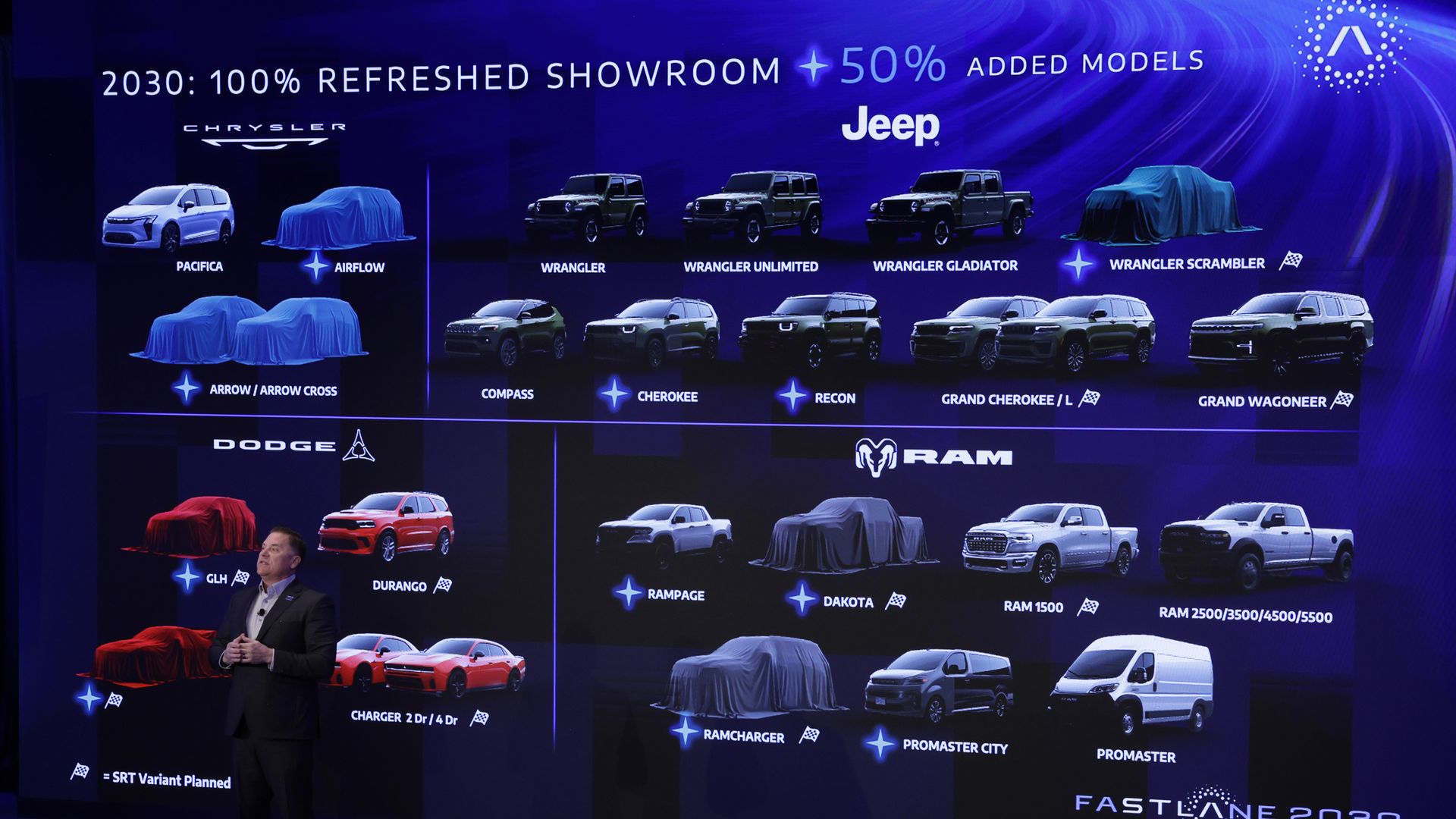
Stellantis is targeting ambitious growth in North America by offering consumers lower-priced choices in vehicle segments where it currently doesn't compete.
Why it matters: The company's renewed focus on affordability comes as it seeks to rebuild market share and restore profits after a $26 billion loss in 2025.
Driving the news: Stellantis plans to add 11 new products across its Jeep, Ram, Chrysler and Dodge brands, and refresh another 12 models by 2030 as part of the turnaround strategy unveiled last week.
- "Without doing anything different, we can grow by just showing up in more segments," Tim Kuniskis, head of Stellantis's North American brands, said at an investor event last week.
- In 2025, he said, Stellantis had just two vehicles with a starting price under $40,000.
- By 2030, it will have nine vehicles starting under that number, including two priced under $30,000.
At the other end of the spectrum, the company is flexing its muscle car heritage with a new line of high-performance Ram truck variants and a two-seat Dodge Copperhead sports car.
Zoom in: The long-neglected Chrysler brand gets new life with two new Fiat-based small crossovers and a large SUV to join the current Pacifica minivan.
- Dodge is adding a full-size SUV in addition to the Copperhead.
- Jeep, which is already rolling out a new Cherokee hybrid and electric Recon SUV this year, plans to add a gas version of the Recon and a sporty, two-door Wrangler Scrambler.
- Ram is adding a full-size SUV, a revived midsize Dakota pickup and a new compact Rampage pickup borrowed from Stellantis' South American business. It's also bringing back the midsized ProMaster City cargo van.
What we're watching: Stellantis aims to boost North American sales 35%, from 1.4 million vehicles to 1.9 million units and grow its revenue by 25% in the region.
Reality check: North American vehicle sales are projected to be flat for the foreseeable future, which will make those ambitions hard to achieve.
What's next: Stellantis and Jaguar Land Rover say they might collaborate in North America.
3. The luxury of a human driver

Today's flex for many wealthy trendsetters is a self-driving Tesla. But when everyone has a robot driver, the real status symbol may be a human one.
Why it matters: The notion of luxury is evolving as automation spreads across the economy, putting a premium on high-end personalized services provided by real people.
The big picture: Autonomous vehicles today are an expensive, high-tech marvel that few people have experienced.
- But as Waymo, Zoox and others bring robotaxis to more cities, driverless rides will become cheaper, opening access to everyone.
- That's when behavior flips: Robotaxis will become commodities for getting from A to B, while hiring a human driver is likely to become an act of conspicuous consumption.
"I see a point where autonomous vehicles bifurcate the mobility market... structurally elevating human-driven service into a premium tier where specialty services become the product," said AV industry veteran Rob Grant, co-founder of research firm Autnmy AI.
- "Doormen aren't necessary, per se, as Amazon can drop off packages and Ring cameras can provide security. But doormen offer premium service in terms of security and discretion."
Case in point: This helps explain a curious trend in the ride-share industry.
- While Uber and Lyft are scrambling to add robotaxis to their ride-hail networks, they're also investing in white-glove chauffeur services.
- Uber acquired the chauffeur booking app Blacklane, for example, and Lyft bought TBR Global Chauffeuring.
As the rich get richer, they want more human interaction, not less, wrote Ezra Klein in a New York Times op-ed.
- As robotaxis scale, luxury may shift from high-tech rides to high-touch service.
The bottom line: Horses didn't go away after the automobile arrived; instead, they became a pastime for the wealthy.
4. Drive-thru
🚖 It's been a rough stretch for Waymo, which paused aspects of its service in some cities while it fixes issues associated with flooding and highway construction.
- In a separate incident, a Waymo vehicle ended a couple's ride early due to "planned protest activity" in San Francisco, after which a remote Waymo employee advised them to call an Uber to finish their trip. (Business Insider)
⚡️ Voltera and Revel Transit are merging their electric-vehicle charging businesses to serve ride-hail cars and robotaxis across urban areas in the US.
- Revel CEO Frank Reig will run the combined company, while Voltera CEO Brett Hauser will become a senior advisor. (Bloomberg)
🇸🇪 Volvo Cars, which is controlled by China's Geely Holding, says it received approval from the U.S. Commerce Dept. to continue selling vehicles in the U.S., satisfying the government that it's in compliance with a Biden-era rule that bans the sale of cars with software and hardware from China. (Reuters)
- For the record: Waymo tells Axios the Geely-built robotaxi it's rolling out now doesn't have any Chinese hardware or software. Waymo buys stripped-down base vehicles and then installs its own AV software, sensors and computing systems at a facility in Arizona.
5. 🚘 What I'm driving
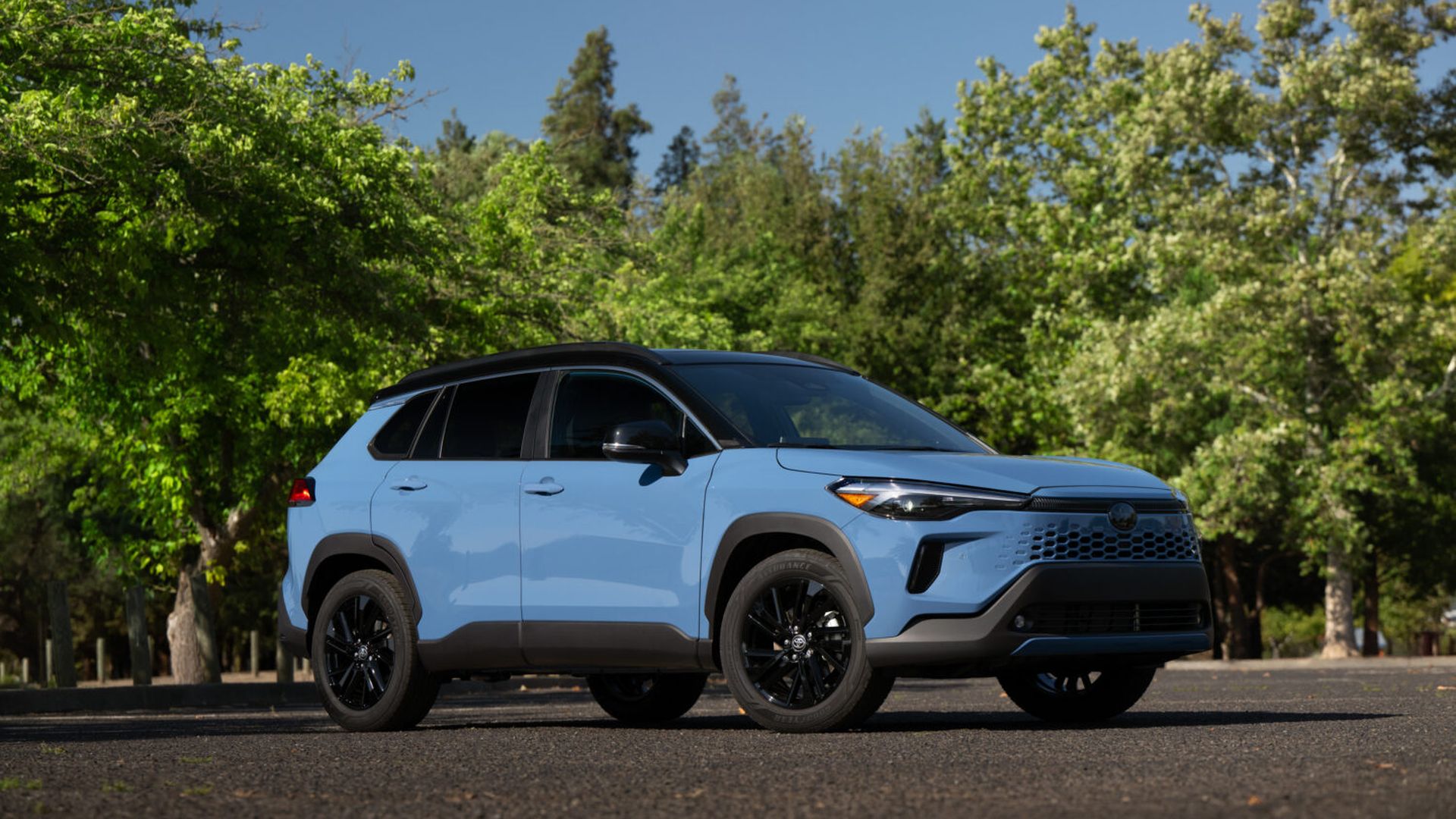
2026 Toyota Corolla Cross
- MSRP: $24,635 starting price for gas model; $28,995 for hybrid. As tested: $37,524 for hybrid with XSE trim plus moonroof, power liftgate and premium audio.
- Under the hood: 196-hp hybrid powertrain with standard all-wheel-drive averages 42 mpg. Also available with a 169-hp gas engine averaging 30 mpg in all-wheel-drive.
What's new: A new front-end design and fun Cavalry Blue paint option, plus an available 10.5-inch infotainment touchscreen.
What I loved: Designed to look like a mini RAV4, the subcompact Corolla Cross has more presence than I expected. There's also a long list of standard safety features.
What I didn't love: It's not as sporty as the Mazda CX-30 I drove recently.
The bottom line: I like the Toyota Corolla in SUV form. It's a practical choice and a great value for budget-minded consumers.
I test-drive vehicles in my role as a juror for the North American Car and Truck of the Year awards. Opinions are my own.
Thanks to editors Pete Gannon and Bill Kole. If you're a fan of this newsletter, please ask your friends to sign up, too.
Sign up for Axios Future of Mobility