Axios Future of Mobility

May 14, 2025

Some of you might remember the epic EV road trip I took in 2023, which nearly ended in disaster.
- ⚡️ Chargers are now easier to find, but the whole experience is still a pain. Read on to see what's changing and who's behind the improvements.
🗓️ Join Axios Wednesday, May 21, at 4:30pm in Washington, D.C., for an event on AI, trade and the new economic playbook, featuring Army Sec. Dan Driscoll, Sen. Jeanne Shaheen (D-N.H.), House Select China Committee Chair Rep. John Moolenaar (R-Mich.), Canada Ambassador to the U.S. Kirsten Hillman & more. RSVP here.
1,660 words, a 6.5-minute read
1 big thing: EV charging gets a do-over
Electric vehicle charging has been a mess for years — with inconvenient, inoperable and isolated stations holding back EV adoption.
- Now, the industry is experiencing a rare do-over, with a greater focus on amenities, safety, reliability and brand loyalty. Call it Charging 2.0.
Why it matters: Automakers have invested $130 billion since 2019 to electrify their fleets, overhaul their factories and establish new battery supply chains in the U.S.
- But it could all be wasted if they can't reassure potential EV buyers that they'll have someplace to plug in.
- It's in their interest to get charging right, so they're spending more, despite disappearing government incentives under the Trump administration.
Driving the news: Eight EV manufacturers have banded together in a joint venture called Ionna, which recently started building the first of 30,000 public EV fast-chargers across the U.S. by 2030.
- A second joint venture, ChargeScape — founded by some of those same auto companies — is working on smart home charging, with the goal of putting money back into the pockets of EV owners.
- Those JVs are in addition to networks built by Mercedes-Benz and Rivian under their own brands, and GM's growing network with EVGo and Pilot Flying J travel centers.
The intrigue: Retailers are getting in on the act, too, convinced that having their own branded charging networks — instead of hosting other networks' chargers — will drive business to their stores and build customer loyalty.
- Walmart, for example, plans to install EV charging stations at thousands of its locations by 2030, rivaling the size of Tesla's Supercharger network.
- Canada's ON the RUN convenience store chain tied charging at its network to its broader customer loyalty program, with discounts and loyalty points that can be redeemed in its stores.
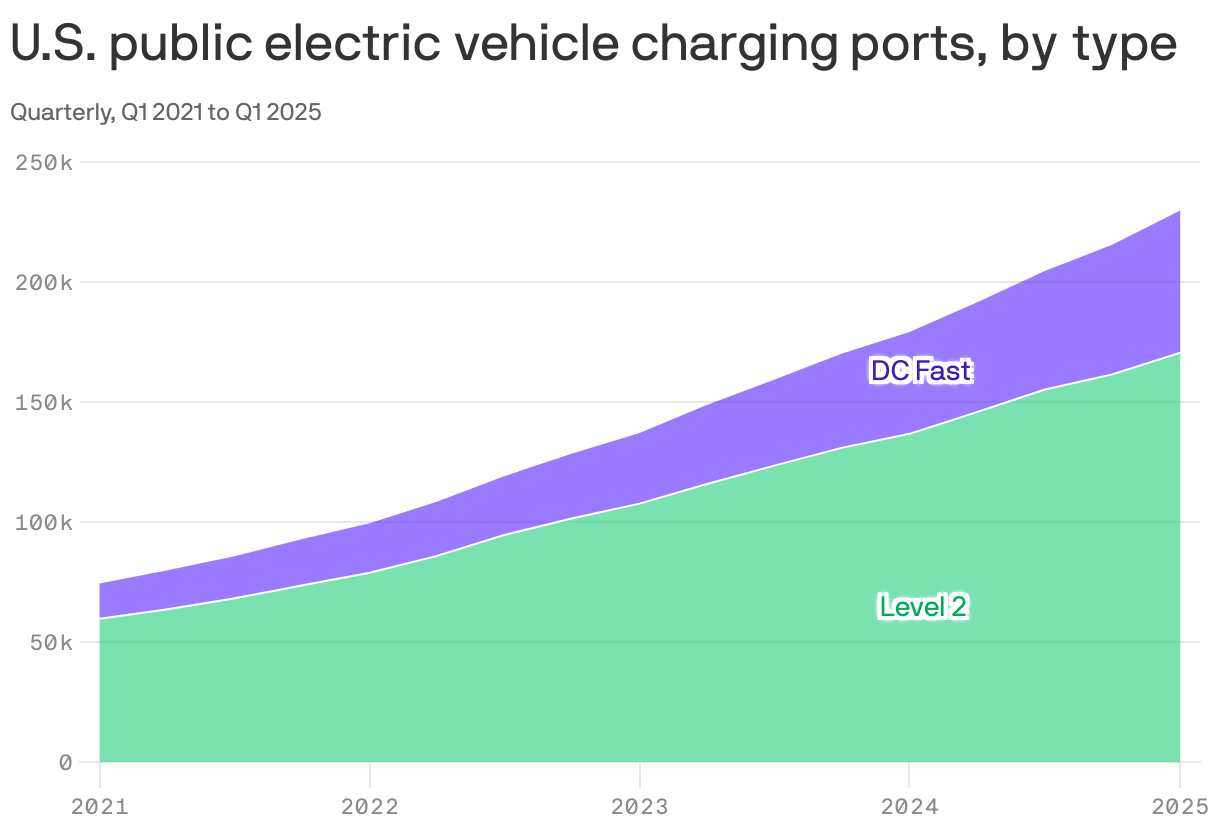
EV charging's first wave was a frantic push to stick chargers in the ground, wherever incentives, real estate or ample electricity were available, explained Loren McDonald, chief analyst at Paren, an EV research firm.
- Back then, charging companies tried to make money selling hardware and software, or by taking a cut on the sale of electricity.
- The hope was that growing EV adoption would eventually boost utilization rates and generate profits, which didn't happen, McDonald said.
- Plus, early business models didn't consider who would maintain those chargers, which is why they often fell into disrepair.
What's next: Charging 2.0 is a more strategic, data-based approach, with an emphasis on improving the customer experience — and selling more EVs, says McDonald.
- Look for less expansion in rural markets as prescribed under a Biden-era highway charging program — now paused under Trump — and more chargers in cities and suburbs where EV sales are growing.
- Better amenities are coming, too — WiFi, food and beverages, and even things as simple as windshield squeegees and trash cans.
The bottom line: If you have to spend 30 minutes or so charging, it might as well be pleasant or productive.
2. A rival to Tesla's Supercharger network
Tesla's Supercharger network has long been the gold standard for EV charging, but automaker-backed Ionna is raising the stakes.
Why it matters: With Ionna, the carmakers' goal is to build a rival charging network that offers faster charging and unique amenities.
- That means reliable, 400 kW charging under lighted canopies, along with coffee, bathrooms, food, and spaces to hang out or take meetings. Think gas station, only better — and electric.
Catch up quick: Less than two years old, Ionna is a joint venture between BMW, General Motors, Honda, Hyundai, Kia, Mercedes-Benz, Stellantis and Toyota.
- It's modeled after a similar pan-European network called Ionity that was created by some of the same players.
- Ionna's goal is to open 30,000 charging bays across the U.S. by 2030 — roughly the same number of plugs Tesla has today, but with faster speeds.
- The fastest Tesla chargers deliver up to 250 kW of power; Ionna chargers provide 400 kW.
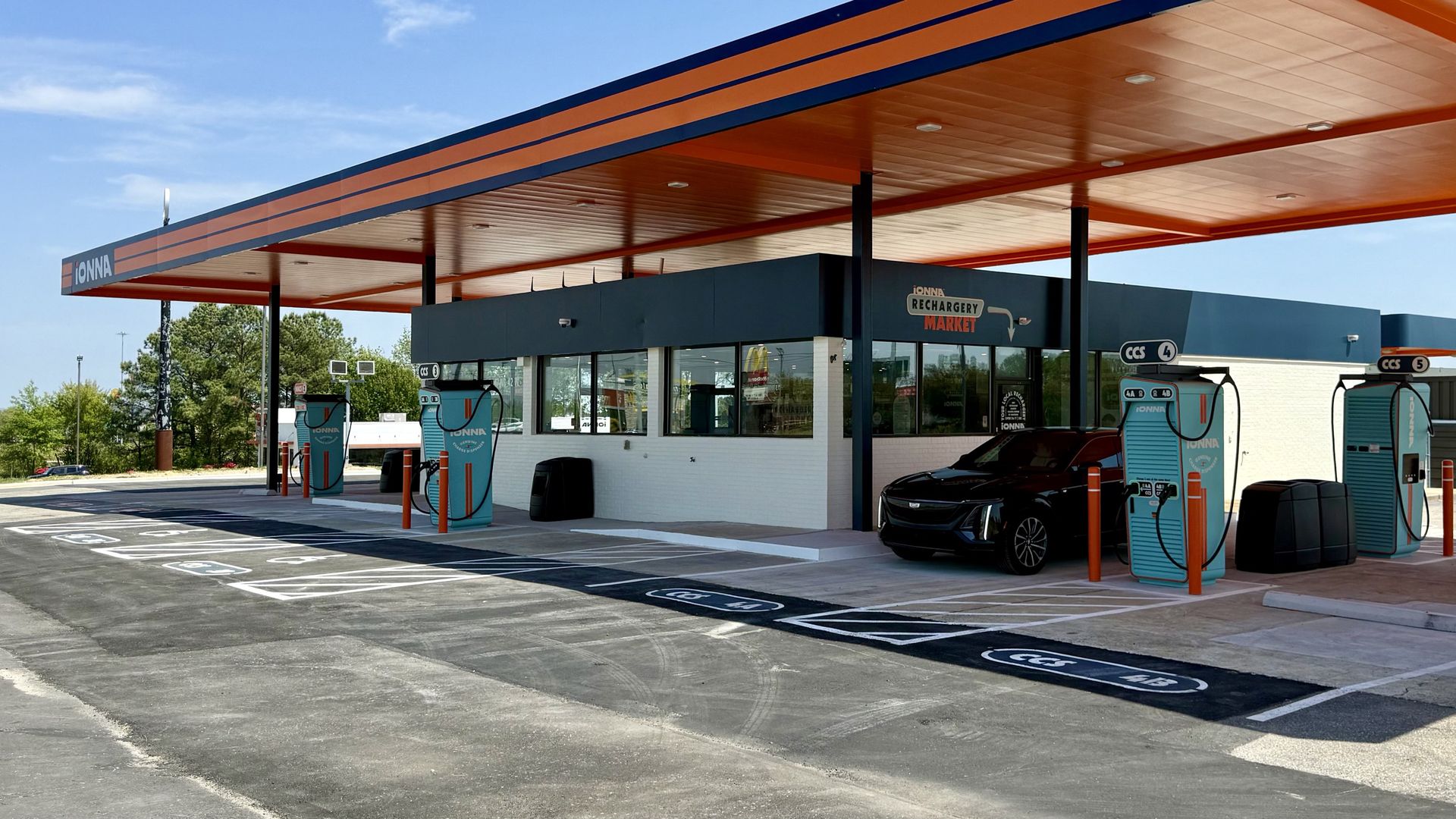
Where it stands: The first 12 "Rechargeries" are now open, providing a total of 120 charging bays, with plans for 1,000 by the end of this year.
- For now, 60% of the bays have CCS connectors, the most common type of plug, and 40% have Tesla's NACS connector, which is gradually becoming the industry standard. That ratio will shift as the NACS transition continues.
- Ionna also has a partnership to open Rechargeries at 50 Sheetz convenience store locations by 2026, with incentives and loyalty programs rolling out this year.
Zoom in: The first Rechargery in Apex, North Carolina, is in a former gas station, where the service shop is now a cafe.
- Another, in Garner, North Carolina, features Amazon's "Just Walk Out" technology in the snack shop.
- Other Rechargeries have opened in Texas, Pennsylvania, Ohio, Kansas, Arizona, and Missouri, with California up next.
- "We're experimenting with different business models," CEO Seth Cutler tells Axios. "We want to make sure the driver experience they have is better, bar none, than what they'd have at a gas station today."
3. EVs could earn while their owners sleep
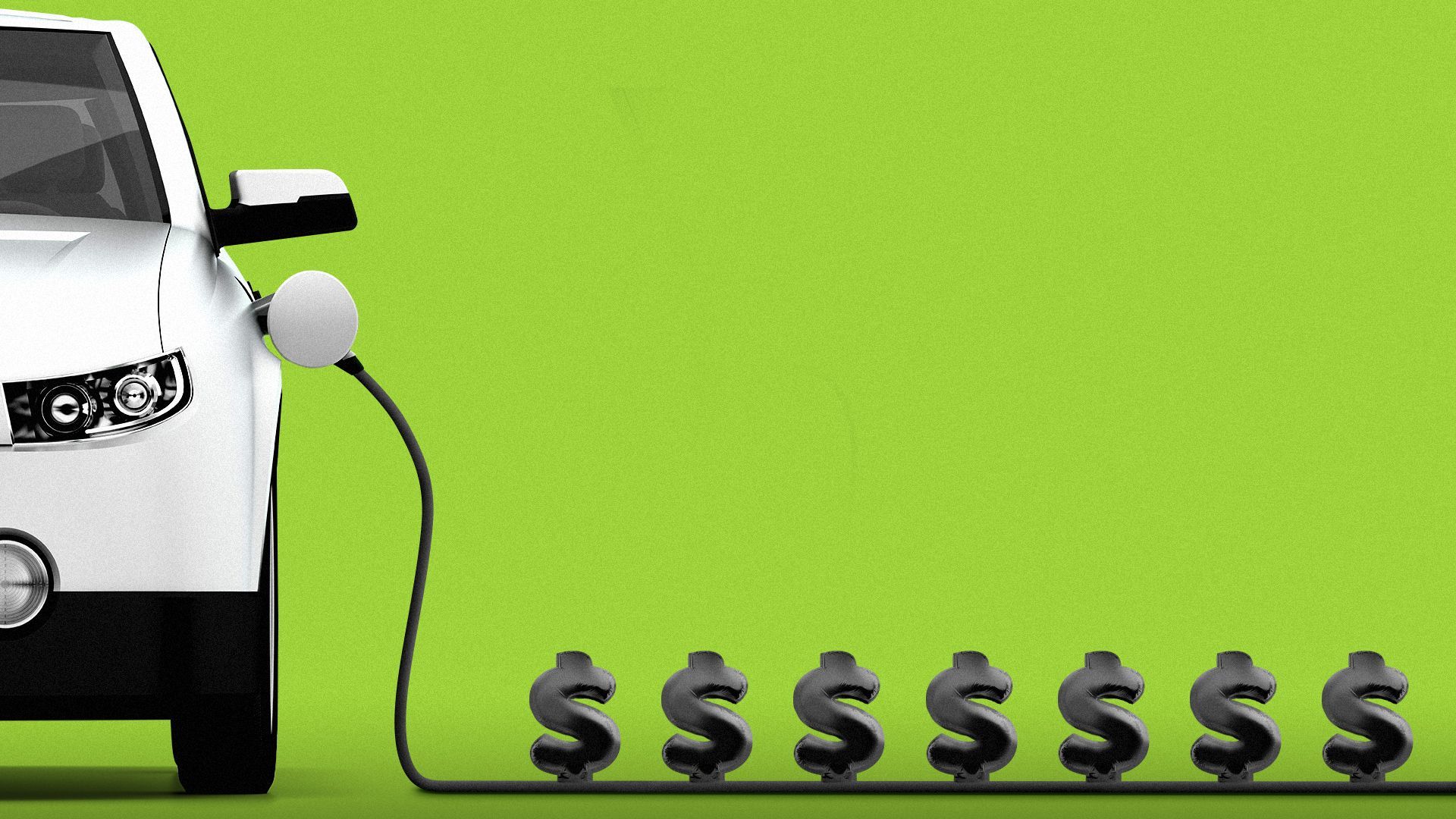
ChargeScape is another way automakers are trying to smooth the transition to electric vehicles by shoring up the nation's power grid and saving drivers money on charging.
Why it matters: As electric vehicle ownership grows, charging risks putting an extra strain on the grid at certain times of the day.
- Imagine turning that problem around by using EVs to support the grid during peak demand instead.
The big picture: About 80% of EV charging occurs at home, according to U.S. Department of Energy estimates.
- At the same time, the nation's power grids have come under increasing strain due to electricity demand from data centers and the intermittent nature of renewables.
- ChargeScape, a joint venture by BMW, Ford, Honda and Nissan, aims to address that problem while helping customers recoup some of the costs of owning an EV.
How it works: ChargeScape's software allows EVs to communicate with utilities while they're plugged in, managing the flow of electrons to match real-time conditions on the power grid.
- During the late afternoon, for example, when energy demand is high, ChargeScape can temporarily pause or slow EV charging through its smart charging software.
- Smart thermostats do the same thing in your home by shutting off the AC for a minute or two.
Driving the news: In California, ChargeScape just announced a partnership with an energy platform called Leap to create the nation's largest EV virtual power plant to help manage peak summer demand.
- It can draw energy out of a vehicle and send it back into the power grid when needed, using vehicle-to-grid (V2G) technology.
- Some Ford and Nissan vehicles have bidirectional charging today, and others will soon.
Follow the money: In return for their flexibility, EV drivers get rewarded with sign-up bonuses and discounts on their home electric bills.
- Incentives vary by utility, but in Sacramento, for instance, the local utility pays BMW EV owners a $150 incentive for enrolling in BMW's ChargeForward program, and a recurring $20 reward each quarter.
- With bidirectional power-sharing, EV drivers could earn up to $3,000 per year, and some utilities offer up to a $4,000 one-time incentive to help cover the cost of the bidirectional charging equipment, says ChargeScape CEO Joseph Vellone.
Yes, but: Importantly, the EV owner is assured that their vehicle will be fully charged by the time they specify.
- "You think we're managing your charging aggressively," says Alexander Schleicher, who heads up e-mobility and charging strategy for BMW.
- "But that's not the case. We're shifting charging for maybe 30 minutes through the night."
Where it stands: The program is young, but ChargeScape is already working with about a dozen utilities, covering 25 million U.S. households.
- Ford says 3,000 EV customers have signed up so far, and BMW says it has 10,000 enrollees (about 10% of its EV owners).
4. Drive-thru
🚖 Waymo is recalling more than 1,200 robotaxis to update software after a series of minor collisions with chains, gates and other barriers. (Reuters)
🚚 GM poached Sterling Anderson, co-founder of autonomous trucking company Aurora, to be its chief product officer, giving him broad responsibilities to develop its high-tech cars of the future. (Axios)
- 🔋 Speaking of GM, it announced a breakthrough battery for its next-generation electric trucks and SUVs.
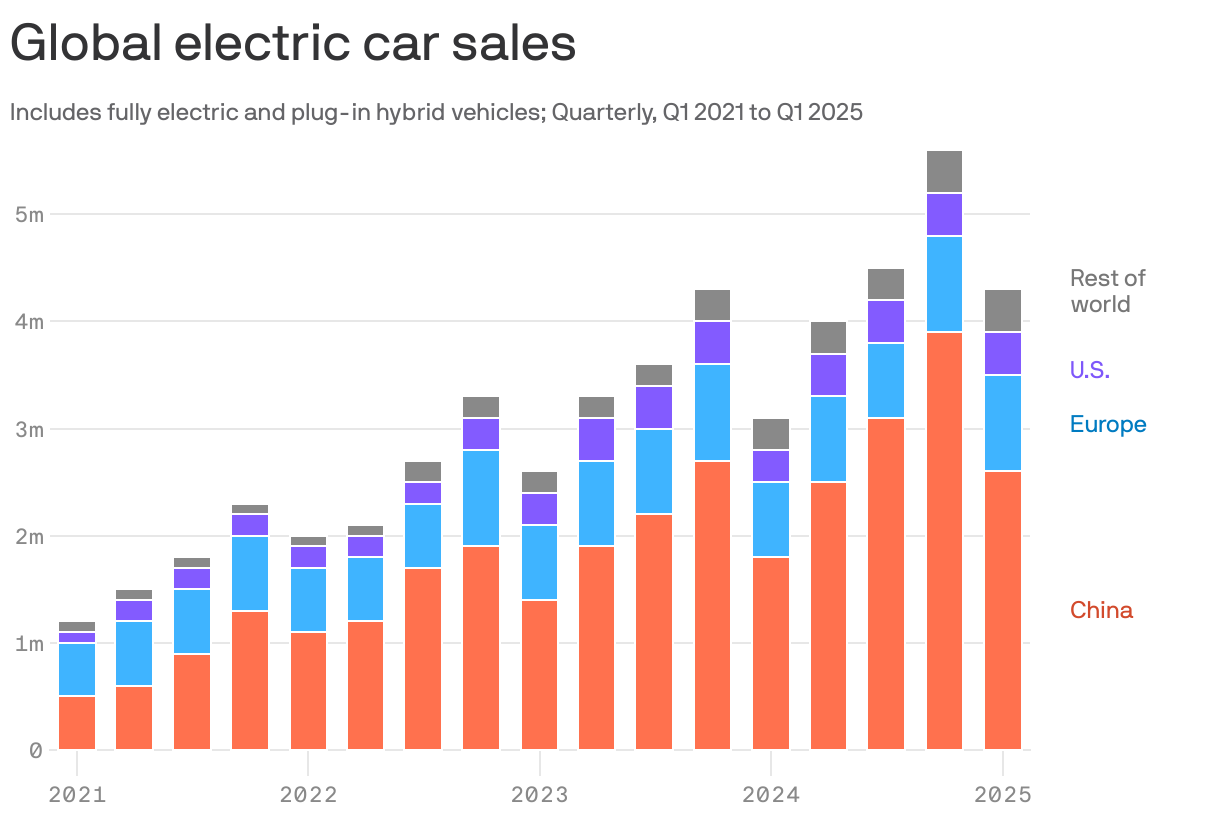
⚡️ A new global EV outlook shows how badly the U.S. is falling behind China as the Trump administration and congressional Republicans reverse Biden-era subsidies and rules. (Axios)
5. What I'm driving: Mazda CX-50 hybrid
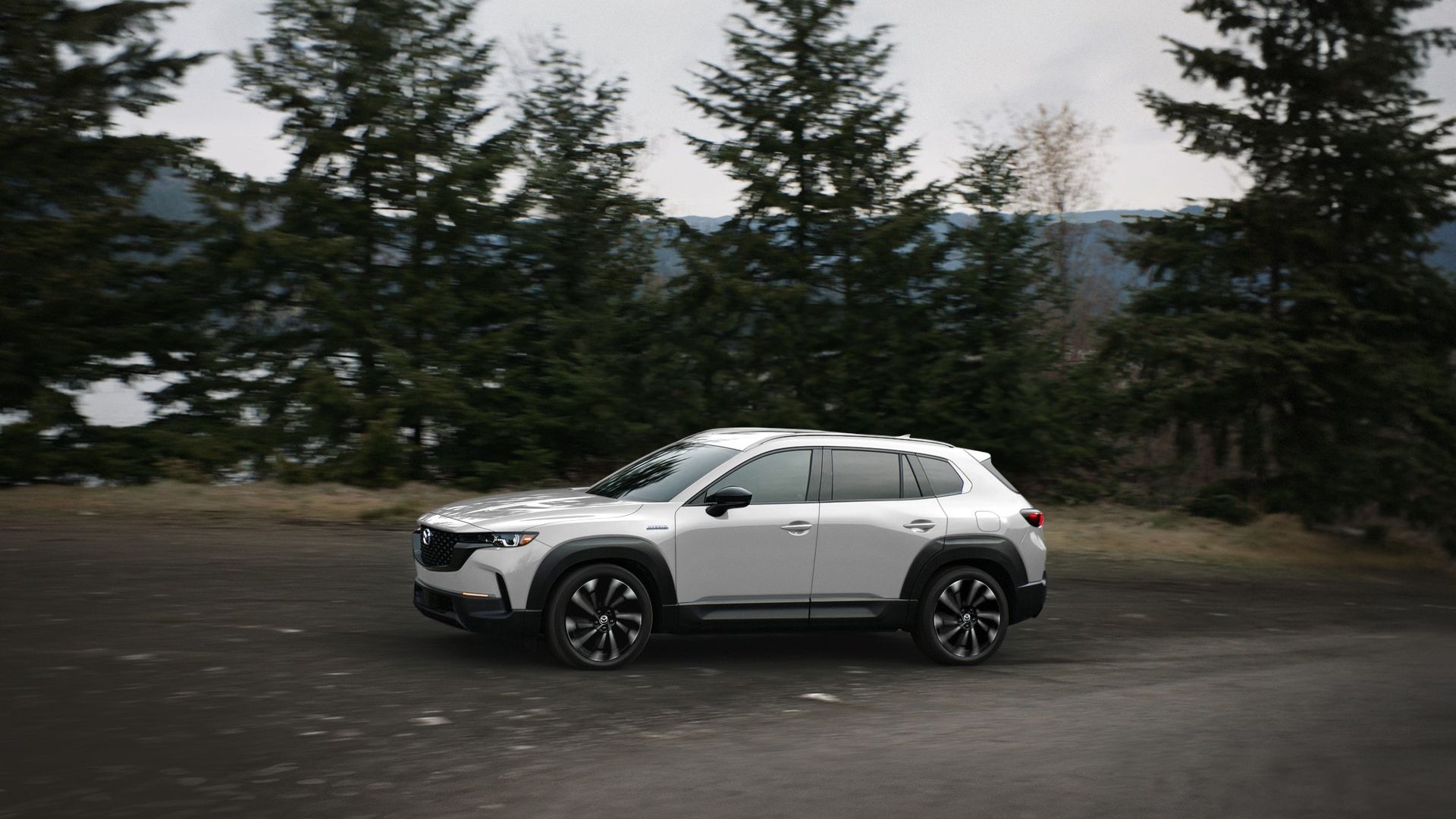
Mazda's CX-50 compact crossover utility vehicle has always been a winner, but now it's even better because it's available as a hybrid, too.
Psst! Here's the secret: It's the same hybrid package in the popular Toyota RAV4, but with Mazda's sporty design and driving dynamics.
- It's built in Huntsville, Alabama, at a factory co-owned by the Japanese carmakers.
Key specs: The CX-50 hybrid gets 38 mpg, adding 100 miles of driving range over gas versions.
Pricing starts at $30,500 for the base gasoline model; the cheapest hybrid is $34,170.
- I drove the range-topping CX-50 Hybrid Premium Plus, which costs $40,250.
My only gripe is one I've had for years about Mazda: the infotainment system is a pain to operate.
The bottom line: The CX-50 hybrid is a great alternative to the top-selling RAV4 and Honda CR-V.
I test drive vehicles in my role as a juror for the North American Car and Truck of the Year awards. Opinions are my own.
Thanks for reading! Please encourage your friends and colleagues to sign up.
Thanks to Ben Berkowitz and Bill Kole for editing.
Sign up for Axios Future of Mobility