Global EV sales are heading for a new milestone

Add Axios as your preferred source to
see more of our stories on Google.
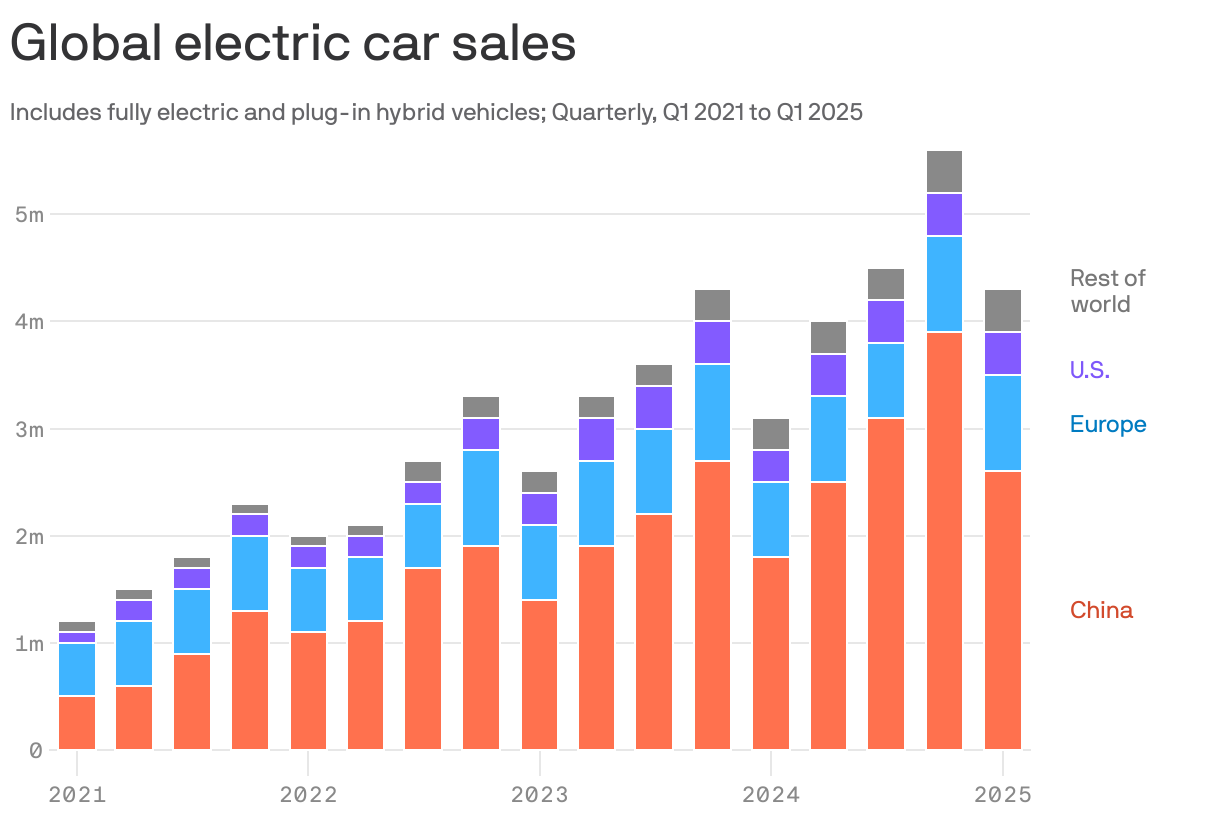
EVs are slated to reach one-fourth of global car sales this year despite trade and policy question marks, the International Energy Agency said Wednesday.
Why it matters: The growth in cars — and, to a lesser extent, big trucks and other heavy vehicles — is affecting oil demand, the new report finds.
State of play: Last year EVs displaced roughly 1.3 million barrels per day in what's currently a 100 million barrel-ish daily market, IEA finds.
- That's slated to reach 5 million bpd in 2030 under nations' existing policies — and that's the most conservative scenario in IEA's modeling toolkit.
Yes, but: IEA sharply cut its U.S. EV growth estimate as President Trump's administration and congressional Republicans reverse Biden-era subsidies and rules.
- The agency now sees EVs with 20% of the light-duty market — sedans, vans, SUVs and pickups — in 2030, less than half of IEA's projection in last year's analysis.
- And IEA projected slightly more 2030 oil displacement in last year's version of the annual report.
Friction point: IEA cautions more broadly that the global auto market landscape is quite fluid these days.
- "Uncertainty about the evolution of trade and industrial policy, downside risks to the economic outlook, and lower oil prices could affect EV uptake — but also car markets overall," the report notes.
The big picture: Other toplines from IEA's latest annual EV report on battery-electric vehicles and plug-in hybrids...
- They topped 20% light duty of sales in 2024, first and foremost in China, with the EU and U.S. as the next largest markets.
- The agency sees EVs snagging 40% of global new car sales in 2030 under current policies, with China maintaining a hefty lead.
- Sales are soaring in emerging markets. Southeast Asia and Latin America grew as much as 60% last year, but from a very small base.
- Big growth from a small base also describes electric heavy-duty trucks, with purchases surging 80% last year to reach 2% of global sales.
Follow the money: EV sticker prices are getting more competitive with petro-powered models as battery costs fall, but gaps persist in key markets outside China.
- The average gap in the U.S. is 30%, and it's 20% in Germany.
The bottom line: "Our data shows that, despite significant uncertainties, electric cars remain on a strong growth trajectory globally," IEA executive direct Fatih Birol said in a statement.
