Axios Future of Mobility

October 28, 2026

🎃 Boo! Can you believe it's almost Halloween?
- We've got some treats for you today, including a look at advancements in EV charging.
- Plus, find out how Axios Publisher Nicholas Johnston spends his time in a Cybercab.
1,914 words, a 7-minute read.
1 big thing: Why EVs aren't powering the grid yet

Electric cars have been touted for years as a secret weapon against the growing crunch on America's electricity grid. So why aren't we using them?
Why it matters: As electricity demand surges from AI data centers and manufacturing, millions of parked EVs could help utilities manage power shortages, lower costs and keep the lights on.
The big picture: The theory is simple enough: EV batteries can store electricity from the grid when it's plentiful and supply it when demand peaks.
- But expensive equipment, complicated utility regulations and consumer skepticism have kept vehicle-to-grid (V2G) technology from catching on.
Driving the news: Ford says its new Fathom electric pickup, arriving in 2027, could help break the logjam by slashing the cost of two-way charging.
- The truck, starting below $30,000, has a built-in inverter that converts the battery's electricity into power homes can use, eliminating a costly piece of external equipment.
- Ford estimates its new home charging and backup-power hardware will cost roughly $2,100, compared with about $5,200 for its existing system. Final prices haven't been announced.
- Simpler installation could cut costs further.
Follow the money: EV owners could save money — or even get paid — for sharing their batteries.
- They could charge their trucks when electricity is cheap, then use the stored energy to power their homes when rates are high, saving an estimated $30 to $60 per month, Ford estimates.
- They can also earn rewards from utilities for charging or sending power to the grid at the right times.
California utility PG&E says drivers in its pilot program could potentially earn $600 per season by supplying electricity during periods of high demand, though actual payments vary.
- To ease fears of draining their car's battery, consumers could set limits on how much power utilities could draw.
Reality check: Despite years of promises, V2G adoption remains tiny.
- PG&E, a pioneer in the technology, says fewer than 70 customers have enrolled in its V2G pilot program, despite 19 eligible EV models.
Between the lines: PG&E's Kristin Landry, who leads the program, says there are three obstacles — availability, affordability and accessibility.
- Cheaper equipment and more compatible vehicles could address the first two.
- But utilities still face a complicated process of integrating different vehicle systems into the grid.
- "Each of these bidirectional charging products is wired differently," Landry tells Axios, which adds complexity in a fragmented industry.
There's also a chicken-and-egg problem: Utilities need enough participating EVs to make grid programs worthwhile, while drivers need easy enrollment and financial incentives to justify the investment.
- PG&E offers up to $4,000 in equipment incentives, yet cumbersome paperwork — like obtaining an electrician's affidavit — has discouraged some customers from enrolling, Landry acknowledges.
- Ford says it's working with five major utilities to simplify the approval process for customers who want to send electricity back to the grid.
The bottom line: Ford may be making bidirectional power affordable. Making it commonplace will take a lot more than cheaper technology.
2. ⚡️ EV charging tease
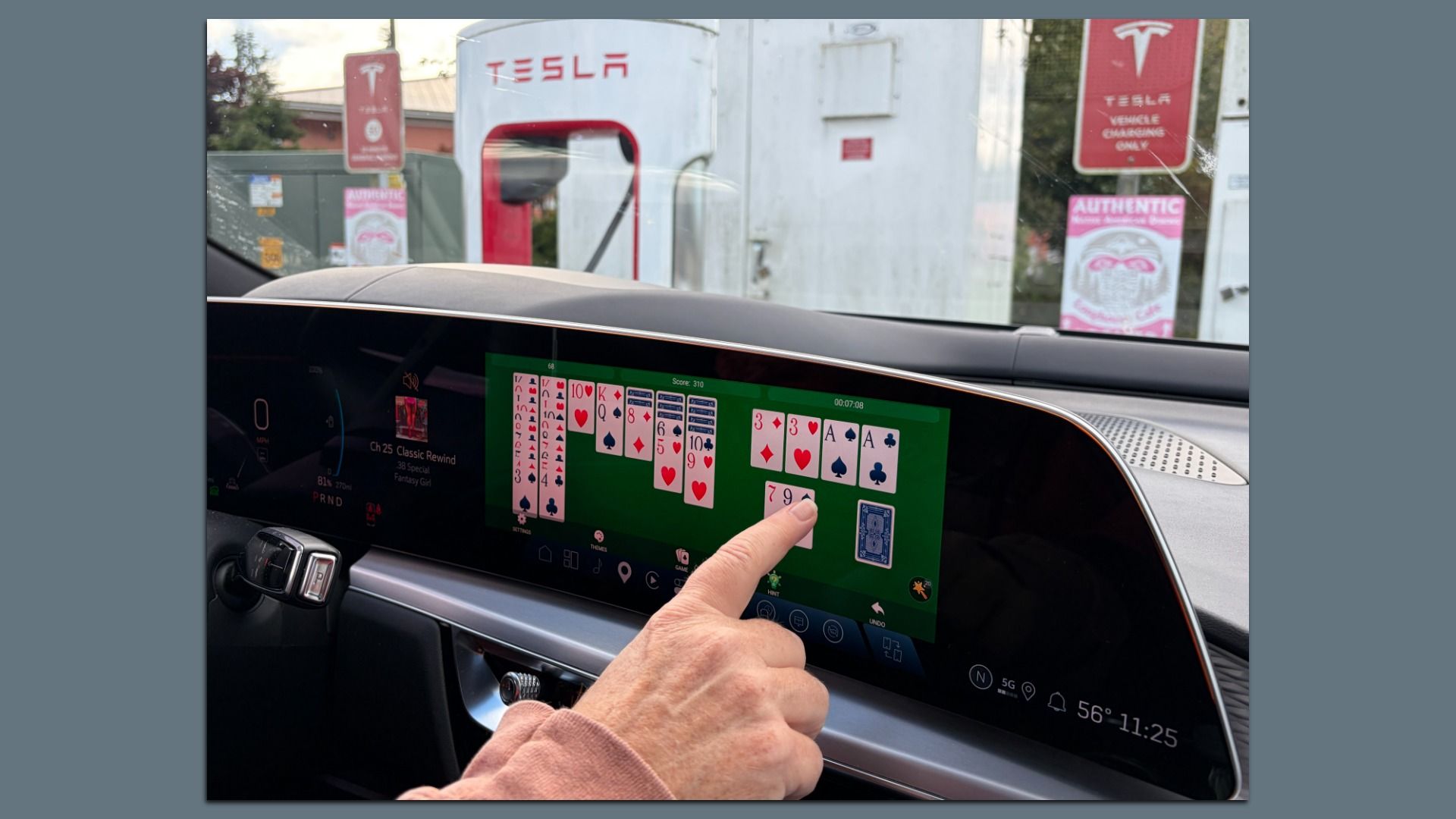
Electric vehicle charging is getting tantalizingly close to effortless, as I discovered on a recent road trip through the Pacific Northwest.
- But every time I thought we'd finally arrived at charging nirvana, some little annoyance reminded me that we're not quite there yet.
Why it matters: Public charging has long been one of the biggest obstacles to EV adoption. Now, automakers are finally eliminating some of the hassles that keep many drivers tethered to gasoline.
🌲 What we did: My husband and I spent two weeks exploring the Oregon Coast and Washington's Olympic Peninsula in a 2026 Cadillac Lyriq on loan from General Motors' press fleet.
- I worried about finding fast-chargers in remote areas, especially within the sprawling Olympic National Park. That wasn't really an issue, though, thanks to the Lyriq's 300-plus mile driving range.
- And I was eager to test GM's new Energy Pass, which streamlines the charging experience — a major pain point for EV drivers — by bringing multiple charging networks into one app, something other carmakers do, too.
🔍 How it works: You only have to enroll once in Energy Pass and add a payment method.
- Then you can find, activate and pay for charging at participating networks, including Tesla, Electrify America, IONNA and Chargepoint. EVGo is coming soon.
- At some chargers, you just click a button on GM's app to start the session.
- It's even easier at networks that support Plug & Charge: You plug in the cable and walk away. The car and charger recognize each other, and payment happens automatically.
Zoom out: Tesla has long set the standard for such a seamless experience at its Supercharger network.
- Now the rest of the industry is catching up by adopting Tesla's North American Charging Standard (NACS), and gaining access to its network.
- Even cars like the 2026 Lyriq, which use the older CCS standard, can charge at many Superchargers with an adapter. (The 2027 Lyriq will have a NACS port to make it even easier.)
Yes, but: Charging speeds in the Lyriq were sometimes disappointing.
- 😩 There were other frustrations, too. Tesla's notoriously short Supercharger cables couldn't reach the Lyriq's front-left charging port unless we parked awkwardly, taking up two spaces.
- And unlike gas stations, most charging sites offered no protection from the elements. Only one stop — at an IONNA station — had a lighted canopy overhead.
What they're saying: GM officials said we likely didn't sufficiently precondition the car's battery.
- If you plug in an EV when the battery is cold, it will take longer to charge. Using the car's built-in navigation system will automatically prepare the battery ahead of the next charging stop, they said.
The bottom line: EV charging has improved enormously since my first EV road trip in 2023.
- I've glimpsed nirvana. Now I just want to experience it at every stop.
3. Honda: North America should unite against China
Honda is urging the U.S., Canada and Mexico to coordinate policies to keep Chinese automakers from gaining a foothold in the American market — even as it acknowledges their arrival is ultimately inevitable.
Why it matters: Chinese automakers are expanding rapidly around the world with inexpensive, technologically sophisticated vehicles, putting pressure on established carmakers to move faster and slash costs.
- "We're not going to be able to keep them out forever," Jennifer Thomas, senior vice president of corporate affairs at American Honda, told reporters during a roundtable discussion Tuesday.
- The challenge, she said, is using that time to become more competitive before Chinese automakers arrive.
Driving the news: Honda is pressing Washington to use upcoming negotiations over the U.S.-Mexico-Canada trade agreement (USMCA) to coordinate restrictions on Chinese vehicles and investment across North America.
- In Canada, Honda has objected to a new import quota allowing up to 49,000 Chinese vehicles annually and is urging officials not to expand it or to encourage Chinese automotive investment in the country.
- In Mexico, where Chinese brands already have a significant presence, Honda is delivering a similar message.
Between the lines: Honda has large factories in both countries that supply U.S. dealerships.
- Thomas said USMCA negotiations could strengthen rules of origin to prevent Chinese vehicles or components from entering the U.S. through its neighbors.
What they're saying: "The U.S. can't do it alone," Thomas said. "It's going to take working with our neighbors to the north and south, working with allies like Japan in order to combat this threat."
The intrigue: Honda's position is striking for a Japanese automaker that helped transform the American auto industry through foreign competition decades ago.
- "It's not lost on me that Honda, a company that has thrived through free trade and foreign direct investment here in this country, is advocating so aggressively to keep another international OEM out of this market," Thomas acknowledged.
- She argued that Chinese automakers benefit from government support that makes fair competition difficult.
Meanwhile, Honda is racing to become more competitive through an internal initiative called "Triple Half," aimed at cutting vehicle development time, costs and workload by 50% compared with 2025 levels over the next several years.
- The company is also pushing for passage of the bipartisan Connected Vehicles Security Act, which would strengthen existing restrictions on Chinese vehicle technology.
Reality check: Thomas believes Chinese automakers will eventually break through because American consumers will demand their affordable, high-tech vehicles.
- As Americans encounter Chinese cars in Canada and Mexico, she said, they'll increasingly wonder why they can't buy them at home.
- "I think it comes from the bottom up, and that is ultimately hard to stop, hard to contain," she said.
4. Drive-thru
🇨🇳 Volkswagen plans to export China-developed technology to overseas markets as it searches for ways to improve its global competitiveness. The once-unthinkable strategic shift is similar to moves Stellantis made earlier this year in response to Chinese automakers' explosive growth. (Reuters)
- 👆 What they're saying: "VW is turning to China and Xpeng to solve its software challenges after a series of painful billion-dollar false starts trying to get the job done with German engineers," says Michael Dunne, CEO of Dunne Insights and author of the upcoming book, "Car Wars: How China Seized the Auto Industry and How America Can Win It Back."
📈 GM is moving its stock listing from the New York Stock Exchange to Nasdaq, reflecting its growing emphasis on AI, autonomy and software-defined vehicles. GM has long argued that it deserves a tech-company valuation. (Axios)
🌎 Rivian acquired Third Dimension, a U.K.-based startup that creates 3D worlds for gaming, to help it accelerate self-driving technology. (TechCrunch)
⛽️ GM plans to introduce hybrid versions of its popular three-row SUVs, the Chevrolet Traverse, Buick Enclave and GMC Acadia, a switch after heavily investing in electric vehicles, Reuters scooped.
5. 🚖 What's driving Nick
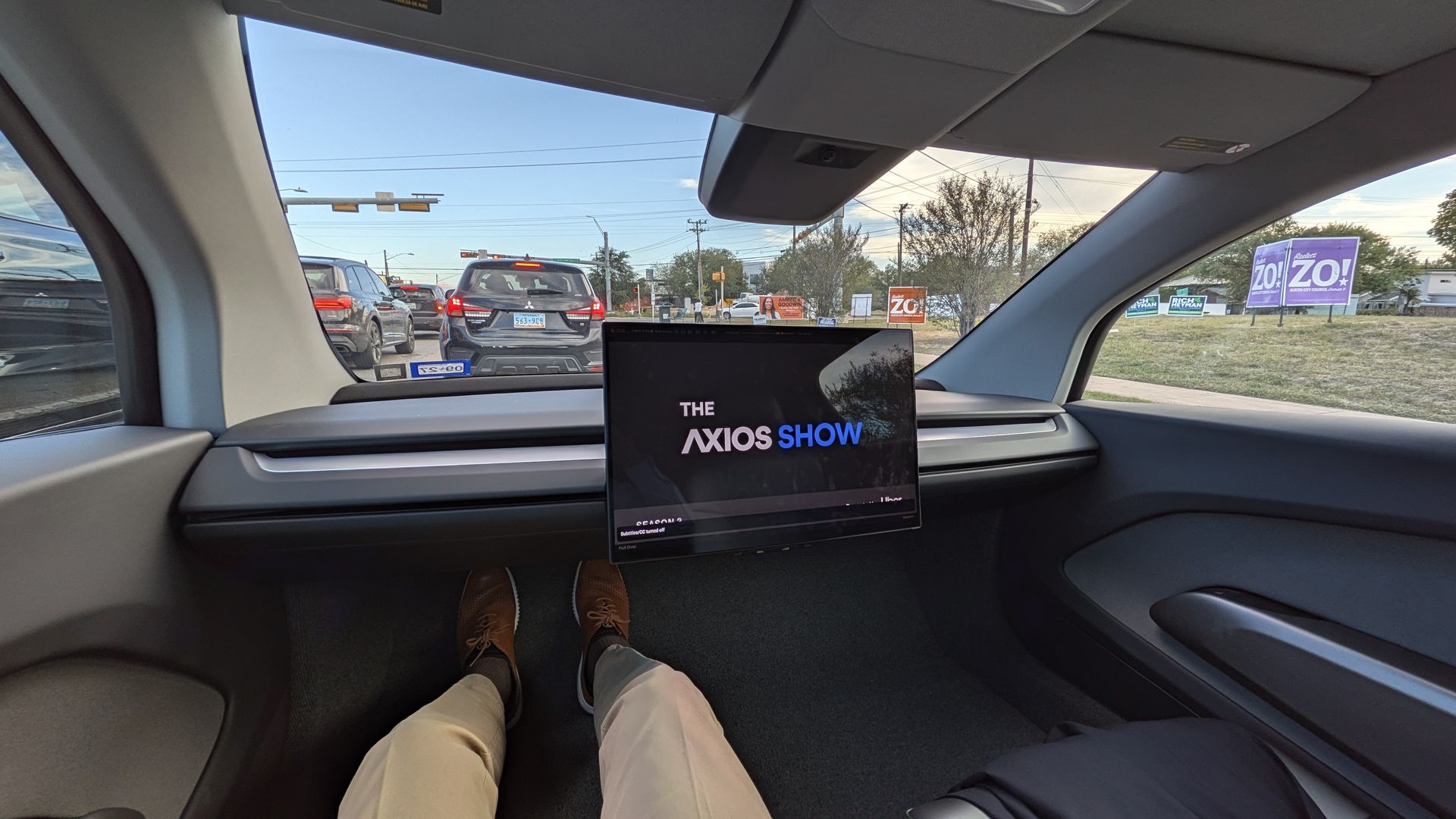
I assigned my boss, Axios Publisher Nicholas Johnston, a self-proclaimed AV aficionado, to file a dispatch from a Tesla Cybercab while he was visiting Austin recently.
Why it matters: I personally haven't gotten to Texas yet for a ride in the gull-winged autonomous taxi.
- And it's fun to make your boss do work!
Nick's big takeaway: The Cybercab is "a great robot-driven ride and a very cool car."
- Plus, he got to watch his favorite show on YouTube. 👆
Zoom in: Nick used Cybercabs to get to and from his hotel in The Domain to Axios events near downtown.
- The rides seemed a bit cheaper than comparable Ubers, he said, and wait times were short after downloading the app.
- It's a confident driver, changing lanes to pass slower cars and zipping through yellow-light intersections like a human, he said.
- Like other self-driving cars, it can struggle sometimes at crowded intersections when it's navigating stop signs and pedestrians.
- "The ride was a lot smoother than the jostling I got in a Lyft ride from the airport," he wrote. "It also picked me up where I wanted and dropped me off where I wanted; no walking to specific spots."
Yes, but: The absence of a steering wheel or mirrors can be disorienting when you want to look behind the car and reflexively glance to the side (though you can turn on cameras).
- The Cybercab didn't have highway access, either, which made his trips 15 to 20 minutes longer, he estimates.
1 juvenile thing: You can tip the robot driver 69 cents or $4.20 after the ride.
Thanks to editors Pete Gannon and Amy Stern. If you're a fan of this newsletter, please ask your friends to sign up, too.
Sign up for Axios Future of Mobility