Axios Future of Health Care

April 26, 2024
Good morning, and happy Friday.
- 🏥 We're moving right along our roadmap of topics and taking a deep dive into hospitals this week.
- Per usual, just hit reply to this email to join the conversation!
Today's word count is 1,443, or a 5.5-minute read.
1 big thing: Hospitals' forced makeover

Illustration: Gabriella Turrisi/Axios
Hospitals' business models are being upended by fundamental changes within the health care system, including one that presents a pretty existential challenge: People have far more options to get their care elsewhere these days.
Why it matters: Health systems' responses to major demographic, social and technological change have been controversial among policymakers and economists concerned about the impact on costs and competition.
- Communities depend on having at least some emergency services available, making the survival of hospitals' core services crucial.
- But without adaptation — which is already underway in some cases — hospitals may be facing deep red balance sheets in the not-too-distant future, leading to facility closures and shuttered services.
The big picture: Many hospitals have recovered from the sector's post-pandemic financial slump, which was driven primarily by staffing costs and inflation. But systemic, long-term trends will continue to challenge their traditional business model.
- Many of the services that are shifting toward outpatient settings — like oncology, diagnostics and orthopedic care — are the ones that typically make hospitals the most money and effectively subsidize less profitable departments.
- When hospitals lose these higher-margin services, "you're starving the system that needs profits to provide services that we all might need, but particularly uninsured or underinsured people might need," said UCLA professor Jill Horwitz.
And hospitals have long claimed that much higher commercial insurance rates make up for what they say are inadequate government rates.
- But as the population ages and moves out of employer-sponsored health plans, fewer people will have commercial insurance, forcing hospitals to either cut costs or find new sources of revenue.
By the numbers: Consulting firms are projecting a bleak decade for health systems.
- Oliver Wyman recently predicted that under the status quo, hospitals will need to reduce their expenses by 15-20% by 2030 "to stay viable."
- Boston Consulting Group last year projected that health systems' annual financial shortfall will total more than $200 billion by 2027, and their operating margins will have dropped by 10 percentage points.
- To break even in 2027, a "typical" health system would need payment rate increases of between 5-8% annually — twice the rate growth over the last decade, according to BCG. If the load is borne solely by private insurers, hospitals will need a 10-16% year-over-year increase.
Between the lines: This is the lens through which to view health systems' spree of mergers and acquisitions, which have increasingly drawn criticism from policymakers, regulators and economists as being anticompetitive.
- For better or worse, when hospitals have a larger market share, they are in a better position to negotiate and bring in more patients, and they can dilute some of the financial pain of poorer-performing facilities.
- And when they acquire physician practices or other outpatient clinics, they're still getting paid for delivering care even when patients aren't receiving it in a traditional hospital setting.
- "I think the hospitals have sort of said ... 'We can keep doing things the same way and we can just merge and get higher markups,'" said Yale economist Zack Cooper. "That push to consolidate is saying, 'Let's not move forward, let's dig in.'"
Yes, but: A big bonus of outpatient care is that it's supposed to be cheaper. But when hospitals charge more for care than an independent physician's office would have, or they tack on facility fees, costs don't go down.
- And there's a growing body of research showing that when hospitals consolidate, costs go up.
- "They've protected their portfolio, and that's added to the cost of health care," said Johns Hopkins professor Gerard Anderson.
The other side: Hospitals are typically on the losing end of negotiations with insurers right now, thanks to how large insurers have become, and are "in an extremely difficult competitive position," said Ken Kaufman, co-founder of consulting agency Kaufman Hall.
- Criticizing their mergers and acquisitions as anticompetitive is a "complete misunderstanding of the situation," he said, and moving toward a new care model will take "an incredible amount of resources."
Reality check: Hospitals account for 30% of the country's massive health spending tab, and they'll have to be at the forefront of any real efforts to contain costs.
- They're also anchors in their communities and are powerful lobbyists, which helps explain why Congress has struggled to modestly reduce what Medicare pays hospital outpatient departments.
2. The emerging divide

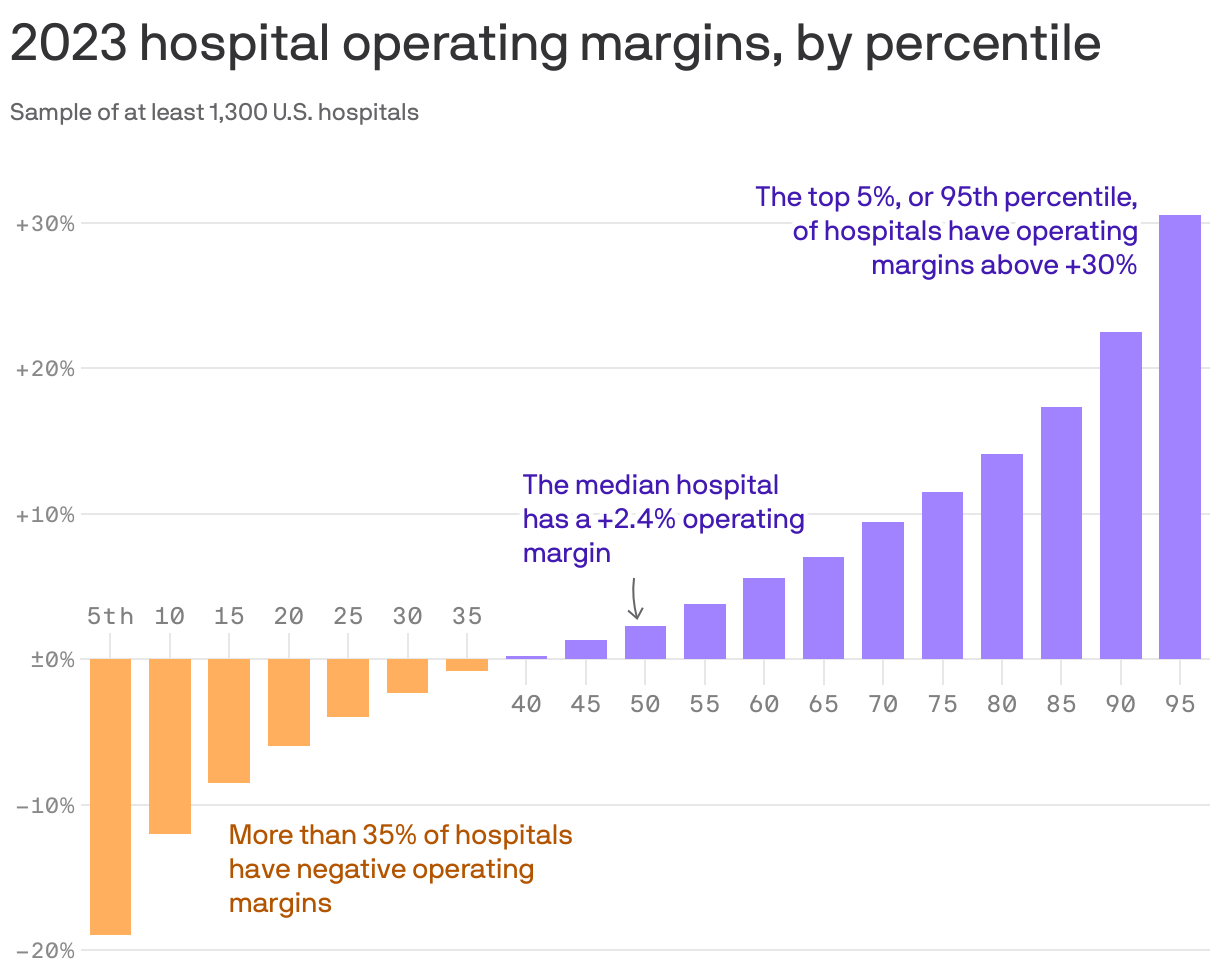
Some health systems have recovered from the pandemic much better than others, and those with healthier margins tend to be the ones that made a stronger push into outpatient care.
By the numbers: There's a wildly large and growing difference between the operating margins of top-performing health systems and those at the bottom, according to Kaufman Hall data shared with Axios. (Go deeper on their analysis.)
- "The hospitals that are not performing well are performing worse, but the hospitals that are recovering are performing extremely well," firm co-founder Kaufman told Axios.
- "I would say hospitals that are not doing particularly well … they're not capturing that outpatient work, or at least not at the level that they need to," he added.
Yes, but: Operating margin is only one measure of a hospital's financial health, and total margins are often much higher, said Anderson, the Johns Hopkins professor.
- "You diversify where there is potential profit, and they have moved into all sorts of things where there is profit," he added. "They have a whole portfolio of ways to make money now that they didn't have 20 years [ago]."
- Some experts also say that hospitals aren't disciplined about keeping costs down.
- "I think partly what happened over time is that … investments were not treated as investments, but as costs," said Cooper, the Yale economist.
3. The hospital of the future

Illustration: Sarah Grillo/Axios
Economists say in an ideal world, different hospitals will specialize in different forms of care while others — particularly in rural areas — will focus on providing basic services.
Why it matters: The hospital of the future will likely mean a significantly different patient experience, in ways both obvious (it'll have better technology) and potentially disruptive (it could require more travel).
- "My own view of what it's going to look like in the longer run is much, much fewer hospitals that are much, much bigger," said Yale's Cooper.
Where it stands: Many health systems are already cutting service lines — maternity care is a common one — or closing altogether, especially rural hospitals.
- To some extent, that may be OK, some experts say. The reality created by shifting demographics is that some places just don't have the population necessary to support certain services.
- Not only do the economics not work, but a handful of specialized procedures every year probably isn't enough to keep providers well-trained.
Between the lines: Instead of consolidation, there should be more of a divergence between hospitals that provide basic care to local communities and those that specialize in more complex care, Cooper said.
- That model, of course, would mean many patients would have to travel for certain care instead of receiving it at their local hospital.
And as technology broadly changes the consumer experience, patients will have similar expectations for their care.
- "People's gold standard is buying stuff on Amazon at 2 in the morning, and when they compare their health care experience, they say, 'Why can't my health care experience be more like that?'" Kaufman said.
- Emerging medical technologies will also impact the care that people receive, and hospitals are positioning themselves at the forefront of that change.
- "Patients right now — and in the future — can expect more care delivery that is driven by 3D modeling; predictive analytics; advanced robotics for surgeries and treatments; and personalized therapies based on genomics," American Hospital Association president and CEO Rick Pollack wrote in a blog post last year.
Yes, but: Hospitals that serve higher populations of vulnerable people, who are more likely to have lower-paying government insurance, are the most financially exposed.
- That means if they don't adapt, care could become even less accessible for these patients.
Some economists' ideal version of the future may mean lower profits for health systems.
- Hospitals "should do what they do best, which is inpatient care and emergency care … and other people should do things that they do best, like the physicians working together as a multi-specialty group but not part of the hospital," said Johns Hopkins' Anderson.
- "They wouldn't make the substantial profits they're making, but for the nonprofits, that's not the goal," he added.
The bottom line: "Is there going to be disruption? Yes," Cooper said. "I think there's a romanticism about local hospitals. They're where our kids were born and where our parents spent their final days."
- "But I firmly believe the local hospital of the future is not doing everything for everyone."
Thanks to Nicholas Johnston and Jason Millman for editing and Matt Piper for copy editing.
Sign up for Axios Future of Health Care

Keep up with health care politics, policy and business