Axios Future of Health Care

August 30, 2024

Good morning! Welcome to Labor Day weekend — hope you have fun plans!
- I wanted to give you a nice light chart to start the long weekend. But as almost always, things got more complicated than I anticipated. Sorry about that!
Today's word count is 1,929 or a 7-minute read.
1 big thing: Into the hospital margin rabbit hole
I wanted to write about hospital Medicare margins this week, but as I started talking to people, they didn't really want to talk about the numbers; they wanted to talk about how analyzing them is kind of pointless because hospital costs are at least partially a product of choice.
Why it matters I: The idea that hospitals can control their costs more than they let on challenges their primary defense of business practices that some economists already decry as indefensible or, at least, unsustainable.
Driving the news: The takeaway from a recent Third Way report is that more than half of hospitals make money on Medicare.
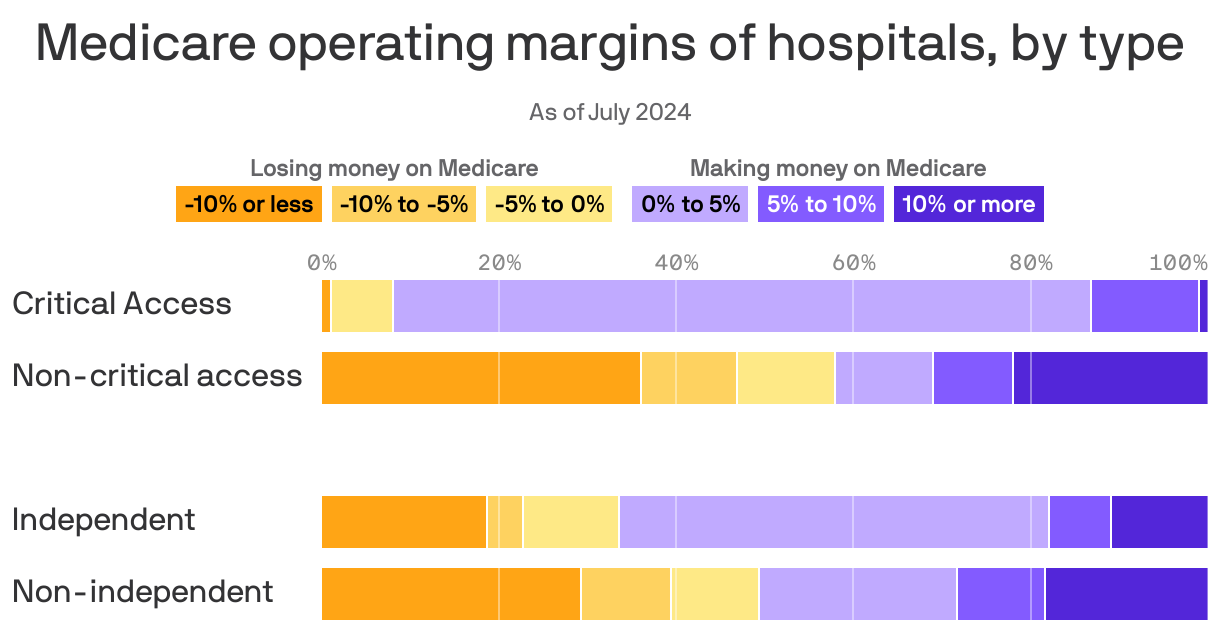
- And some hospitals make more money on Medicare patients than others; including for-profits, critical access hospitals, and independent hospitals, according to further Third Way analysis provided to Axios.
Why it matters II: If the U.S. is ever going to seriously address its high health care costs, the solution will almost certainly have to include hospital spending, which makes up the largest chunk of total spending.
- But hospitals argue that the industry is barely getting by, especially in the post-pandemic era of high labor costs and inflation. And no one disputes that many hospitals around the country are struggling to stay afloat.
- Efforts to cut from their more lucrative lines of business — thus saving patients and taxpayers money — would upset the delicately designed balance sheet, hospitals say, because they need those profits to offset the losses they incur from Medicare and Medicaid.
- But the Third Way analysis presents a different narrative: Hospitals can — and often do — make money off of Medicare. Economists argue those who don't may have little incentive to try, at least via lowering their costs.
The big picture: "Hospitals' costs are in their control, and so there are plenty of hospitals that see lots of Medicaid patients who are able to make money on Medicare patients," said Zack Cooper, a health economist and Yale professor.
- "Conversely, some of these academic medical centers are set up to primarily make money off of the privately insured and attract privately insured patients," he added. "So it often looks like they're making losses on Medicare patients, but that's a choice that they've made."
"Margins you have revenue and cost. If cost is inflated, then the margins may not be representing what's truly happening," said Arnold Ventures executive vice president Mark Miller.
- "The question is, how much of that is legitimate, and how much of that is being driven by the fact that they're being paid so much on the commercial side that their costs are being driven by that."
The other side: "The report doesn't acknowledge that according to the government's own data via the Medicare Payment Advisory Commission (MedPAC), the federal body charged with advising Congress on the Medicare program, hospitals' Medicare margins for inpatient care in 2022 were negative 11.6%," the AHA wrote in a blog post responding to the report.
- "Said another way, hospitals lost $100 billion by providing care to Medicare patients."
Between the lines: The AHA is correct: The Third Way conclusion is pretty different than MedPAC's. The report's authors say that's because of methodology and how the groups account for costs and revenue.
- But the variability in hospitals' financial performance is consistent, as is the on-its-face somewhat counterintuitive relationship between Medicare margins and commercial prices.
- That argument goes like this: Hospitals that can obtain more revenue from private insurers have more money and less incentive to keep their costs down. In fact, nonprofit hospitals often plow excess revenue right back onto the balance sheet as costs.
- That makes the cost component of the Medicare margin equation higher at these hospitals with more commercial patients and/or higher commercial prices.
In MedPACspeak from earlier this year: "Ascertaining the 'true' costs of care for Medicare beneficiaries is challenging ... when providers receive high payment rates from insurers, they face less pressure to keep their costs low, and so, all other things being equal, their FFS Medicare margins are low because their costs are high."
- And to really drive this full circle, MedPAC links this dynamic back to consolidation, which we've talked about a lot in this newsletter.
- "Lack of fiscal pressure is more common in markets where a few providers dominate and have negotiating leverage over payers. This situation is becoming more common as providers continue to consolidate."
Let's get into the nitty gritty below...
2. Diving into the weeds

Time to get wonky about margins! Let's start with the topline:
- The Third Way analysis found that 55% of hospitals made money on Medicare in 2022, based on hospitals' own financial reports.
- Third Way combined traditional Medicare and Medicare Advantage for this analysis. The data they used show that Medicare margins are, on average, -5% for traditional Medicare and 0% for Medicare Advantage, author David Kendall told me.
- MedPAC, on the other hand, reported earlier this year that hospitals' average Medicare margin fell to a "record low" in 2022, which was -11.6% (This is the number quoted by the AHA if you recall from above).
Details: Third Way used a dataset compiled by the National Association for State Health Policy and supported by Arnold Ventures that uses cost reports submitted by hospitals to the federal government.
- The AHA in its blog post argued that the dataset "inflates hospitals' margins by both undercounting hospital costs as well as incorrectly counting hospital revenue (including by assuming revenue that demonstrably does not exist)."
I called up Arnold's Miller to discuss the differences between the datasets since he's a former MedPAC executive director in addition to his current title.
- He said the datasets have different purposes, so neither is the "right" one. But he wanted to talk more about the fake costs idea, and he said Third Way's finding that independent hospitals have better Medicare margins than health systems makes perfect sense.
- "If you have pressure from your revenue, you actually contain your costs. But if you're a large hospital system, you have a consolidated position in the market, you're not under fiscal pressure and your costs are higher," he told me.
- "The richest hospitals in this country have the worst Medicare margins. It's so much revenue that their costs follow the revenue, and that, of course, made them much worse on Medicare."
When you hear hospitals talk about "investments," those are costs. At a very high level, they can be broken down into clinical and non-clinical spending.
- "Imagine I make lots of profits in one year and I decide to build a new cancer center or I choose to recruit a bunch of really good doctors at really high pay. That's going to make my costs pretty high," Yale's Cooper said.
- "I'd rather them go to high-quality doctors than self-playing musical instruments in the lobby," he added.
The bottom line: Separate research has found that hospitals with more potentially privately insured patients have higher quality, which takes money.
- "As the spread between private and Medicare goes up, you're more incented to attract more privately insured patients, and part of the way you attract more privately insured patients is really investing in things that privately insured patients want," Cooper said.
My thought bubble: Thanks for coming with me on this journey, where we basically ended up at the idea that hospitals' costs may be related to the kind of patients they want to — or do — attract. And that's not people with lower-paying government insurance, at least when looking at it through a financial lens.
- That seems to me like a pretty big idea in itself — hit reply if you have thoughts!
3. Axios Interviews: Focusing on quality

I recently visited NYU Langone, where I had the chance to sit down with CEO Bob Grossman, who's held the position since 2007 and is retiring next year.
- He's also the dean of NYU Langone's medical school.
I was particularly interested in his thoughts as NYU Langone Health is doing very well financially and reported a 7.4% operating margin in its latest quarterly report.
- One thing that struck me in conversations throughout the day: There was very little doom and gloom! That's a stark contrast to a lot of the conversations I have with hospital groups, which are always very concerned about money and financial ruin.
Here's a lightly edited version of our Q&A:
Q: What is transformative about what you are working on?
- Number one, we changed the culture. That's really important. It's a culture that's focused on quality and safety and outcomes. Number two, we are really data-driven. Number three, we went from an inpatient model to an ambulatory model with a small number of hospitals.
- Number four, we wanted to recruit doctors who are at the bleeding edge of their field. Things like face transplants, eye transplantations, xenotransplants, and using catheters to do all these amazing things, both in cardiology and neurosurgery.
Q: One trend transforming health care that we're not paying enough attention to?
- I think the electronic state of health care has really been transformative ... This whole electronic age has transformed many specialties, and obviously associated with that is the electronic health record system, which is now on your phone.
- So what's next? You have all these devices where you're getting information on a contemporaneous basis, and I think we're going to get a lot more information about humans where everyone is wearing and having all this information that's ultimately going to come to data warehouses and be diced and sliced.
Q: Biggest challenge health care faces?
- The government, by far, because of the uncertainty .... Businesses always like certainty. They're happy if they know there's going to be a tax increase — as long as they know it. But what they can't and what they don't know is the unpredictable, and in the government health care is very unpredictable.
Q: Biggest opportunity?
- Quality and safety trumps everything, and so what we see is this flight to quality. Take away all the bulls**t, everybody wants the best quality health care...
- If your name represents quality and safety, patients are going to come, and that's a huge opportunity. It's the brand that actually attracts the patients.
Q: Do you think the government does need to do anything to reduce the cost of health care?
- The way to reduce health care costs is to emphasize quality and safety and pay for that. In the United States, the government assumes quality and safety. So in other words, if you do liver transplants, and she does liver transplants, they're going to pay the same amount to you as they do to her. Now suppose she has three times the complications that you have — should they pay it?
- I think they have to steeply incent quality and safety. If they did that, it would change the game.
Q: What's your go-to piece of advice?
- For his kids: Hard work. Be a worker and have humility, because you can't learn without humility and there are a lot of smart people. But the people who are successful are people who are hard workers.
- And for his wife: My wife's a physician, so my advice for her is to keep doing what you're doing because you'll drive me crazy if you stop. (Yes, he laughed while saying this!)
Q: What's your morning routine?
- I get up around 4:30, and I read. I'm a big reader. I tend to read all the newspapers ... then I work out at 6 o'clock usually, on the days I don't have to be here that early, then I get to work and I'm scheduled usually every half hour.
Thanks for reading! Many thanks to editor Nick Johnston and copy editor Patricia Guadalupe.
Sign up for Axios Future of Health Care