Axios Future of Energy
March 31, 2026

🌮 Happy Tuesday. Hope there are some tacos in it for you (but not too many). We've got a stuffed edition with news on:
- Building nuclear reactors
- Energy shock's effects
- COVID-19 and the current crisis, and more, all in 1,289 words, 5 minutes.
🚨Situational awareness: U.S. average gas prices have hit $4 per gallon nationwide, per AAA — a 35% increase at the pump since the war in Iran began.
🎵 Today's intro tune is a chart smash throwback to 20 years ago this month, and seems fitting for a future that seems wholly unwritten...
1 big thing: The race to build new nuclear reactors — fast

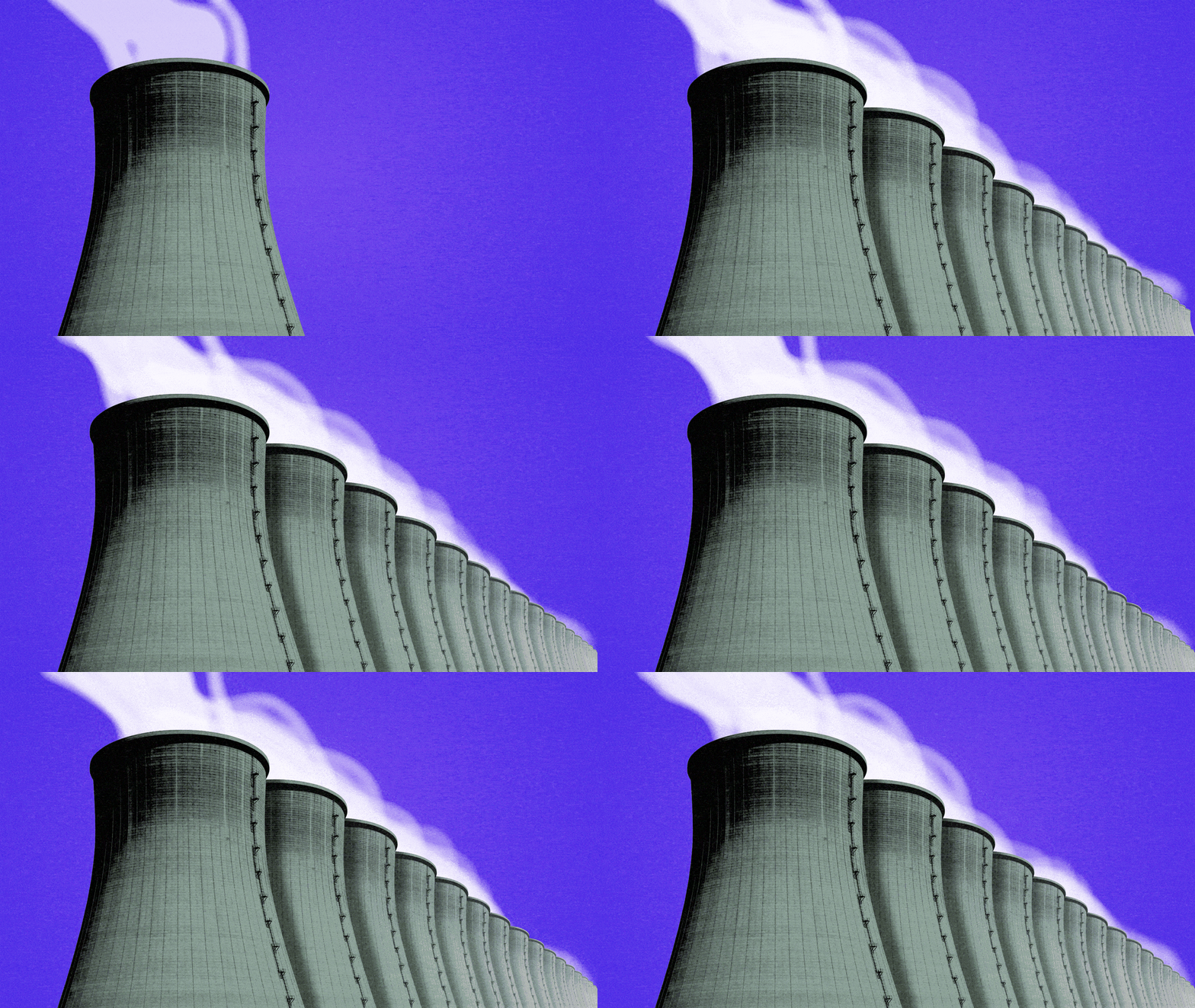
HOUSTON — As nuclear energy industry deals pile up, executives are turning their focus to what many describe as a huge challenge: How to build multiple plants quickly.
Why it matters: Nuclear energy is seen as critical to supplying enough power for AI data centers' massive electricity needs.
- And AI itself is being seen as part of the solution.
The big picture: A March report from the Nuclear Scaling Initiative research group concluded that "a concentrated set of structural bottlenecks" has created "an industrial capacity constraint" on future nuclear plant projects.
- Unless that constraint is addressed, the result could be a series of one-off projects "rather than sustained, multi-unit delivery" of new plants, said the group, a collaboration among the Nuclear Threat Initiative, Clean Air Task Force and EFI Foundation.
- The report said that while nuclear technology has advanced rapidly, other areas — such as the development of supply chains as well as enough skilled workers to build the plants — have not.
Driving the news: At last week's CERAWeek energy conference in Houston, industry officials predicted that companies' willingness to try new approaches — particularly with AI — will speed things up.
- "It's much more of a Silicon Valley-type ecosystem than we've ever seen in this sector," John Kotek, the Nuclear Energy Institute's senior vice president of policy development and public affairs, told Axios.
- Two tech industry heavyweights — Nvidia and Microsoft — announced last week they're joining forces on a new initiative aimed at breaking nuclear construction bottlenecks.
- It involves using AI tools that can help identify documentation inconsistencies, make sure the data for plant construction is consistent from beginning to end, and support "digital twins" — virtual replicas that allow engineers to test changes.
Zoom in: Aalo Atomics said it already has cut the time-intensive permitting process by 92% using Microsoft's Generative AI for Permitting solution while saving about $80 million a year.
- Aalo broke ground last year on a precursor to the "Aalo Pod," a reactor designed for data centers that the company says will be in commercial use by 2029.
- Aalo aspires to a "copy and paste" approach, said Jon Guidroz, the company's senior vice president of commercialization and strategy.
Another advanced-nuclear company, Kairos Power, said it's also aiming for a copy-and-paste approach by building in both New Mexico and Tennessee and comparing what works, said Mike Laufer, Kairos' CEO.
- "So if you kind of combine those two, we're getting a lot of real information," Laufer said at a CERAWeek panel.
Zoom out: Getting a qualified workforce fully up to speed to build many plants will take time, said Ross Ridenoure, Hadron Energy's chief nuclear officer.
The bottom line: Hyperscalers are bringing more than just a demand for electricity to the nuclear field — they're bringing a much-needed sense of urgency, said TerraPower president and CEO Chris Levesque.
- "They're really kind of shocking our pretty slow-moving industry," he said.
2. America's less energy-intensive economy


The U.S. has a key advantage in weathering the Iran war-triggered energy shock that was missing in previous episodes of overseas tumult: an economy that has become substantially less energy-intensive.
Why it matters: Higher prices at the gasoline pump, for jet fuel and for diesel will no doubt hurt. But in relative terms, both the average household and the economy as a whole have more capacity to weather the hit than in the past.
The big picture: Over recent decades, the share of U.S. economic activity has increased in service industries that demand less energy. And the sectors that do require large-scale energy resources have become more efficient.
- At the household level, wages have risen rapidly enough that gasoline and other energy sources are a smaller share of household expenses than in many previous energy shocks.

3. The oil market's COVID moment
The oil shortage brought on by the Iran war will spread throughout the world, much as COVID-19 did, moving from east to west and leaving a path of destruction in its wake, a new analysis says.
Why it matters: If the oil shock plays out along those lines, it would mean the global economy has only just begun to feel the pain of the war's impact.
Catch up quick: During the pandemic, demand for oil plummeted by about 7 million barrels a day.
- Gas prices plunged, and at one point oil prices went negative in the U.S.
Where it stands: Now there's about twice as much oil missing from the global market because tankers can't get out of the Strait of Hormuz.
- But we haven't yet seen a disruption that looks anything like the pandemic.
The big picture: If this crisis continues, and millions of barrels of oil are sucked out of the global economy, the situation will get nasty.
- It will lead to what economists call "demand destruction," as Peter Coy explained yesterday on Substack.
- That means that prices have to get high enough to force people and companies and economies to stop using oil — "to get a whole bunch of cars and trucks off the road, ships off the seas, planes out of the sky, et cetera," Coy wrote.
- "In a word, ugliness."
4. Iran news: Trump's threat, tolls, Zelensky's assessment, Houthis
🇮🇷 Trump threat: President Trump threatened yesterday that if a deal with Iran "is not shortly reached" and if the Hormuz Strait isn't open "immediately," the U.S. will "completely obliterate" Iran's power, energy and water infrastructure.
- Why it matters: His threat to bomb Iran's water supply would constitute his most dramatic breach of the laws and norms designed to protect civilians in wartime.
💰Toll time? Iran's parliament approved a plan to collect tolls on vessels traveling through the strait, according to Iranian state media. It also attacked and set ablaze a giant oil tanker off Dubai.
🇷🇺 Ukraine's view: Ukrainian President Volodymyr Zelensky believes a long war in Iran would be very good for Russia and very bad for Ukraine, he told Axios' Barak Ravid.
- Why it matters: Zelensky told Axios: "I am sure Russia wants [a] long war. They have benefits: The U.S. is focusing on the Middle East and may decrease military help to Ukraine. Sanctions are partially lifted. I see only benefits for Russia from the war with Iran continuing."
🇾🇪 Houthi complications: The Houthis — a military rebel group from Yemen — have joined the Iran war, massively complicating the road ahead for the U.S. Here's an explainer on why.
5. Catch up fast: Pollution rules, coal, BP
🌬 EPA challenge: Public health, environmental and other groups, including the American Lung Association and Sierra Club, filed suit in federal court yesterday challenging EPA's repeal of updated limits on mercury and air toxics from power plants.
- Why it matters: The groups say the EPA is putting the public at risk. An EPA spokesperson declined to comment on pending litigation.
🏭 Colorado coal: Energy Secretary Chris Wright yesterday issued an emergency order to keep another coal plant operational — this one in Colorado.
🚗 EV move: Per FT, "BP has lost the head of its electric vehicle charging division for the second time in a year, as it scales back investment in its energy transition businesses and refocuses on oil and gas ahead of the arrival of its new chief executive this week."
✅ Thanks to Chuck McCutcheon, David Nather and Chris Speckhard for editing and to our brilliant Axios visuals team.
Did a friend send you this newsletter? Welcome, please sign up.
Sign up for Axios Future of Energy