Axios Future of Energy

January 13, 2026

โ Tuesday. We're opening with a wide-angle look at the climate movement, then moving into lots of news, all in 1,489 words, 5.5 minutes.
๐ Thanks to Chuck McCutcheon and Chris Speckhard for edits to today's newsletter, along with the brilliant Axios Visuals team.
๐ง At this moment in 1990, Janet Jackson ruled Billboard's R&B chart with today's exquisite intro tune...
1 big thing: The world's great climate collapse
The climate agenda's fall from grace over the past year has been stunning โ in speed, scale and scope.
Why it matters: Whether this collapse in climate-change ambition proves permanent or temporary will shape the planet โ which is still warming in unprecedented ways โ and trillions of dollars in global energy investment.
Driving the news: President Trump last week announced that he's withdrawing from the world's flagship climate treaty that's been in place for more than 30 years, making the U.S. the only country not to be part of it.
- "There's no hand-waving about how 'We want to cooperate on climate,'" oil historian and S&P Global vice chairman Dan Yergin said in an interview. "It's, 'We're slamming the door on that issue.'"
- "We've gone from over-indexing it to zero-indexing it."
The big picture: The last 30 years of global history "was an exceptionally unusual period," said Nat Keohane, president of the nonprofit Center for Climate and Energy Solutions.
- After the Cold War, countries โ led by the U.S. โ bonded together and created global institutions.
"Climate policy was facilitated by multilateralism, globalization and the sense nations had a common agenda far more than the world we live in right now," Yergin said.
Catch up fast: The last year has seen an epic reversal that spread quickly from governments to boardrooms to pop culture.
- Click here to see the rundown โ beginning with Trump, with stops in Canada and Europe, and ending with Hollywood's "Landman."
Yes, but: Climate ambition isn't collapsing everywhere โ or all at once.
- The New York Times used "tiptoe" in this headline about Europe's retreat on climate issues for a reason: The bloc is still largely sticking to its long-term goals.
- Trump's muscular support for nuclear fission and fusion could have the unintended consequences of helping address climate.
The intrigue: These reversals represent a retreat from the goal of "net zero" emissions by 2050 โ but not a wholesale retreat from climate action itself.
- Instead of banning gasoline cars by 2035, the European Union now requires a 90% reduction in tailpipe emissions by then. Translation: It's a pullback from a maximalist goal โ but still an aggressive one.
- Though it deleted many Inflation Reduction Act climate provisions, Trump's One Big, Beautiful Bill Act preserved support for geothermal, energy storage and other technologies and would still rank among the biggest cleantech laws ever passed.
What's next: Climate is among the official themes at the annual World Economic Forum, which meets next week in Davos, Switzerland.
- "How can we build prosperity within planetary boundaries?" the forum asks in one theme. But the main one underscores a more fundamental challenge: "How can we cooperate in a more contested world?"
2. ๐ Climate venture capital deals fall from 2021 high
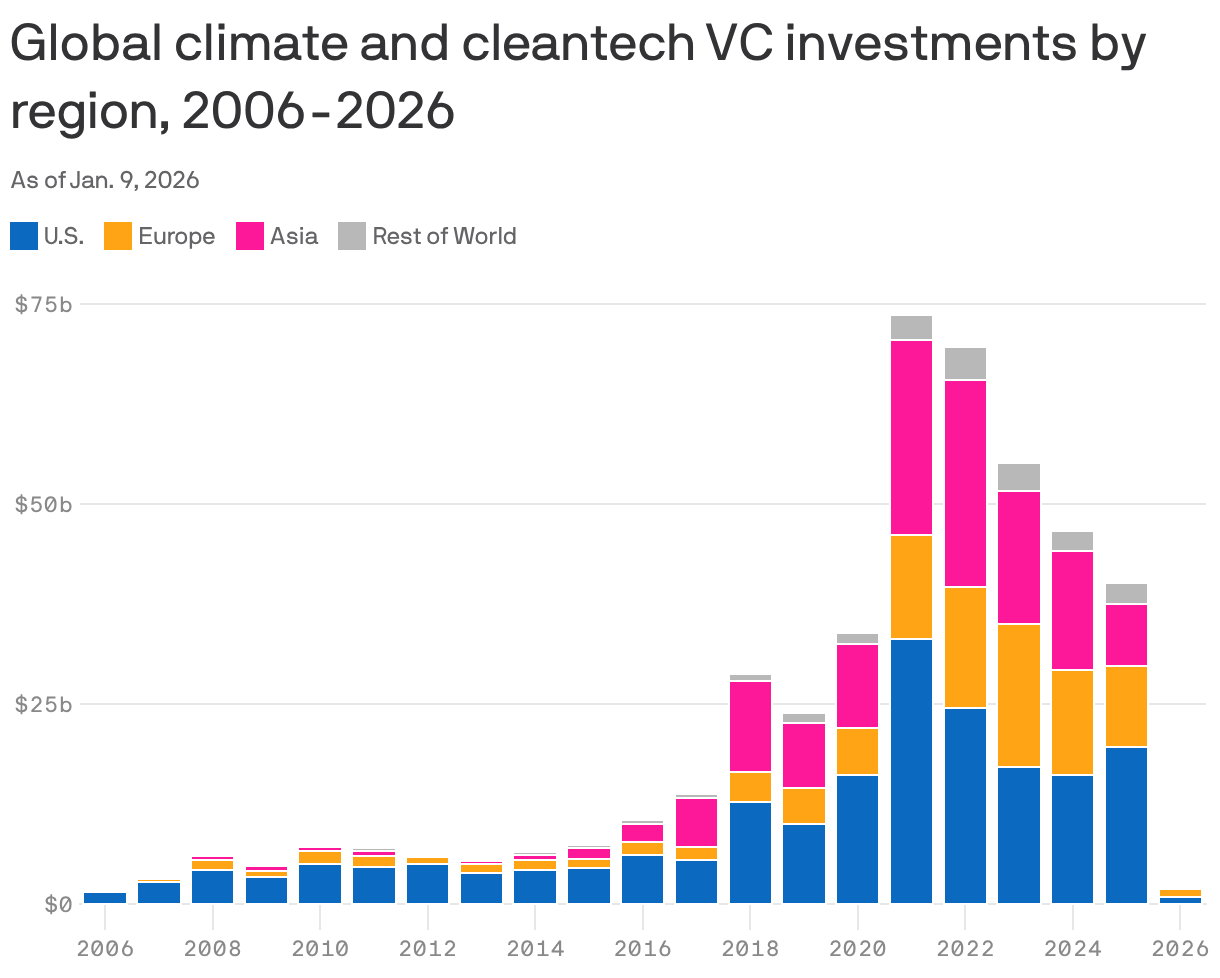
Global venture capital investments into climate and clean tech deals have dropped nearly 50% since their high of 2021, according to PitchBook data compiled for Axios.
Why it matters: VC deals have fallen due to the aforementioned climate ambition collapsing โ and a necessary correction from market frothiness, investors say.
Reality check: Even this fall is still far higher than earlier periods. The roughly $40 billion in investments last year still represents a roughly 450% increase since 2015, when the Paris Agreement was signed.
Driving the news: The rush for power to fuel AI is boosting parts of climate tech โ especially nuclear power โ but it's far from clear whether it will be a net positive for climate efforts overall.
What they're saying: "We need to embrace the energy boom as a good thing, but also to lean into the need to do it in a low-carbon way," said Keohane.
The intrigue: Some estimates even show a slight increase between 2024 and 2025, thanks to AI and nuclear deals, Axios' Alan Neuhauser reports from Sightline Climate data.
Flashback: "I think there was a necessary recalculation from the frothiness of the earlier part of the decade," said Gabriel Kra, co-founder of climate VC firm Prelude Ventures.
What we're watching: Whether VC investments bottom out here, keep falling or start to rise significantly again. "What's continued to happen now is an irrational swing in the other direction," Kra said.
3. ๐ต Microsoft boss vows to "pay our way" on data center power

Breaking: Microsoft President Brad Smith said the company will "pay our way" to ensure its data centers don't raise power prices โ and Trump posted that other tech giants will follow suit.
Why it matters: The industry faces backlash against the growth of huge AI data centers.
- The pledge is part of Microsoft's wider new principles for building "Community-First AI Infrastructure."
Driving the news: Microsoft will "ask utilities and public commissions to set our rates high enough" to cover costs of adding and using power, Smith said in a blog post.
- The company is vowing work with utilities on new generation and improving grid infrastructure.
What we're watching: Other corporate and regulatory efforts popping up to handle AI energy thirst and limit prices increases.
- "I never want Americans to pay higher Electricity bills because of Data Centers," Trump wrote on Truth Social.
- One example: FERC recently ordered PJM, which operates the largest U.S. grid, to better enable co-location of data centers and power sources.
4. ๐ U.S. emissions rise could preview bigger spikes
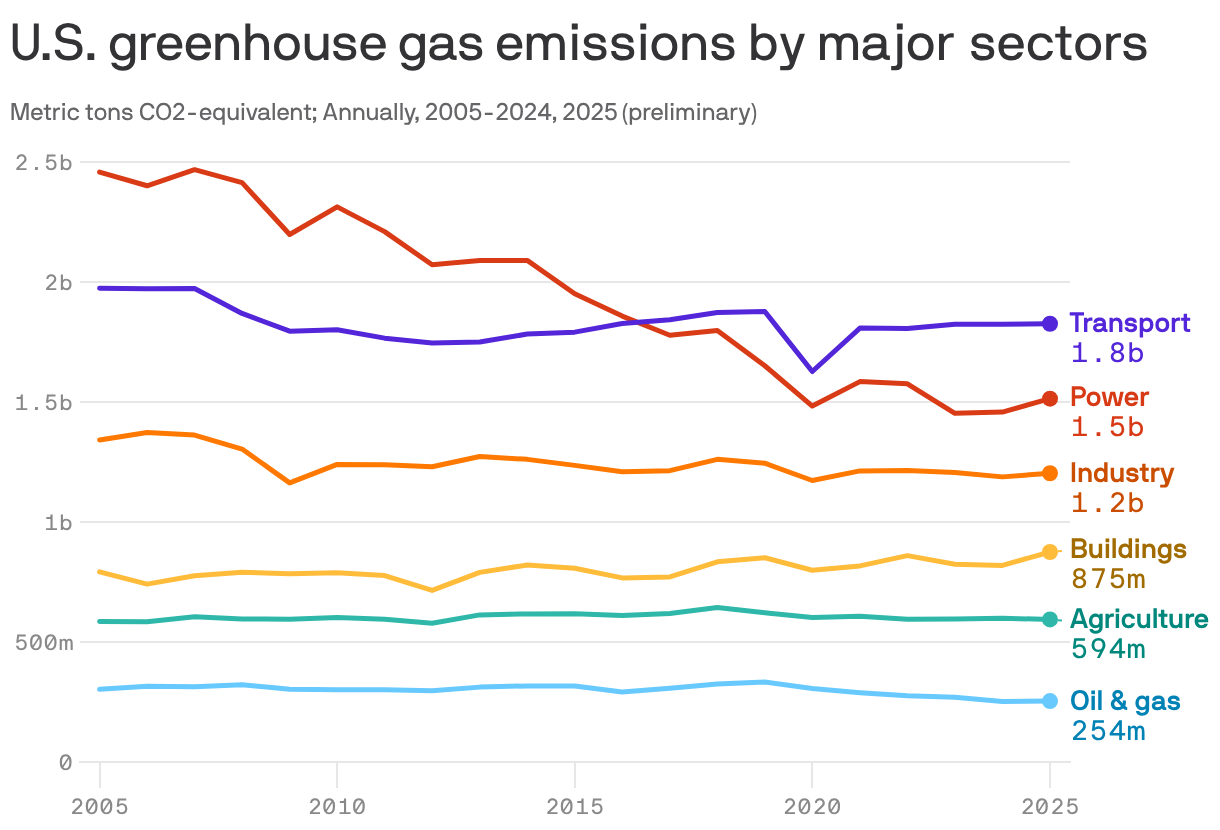
U.S. greenhouse gas emissions rose 2.4% in 2025 after two years of declines, per new estimates from the Rhodium Group.
State of play: Emissions from fuel use in buildings rose 6.8% as colder winter temperatures drove space heating demand.
- Higher natural gas prices and growing electricity thirst boosted coal-fired generation, causing a 3.8% rise in power sector emissions, Rhodium found.
The big picture: Overall U.S. emissions remain 6% below pre-pandemic levels and 18% lower than in 2005.
What we're watching: This year's levels were "not meaningfully impacted" by Trump administration and congressional policies, such as ending consumer tax credits for electric cars.
- "[B]ut we project that those policy changes could have increasing effects in the years to come," it states.
5. โ๏ธ The stakes of Trump's clean energy legal setbacks

By now you may have seen two federal judges' rulings yesterday against Trump 2.0 moves: one reversing termination of DOE clean energy grants in blue states, the other allowing a halted offshore wind project to continue for now.
Why it matters: Both rulings yesterday have implications beyond the projects at hand in the cases (which themselves are substantial!).
State of play: The preliminary injunction that allows construction to resume on the nearly done Revolution Wind project off Rhode Island?
- It could signal that four other halted Atlantic Coast wind projects will also win court approval to keep building, ClearView Energy Partners said in a note.
And that separate ruling that vacates the termination of DOE grants for seven clean energy-related projects?
- It could affect the vastly higher number of projects โ around 200 โ swept up in $7.6 billion worth of cancellations announced.
What we're watching: Potential appeals.
Go deeper on the wind and project grant rulings.
6. ๐ข๏ธ Here's the oil industry's 2026 to-do list
The U.S. oil industry's top lobbyist isn't giving up on legislation to overhaul permitting but sees the political window closing quickly.
Why it matters: American Petroleum Institute CEO Mike Sommers' comments signal how easing project timelines and building certainty is API's top legislative priority.
- But Trump officials' blocking offshore wind projects under construction โ and wider hostility to renewables โ has left talks foundering.
State of play: "There's a lot more going on behind the scenes than what people are saying publicly," Sommers said in an interview.
- "I am still optimistic that we can get comprehensive, bipartisan, permanent reform done in this Congress within the next couple of months," he said.
The intrigue: On Venezuela, he sees API playing a "convening" role and briefing lawmakers.
- Sommers sees industry interest in new investments and operations. But he cautions that requirements around security, contract assurances, and more must be met.
The big picture: API just released its wider 2026 policy agenda.
- Planks include finalizing new offshore leasing schedules, limiting trade restrictions, and fighting state-level climate "superfund" laws.
What we're watching: One goal is outright repeal of the EU's Corporate Sustainability Due Diligence Directive, Sommers says.
- EU officials have softened the rule, which sets supply chain ESG requirements for companies in Europe and doing business there.
- But critics, including Trump officials, call it highly burdensome.
7. ๐Catch up quick: Nuclear and EPA
โ๏ธ New York Gov. Kathy Hochul (D) will today unveil plans to develop five gigawatts of new nuclear power, a fivefold boost from current targets, the Syracuse Post-Standard reports.
๐ EPA is no longer attaching a monetary value to health benefits of curbing fine particulates and smog-forming pollution, the NYT reports.
8. ๐งฎ Number of the day: 55% increase
The Bureau of Land Management issued 55% more permits to drill for oil and gas in Trump's first year compared to the final year of the Biden-era, E&E News reports.
๐ฌ Did a friend send you this newsletter? Welcome, please sign up.
Sign up for Axios Future of Energy