Axios Future of Energy

October 07, 2026

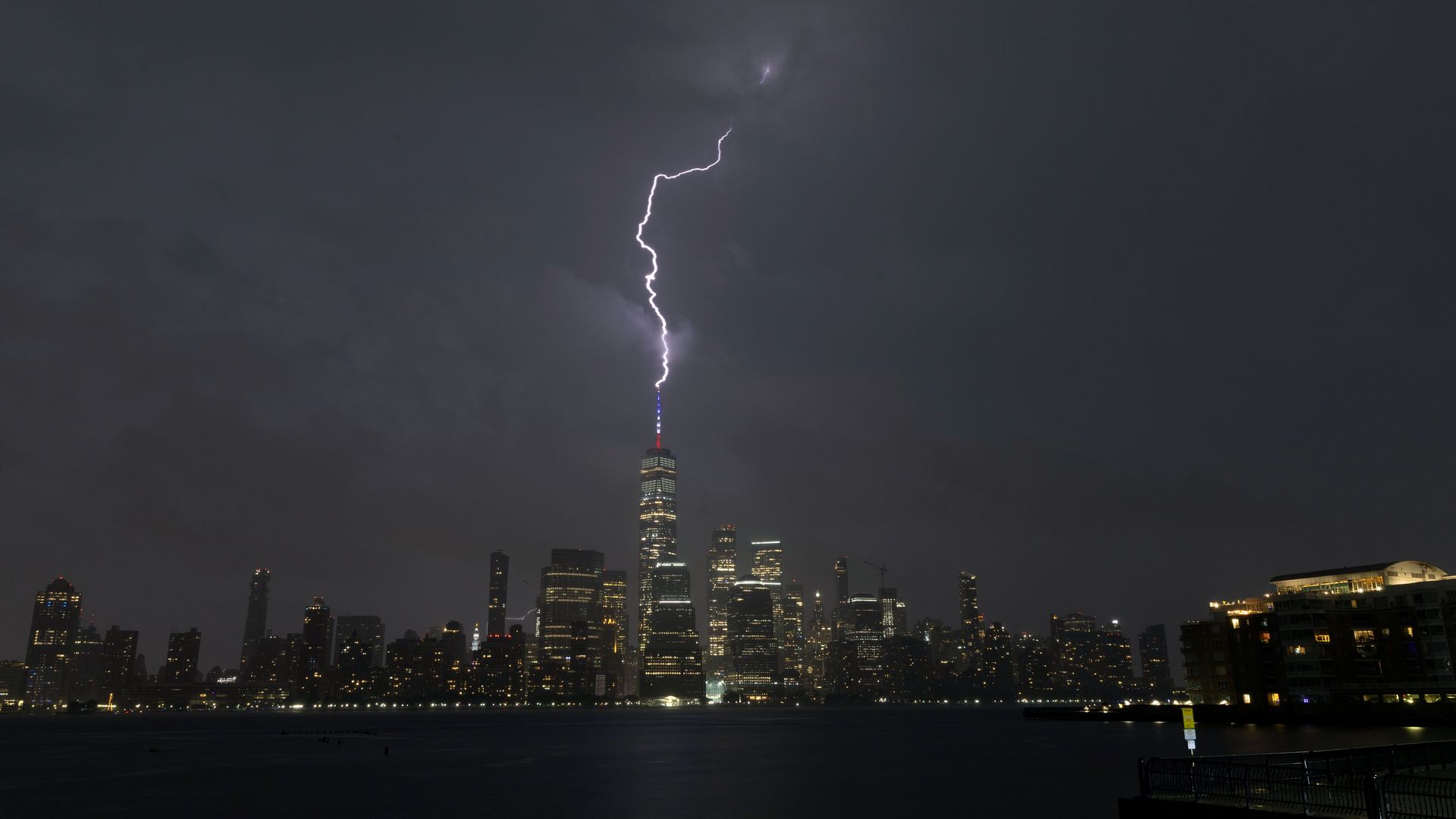
⚠️ The power industry has entered a stormy period — literally. We start there and then move on to...
- Evolving power priorities, U.S. oil outlooks, tech finance and more, all in 1,283 words, 5 minutes.
🙏 Thanks to Mackenzie Weinger and Chris Speckhard for editing, and to our brilliant Axios visuals team.
🎶 RIP to hit-making R&B singer Freddie Jackson, who has today's intro tune...
1 big thing: America's changing disaster risk hits energy

Hurricanes have long dominated efforts to make the power system more resilient to extreme weather. But America's energy buildout is running into growing risks from severe thunderstorms.
Why it matters: New energy infrastructure and data centers are being built in harm's way as severe weather risks shift, leaving more for developers and insurers to lose when storms hit.
Driving the news: Severe thunderstorms account for 40% of modeled global insured catastrophe risk, compared with 27% for hurricanes, according to analysis from risk analytics firm Verisk.
- The U.S. accounts for $117 billion, or 68%, of Verisk's modeled global insured catastrophe losses.
Threat level: A warmer atmosphere can hold more moisture, potentially creating more favorable conditions for powerful thunderstorms. But the effects of climate change on severe storms are complicated.
- National Oceanic and Atmospheric Administration research scientist Harold Brooks told Axios that other atmospheric conditions needed for severe storms may become less favorable as the planet warms.
Reality check: Verisk's Jay Guin said growing exposure, more than climate change, is the dominant driver of rising insured losses, as more and increasingly valuable property is built in harm's way.
- Guin says climate change contributes, but expanding development and higher reconstruction costs are much larger drivers.
Zoom in: America's changing energy system is creating new kinds of exposure.
- Verisk is assessing risks to renewable projects in tornado- and hail-prone areas, where Guin said large hail can cause major damage to solar farms.
- "While they are renewable, you have a new asset class that is quite vulnerable," he said.
- Data center developers must balance natural-hazard exposure against access to land, power and water. Some sites have billions of dollars in property and hardware, raising the stakes for siting and engineering.
State of play: Tornado activity has increased about 10% in the mid-South while declining by roughly the same amount from the Texas Panhandle through western Kansas, Brooks said.
- Population densities in rural areas of the Southeast are roughly 100 times those in the High Plains.
- "It's 10 people per square kilometer in rural areas of northern Mississippi and Alabama, and so a tornado in that area can't miss buildings and can't miss people," Brooks says.
Zoom out: For infrastructure, Brooks said the biggest thunderstorm-related concern is flooding.
- Heavy rain and flooding are "a huge threat to virtually all of our infrastructure," he said.
The bottom line: "There is no ... safe climate zone," Guin said.
2. 👋 New AI power acronym just dropped: Say hi to "SCACP"

Morgan Stanley analysts just dropped a useful (if awkward) new metric they're calling the "Stranded Compute Adjusted Cost of Power."
Why it matters: Power cost isn't the only coin of the realm as tech companies seek electricity for data centers.
Driving the news: Generation that can be deployed fast can justify higher costs because it gets data centers running sooner, rather than leaving expensive computing hardware sitting idle, Morgan Stanley's note states.
- Economics are "only part of the equation."
- Data center developers must also weigh reliability, modularity, noise, "local/NIMBY considerations" and much more.
Zoom out: This is all putting a premium on power tech that doesn't require long waits for grid connections.
- That's especially true for data centers used to run AI models, which can be smaller than the huge facilities needed to train them.
How it works: SCACP starts with the commonly used "levelized" cost of power — an all-in comparison of the costs of building, fueling and operating different types of facilities over time.
- But it layers on a "stranded compute premium," which basically means the cost of letting powerful AI chips sit idle and the missed revenue while waiting to get power.
What we're watching: Morgan Stanley name-checks several companies and technologies poised to fare well in the SCACP-y new world.
- They include Bloom Energy's on-site natural gas fuel cells, BorgWarner's small gas turbines, and FTAI's repurposed jet engines.
3. 🛢️ Charted: How the Iran war changed the U.S. oil outlook


The Iran war is boosting the U.S. oil production outlook as prices remain elevated and may stay that way for quite a while.
Why it matters: U.S. producers are responding to higher prices — to a point.
State of play: EIA forecasts in recent months have consistently estimated U.S. production averaging fresh records north of 14 million barrels per day in 2027.
- The latest estimate sees production averaging 14.3 million barrels per day (mbd) next year, a million above the last pre-war estimate in February.
- The 2026 outlook has also moved higher, though not as much, with EIA projecting an average of 13.9 mbd this year compared to 13.6 pre-war.
Yes, but: The 2026-27 rise won't match the biggest annual jumps, with the industry showing little appetite for shale's debt-fueled, go-go-go era last decade.
- Investment in new output is competing with shareholder returns and other priorities.

4. 🏃 Catch up quick on tech finance
⚡ LS Power, an investment and development firm, raised $6 billion for its latest fund, blowing past the initial $4 billion target amid rising power demand.
- Catch up quick: It's already deploying the fund, with $1.7b committed to buying natural gas generation assets from Constellation Energy. Go deeper
⚛️ Fusion player Type One Energy raised a $200 million Series B round led by Breakthrough Energy Ventures and Clutterbuck Capital.
- State of play: New investors include Lowercarbon Capital and Siemens Energy Ventures. TechCrunch has more.
🤝 Gas pipeline giant Energy Transfer is acquiring gas gathering and processing company Vaquero Midstream in a $2.63 billion deal.
- Why it matters: Gas assets are in demand amid rising domestic consumption and LNG exports.
- Catch up quick: Vaquero is the third Permian Basin gathering and processing system to change hands in 2026, Melius Research said in a note.
🇨🇦 Canadian Utilities and Emera, which has major assets in Florida, are merging in a deal that values the combined company at over $50 billion.
- Why it matters: The deal creates a "top 20 North American utility," the companies said. The Canadian Press has more.
5. 🏡 The Iran war's latest price shock could be your heating bill

Americans could pay far more to heat their homes with oil this winter than last, a new analysis reviewed by Axios shows, as volatile energy markets and the Iran war deepen the affordability crisis.
Why it matters: Heating bills are eating into household budgets before winter sets in, with stark divides between fuel types.
By the numbers: Families that heat with oil could pay about 50% more this winter than last, according to estimates from the National Energy Assistance Directors Association (NEADA), up from its 31.3% projection in mid-September.
- The average cost of heating a home with oil is expected to rise by about $878, costing over $2,600 this winter.
Zoom in: By comparison, the Energy Information Administration's Winter Fuels Outlook released yesterday projects electricity bills will rise 4% nationally, while natural gas bills will fall 9% and propane spending will drop 3%.
- EIA expects a smaller increase on heating oil than NEADA, projecting a 21% increase in household expenditures.
Northeastern households will feel the pain most acutely: about 82% of home heating oil is consumed in the region, where some states lack robust natural gas pipelines, per NEADA data.
- Just 3% of U.S. households use oil as their primary heat source, compared to about 45% using natural gas and 43% using electricity, NEADA says.
6. ⚛️ Number of the day: 12.25%


That's the rise in power giant Constellation Energy's share price yesterday on the news of its power purchase deal with Google, which will finance expanded output from nuclear plants in three states.
📫 Did a friend send you this newsletter? Welcome, please sign up.
Sign up for Axios Future of Energy