Axios Future of Energy

December 08, 2025


🥞 Welcome back! We're sprinting into Monday with looks at...
- 🏭 The enviro justice movement around data centers.
- 🕵️ A search for clues on permitting, and other policy notes.
- 💵 And the latest on tech finance, all in 1,414 words, 5.5 minutes.
🚨 Breaking: Google and NextEra Energy said they'll jointly develop "multiple" new gigawatt-scale data center campuses with "accompanying generation and capacity." Go deeper
🎙️ Join Axios tomorrow at 8am ET in D.C. for an event with key lawmakers on the next phase for a permitting overhaul on Capitol Hill. RSVP here.
🎸 This week marks 45 years since The Clash dropped the triple album "Sandinista!," which provides today's intro tune...
1 big thing: AI boom fuels environmental justice fears


Civil rights groups are increasingly concerned that AI's rapidly spreading physical infrastructure is deepening climate burdens for communities of color.
Why it matters: Massive data centers require vast quantities of water, energy and land.
- Many of these centers are clustered in regions where marginalized communities already face higher levels of air pollution, industrial zoning and climate vulnerability.
Threat level: Civil rights groups say these impacts resemble earlier patterns seen with highways, refineries and manufacturing: pollution concentrated where political resistance is weakest and property values are lowest.
- Data centers can also consume millions of gallons of water per day and use as much electricity as a small city, driving up energy and water use costs for poor residents.
Zoom in: A supercomputer data center built by Elon Musk's xAI in southwest Memphis, a historically Black neighborhood, faces a legal challenge from the NAACP. The group says the site's gas generators are violating the Clean Air Act.
- Nitrogen dioxide pollution near the site has spiked as much as 79%, according to Time, raising the risk of asthma and respiratory illness in a community already burdened by high pollution rates.
- Earlier this year, Brent Mayo of xAI said the data center was adding newer units that would make it "the lowest-emitting facility in the country."
In Amarillo, Texas, advocates are fighting what developers call the world's largest AI data center, warning it could drain the Ogallala Aquifer, a shrinking water lifeline for the Texas Panhandle and southern Great Plains.
- Latino residents and rural water advocates fear losing access to groundwater already stretched thin by agriculture and drought.
- The city's former mayor, working as a community lead on the data center project, says it will use closed-loop cooling that should minimize water usage.
Northern Virginia — site of the world's largest data center hub — is seeing mounting resistance in Loudoun and Prince William counties, where Black families say the build-out is overwhelming their communities.
Near Tucson, Ariz., a majority-Latino city strained by megadrought, a proposed "Project Blue" data center could consume millions of gallons of water per year.
What they're saying: "Data centers by design do not have a lot of jobs. It's predatory. They target cities desperate for economic development," LaTricea Adams, CEO of the Memphis-based Young, Gifted & Green, tells Axios.
- "This is the Wild West. There's not even case law yet. What happens now will dictate the future of how data centers are regulated."
Friction point: As AI data centers expand across the West, Indigenous nations say the industry is accelerating resource extraction without tribal consent.
What's next: The NAACP announced it's bringing together advocates, researchers and regional leaders for a two-day strategy summit in Washington this week to discuss AI data centers.
2. 🔨 House may offer clues soon on permitting overhaul

The House may soon provide an indication as to whether an overhaul of permitting — a legislative Holy Grail for many business groups — will be possible in this Congress.
Why it matters: Streamlining how the government green-lights energy and other projects is one of the few areas of widespread agreement on Capitol Hill, though a compromise has remained elusive.
Driving the news: The House is expected next week to consider a permitting bill, the SPEED Act, co-sponsored by Natural Resources Chairman Bruce Westerman and Rep. Jared Golden (D-Maine).
- It is aimed at overhauling environmental reviews in what proponents say would be a way to unlock fossil fuels and renewable energy alike.
- The bill includes a provision aimed at protecting already-approved permits in response to Trump 2.0 efforts to overturn those projects, particularly offshore wind.
Friction point: The House Freedom Caucus is deeply skeptical of any changes that could benefit wind and solar.
Zoom in: The House is expected this week to take up a separate bill that would limit states' authority under the Clean Water Act to block infrastructure projects.
- The Transportation and Infrastructure Committee advanced it in June on a party-line vote.
- Republicans say it would provide clearer instruction and standards for permitting agencies. Environmental groups counter it would make it easier for polluters to contaminate rivers and other drinking water sources.
- A second bill expected to come up this week would empower the Federal Energy Regulatory Commission to speed pipeline reviews.
What we're watching: The Senate, whose Environment and Public Works Committee members have been working on a separate bipartisan package to overhaul the National Environmental Policy Act (NEPA).
3. 🏃 Catch up quick on policy: Trade, FERC, cars

📫 Pressure on Trump's trade team: Manufacturers want Commerce Secretary Howard Lutnick and trade rep Jamieson Greer to seek full exemption for U.S. companies from a major EU sustainability rule.
- Why it matters: A new letter from the powerful National Association of Manufacturers shows K Street angst over the reach of the Corporate Sustainability Due Diligence Directive — and potential legal exposure.
- State of play: The group argues that EU plans to soften the rule aren't enough, and floats options for the U.S. team's posture. Even short of a full exemption, EU officials could limit its reach to corporate activities within its borders, the letter states.
🖥️ States press FERC for data center summit: State utility regulators are asking FERC to convene a conference next month to hash out its plans to take control of large data centers' interconnection to power grids.
- Why it matters: The ask, from the National Association of Regulatory Utility Commissioners, shows how states fear getting rolled in the DOE-backed FERC rulemaking, which is touching off an intense turf fight.
- What we're watching: "This technical conference should include state regulators and commenters who have suggested alternative paths, including a consensus-based approach that incorporates the concept of cooperative federalism," NARUC's comments state.
🚘 Via Bloomberg, "Six European Union leaders including Italy's Giorgia Meloni asked the European Commission to propose softening the bloc's vehicle emission rules to halt a de-facto ban on combustion engines planned by the middle of the next decade."
- Why it matters: Aggressive climate targets are coming under pressure in Europe and beyond.
4. 💵 Investors charge up advanced data center batteries

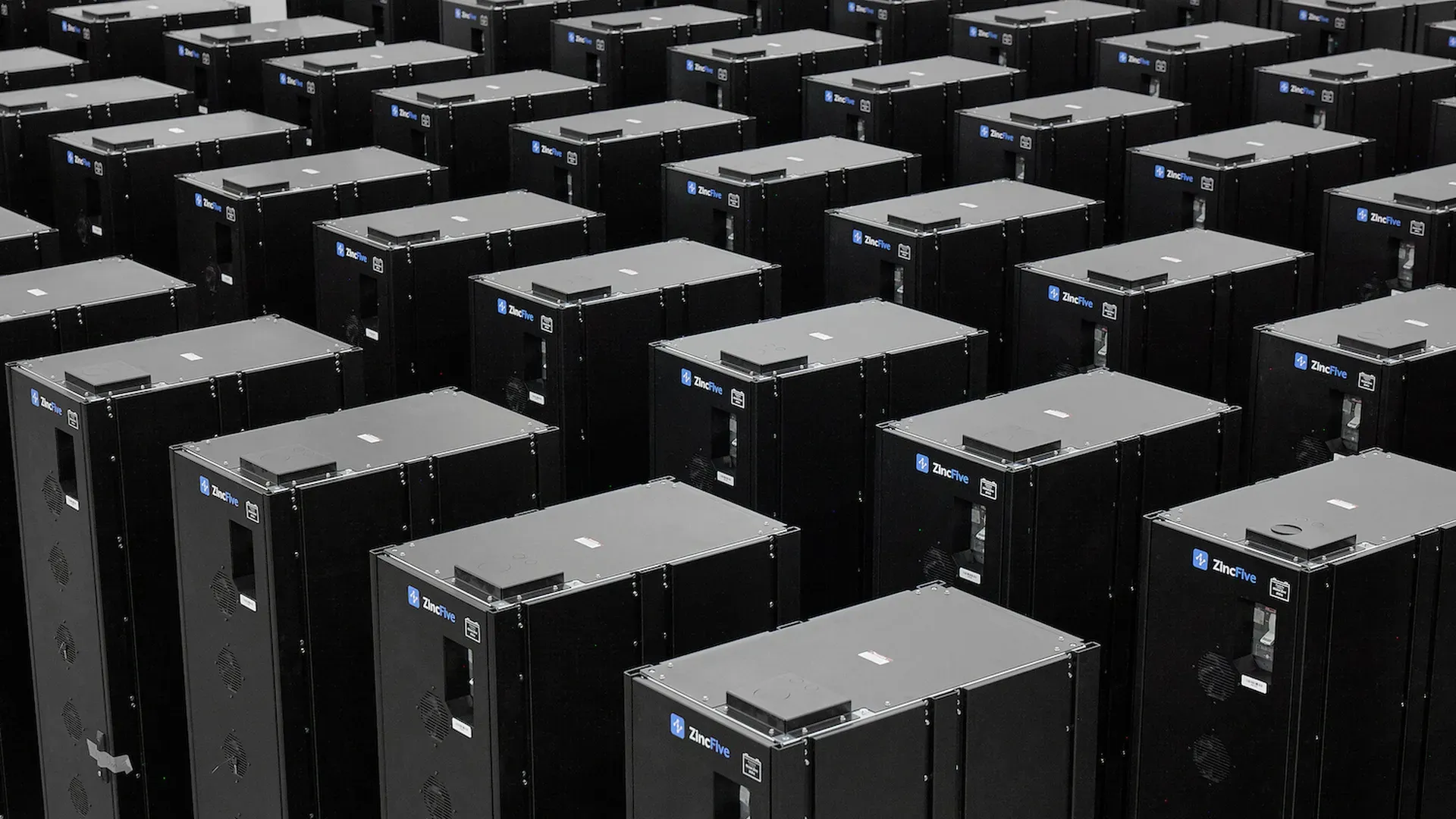
Battery startup ZincFive has closed a $30 million Series F round to meet a backlog of orders and develop more AI data center products, Axios Pro Deals was first to report.
Why it matters: Data center developers are interested in specialized backup batteries as a way to manage spiky AI training loads and lower costs.
How it works: ZincFive makes a nickel-zinc battery that can charge and discharge more quickly and is less flammable than lithium-ion batteries.
- The nickel-zinc battery can provide backup power for a data center at a lower cost than lithium-ion batteries if used in short bursts of seconds and even milliseconds.
- For a longer duration, like hours, nickel-zinc batteries are more expensive than lithium-ion.
Zoom in: The funding round included Helios Climate Ventures, Climate Investment, Japan Energy Fund, General Ventures, and Clear Creek Investments.
Unlock the whole story, and talk to our sales team about Axios Pro Deals for a steady diet of exclusives and smart analysis.
5. 👀 Energy and climate exclusives you may have missed

⚡️When DG Matrix starts shipping its commercial solid-state transformers next month, it'll be the first among a handful of startups racing to market. Go deeper
⚛️ Advanced nuclear startup Antares raised $96 million in equity and debt to turn on its test reactor by mid-2026, says CEO Jordan Bramble. Go deeper
🌎 Addis Energy, an MIT spinout aiming to produce ammonia underground, has raised an $8.3 million seed round, says Addis CEO and co-founder Michael Alexander. Go deeper
⛏️ PH7 Technologies, a startup that extracts metals from recycled and mining materials, raised $25.6 million to scale its tech in mining, says CEO Mohammad Doostmohammadi. Go deeper
6. 🧮 Number of the day: $5.29 per million British thermal units
That's the settlement price of U.S. natural gas futures at Henry Hub on Friday, the highest since late 2022.
What we're watching: How higher prices affect the permitting legislation, pipeline fights and even the midterm elections. Go deeper.
🙏 Thanks to Chuck McCutcheon and Chris Speckhard for edits to today's newsletter, along with the brilliant Axios Visuals team.
📬 Did a friend send you this newsletter? Welcome, please sign up.
Sign up for Axios Future of Energy