Axios Future of Energy
October 16, 2026

🍸 Happy Friday! We're opening with a look at geothermal's good vibes and persistent risks, then moving on to...
- Lots of policy news, the early fallout from Tesla's Roadster reveal, and plenty more, all in 1,273 words, 5 minutes.
🙏 Thanks to Mackenzie Weinger and Chris Speckhard for editing, and to our brilliant Axios visuals team.
🎸 Happy birthday to influential rocker Bob Mould of Hüsker Dü, Sugar, and lots of solo work. He's got this week's final intro tune...
1 big thing: Geothermal finds rare political sweet spot amid AI boom

Geothermal — power drawn from the Earth's natural heat — is pulling off something remarkable in today's hyperpolarized America: Winning fans across the political spectrum.
Why it matters: The bipartisan appeal, combined with surging electricity demand from AI, is helping fuel investment in a niche energy source yet to prove it can compete at scale.
Driving the news: Geothermal received unusually extensive attention in a bipartisan Senate bill introduced late last month to expedite infrastructure permitting.
- The House this summer passed a package containing several of the same geothermal provisions, including measures sponsored by lawmakers as ideologically distant as Reps. Alexandria Ocasio-Cortez (D-N.Y.) and Mike Kennedy (R-Utah).
The rising cachet of geothermal is the product of three trends converging:
- Technologies adapted from the oil and gas industry, including fracking, are making it possible to tap heat in more places than just far-flung hot springs and volcanoes.
- Tech companies, on the hunt for reliable electricity, are willing to pay a premium for next-generation geothermal to power data centers.
- Investment is surging as companies race to scale a renewable energy source that can generate power around the clock.
The intrigue: Geothermal's appeal crosses traditional political divisions precisely because it doesn't fit neatly into Washington's usual energy-policy boxes.
- Its renewable characteristics appeal to Democrats.
- Its reliance on drilling expertise and overlap with the oil and gas industry appeals to Republicans.
- Its ability to provide stable, carbon-free electricity makes it attractive to utilities and tech companies.
Reality check: Geothermal's political popularity and investment boom are running ahead of its commercial reality. The technology remains expensive, and questions persist about whether it can reliably generate electricity over decades.
- Geothermal currently generates less than 1% of U.S. electricity, and increasingly lucrative federal leases are for the right to explore for geothermal, not for active geothermal wells.
What we're watching: Geothermal has found something rare in Washington: Political consensus. The test now is whether that consensus survives the industry's growth.
2. 💰 Bonus: Geothermal's cash surge

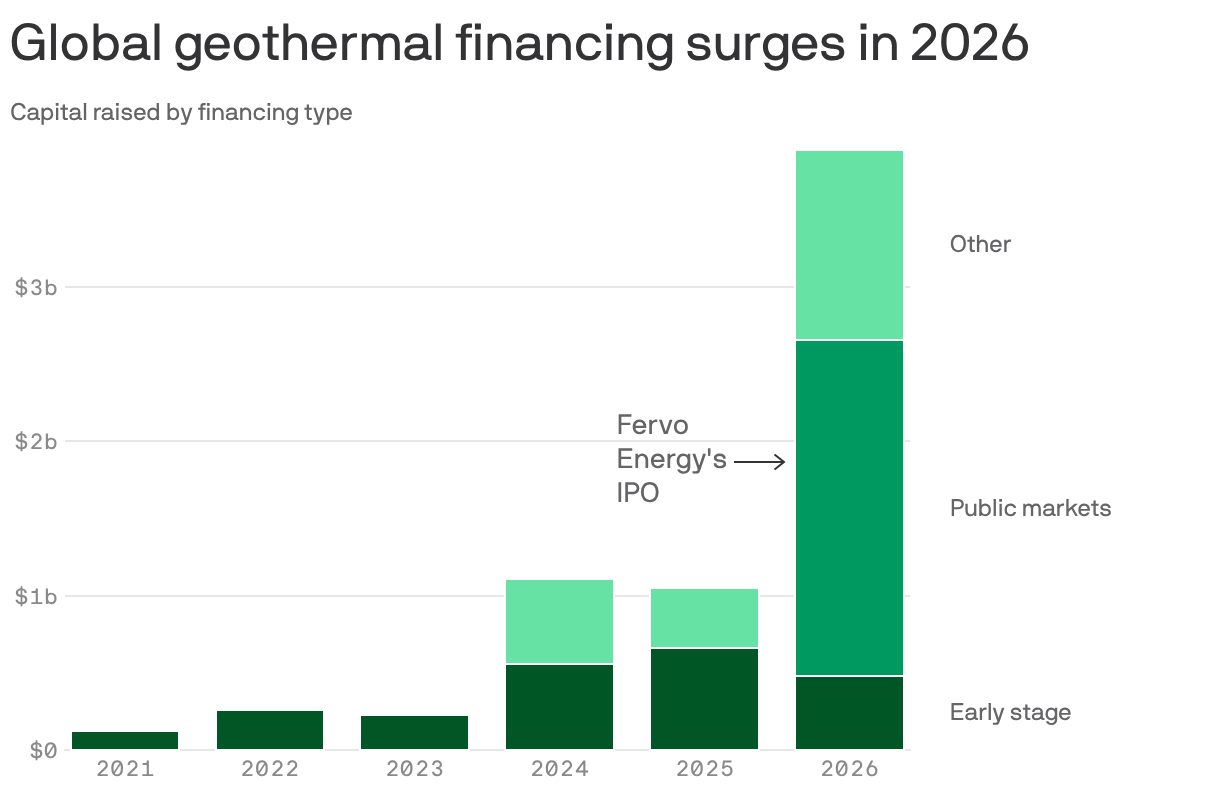
Geothermal's investment boom is reaching new heights, with financing exploding this year.
By the numbers: The average winning bid for federal geothermal leases has surged, reflecting growing commercial interest.
- The average winning bid in 2023 was $10 an acre, and so far this year, the average is $182, according to Guy Cohen, a geothermal analyst at the market intelligence firm Currence.
- A record $1,207-an-acre bid was placed for a single parcel in Utah this summer.
Yes, but: The industry's commercial prospects remain uncertain, and Fervo's stock has fallen nearly 70% from its first-day closing price following its IPO earlier this year, amid what Axios Pro calls a broader slowdown among energy startups.
3. 🏃 Catch up quick on policy: Batteries, permitting, LNG, Russia

🔋 Base Power, the home battery and virtual power plant company, is expanding its policy and lobbying muscle on two fronts as permitting battles simmer.
- State of play: Phil Bartlett, who just ended years heading Maine's Public Utilities Commission, joined Base as senior director of regulatory policy. And it retained the lobbying firm Cassidy & Associates to work on permitting reform, a filing shows.
- The big picture: Deploying tens of thousands of residential batteries and operating them as a fleet can bolster grids and curb costs, but "we need permitting reform to deploy this at optimal speed, and that's why we're joining the conversation at the federal level," Base chief legal officer Zina Bash tells Axios.
- Catch up quick: The moves come as Base Power is expanding beyond Texas.
⚔️ Speaking of permitting, fresh signs of House support and opposition to the Senate bipartisan plan are piling up.
⏩ FERC members unanimously endorsed a proposal to speed expansions of planned or operating LNG projects through a "blanket authorization" system.
- Go deeper: FERC staff presentation ... proposed rule.
🛢️ The Trump administration may ease sanctions on "shadow fleet" tankers linked to Russia and Iran, per Reuters and the Financial Times.
4. 🚗 Catch up quick on EVs: Sales and Chinese exports


🧮 Ember, a clean energy think tank and advocacy group, dropped a helpful interactive tracker of global and country-by-country electric vehicle sales.
- Why it matters: It estimates how much oil use the vehicles are displacing as sales rise globally, though in some markets much more than others.
- The bottom line: The roughly 88.5 million EVs on the roads as of August were avoiding 1.4 million barrels of oil use per day, per Ember's tally.
🇨🇳 The Hormuz crisis is the "first major energy shock with a real electric alternative" the consultancy Rystad Energy states in a new report summary.
- The big picture: China is taking advantage, it notes in tallying the rise of Chinese EV exports.
- State of play: Exports to the EU, the biggest destination, grew 101% in January-July 2026 compared to the same stretch in 2025. Shipments to Asia and South America rose 65% and 177%, respectively.
- Zoom out: That's just one piece of Rystad's wider annual Global Energy Scenarios report that landed yesterday.
5. 💬 What they're saying about Tesla's wild Roadster reveal

Elon Musk unveiled his long-promised next-generation Tesla Roadster last night, and it's every bit as outrageous as you'd expect from a man who launches rockets into space.
- The car — a collaboration with SpaceX engineers — briefly flies, does backflips and even drives upside down.
Yes, but: The space-age acrobatics would not be street-legal. There's no info yet on pricing or detailed production plans for a road-ready version of the insanely fast car.
What they're saying: Analysts see other messages behind the wild rollout at SpaceX's McGregor, Texas, site.
- Dan Ives of Yorkville Ives, a longtime Tesla optimist, said in a note that it "will not move the volume or revenue needle."
- Instead, it's a "small example of the synergies between Tesla and SpaceX," and he sees an 80% chance of a merger by the end of next year.
- The launch event "was an engineering flex with no commercial value beyond embarrassing traditional car makers," and shows that Musk "can't wait" to combine Tesla and SpaceX, Gene Munster of Deepwater Asset Management posted on X.
What we're watching: Musk says the Roadster will enter production in 2028. There are still so many unanswered questions, but for one crazy evening, Musk made the future look like a science-fiction movie. Go deeper
6. 👓 Hot reads: AI, solar, fish
🌎 Inside the frenzied heart of the $11 trillion AI buildout 😵💫 (CTVC newsletter)
Amy says: This was an entertaining read about one of the data center industry's biggest conferences. It's long but worth the read IMO. I only wish all the photos had captions!
☀️ Annual opinions about solar thread (Jenny Chase, BloombergNEF)
Ben says: No matter what aspect of solar and batteries are your jam, there's something informative here, from the wide angle to sub-topics like agrovoltaics.
🤫 The Dirty Secret Behind the Farmed Fish You Eat (NYT)
Amy says: This is extremely eye-opening and, frankly, at times overwhelming to read. One interesting point: China shifted its fish-farming industry from the coast inland due to environmental problems with the former.
- It reminds me of a quote I saw once that goes like this: "There are no solutions. Just trade-offs."
7. 🛢️ Quote of the day: Funhouse mirror edition
"Everything associated with energy is going up but Brent. It is not connected to the real world anymore."— Veteran commodity analyst Jeff Currie, speaking to Bloomberg
He's in the camp that argues Brent futures don't reflect real supply risk — with real-world consequences that affect needed investments.
📫 Did a friend send you this newsletter? Welcome, please sign up.
Sign up for Axios Future of Energy