Axios Future of Energy

February 18, 2026


🗞️ Lots o' news today! Our quick tour includes...
- An AI business exclusive
- UN climate moves
- Endangerment litigation, U.S. data and more, all in 1,485 words, 5.5 minutes
🚨 Situational awareness: Energy Secretary Chris Wright said the U.S. is still weighing withdrawal from the IEA. Wright credited some changes but argues it's still kind of a de facto climate NGO. Full remarks at 46:15 here.
🎧 At this moment in 2010, Melanie Fiona ruled Billboard's R&B charts with today's stunning intro tune...
1 big thing: ⚡️Exclusive — Power broker in AI boom draws takeover interest

An obscure, two-year-old company has emerged as a quiet power broker — literally — in the AI boom.
Why it matters: Houston-based Cloverleaf Infrastructure is lining up massive deals securing land and city-scale electricity to fuel data centers — the single biggest bottleneck in AI expansion.
Driving the news: The company — founded in February 2024 by three energy veterans — is being courted by multiple potential buyers, according to a person familiar with the matter who spoke on condition of anonymity.
- A decision could come within weeks.
- Brian Janous, co-founder of Cloverleaf, declined to comment on acquisition discussions.
The big picture: Cloverleaf's rapid rise — and takeover interest — underscores the frenzy to lock down power as AI demand explodes.
- Natural gas is fast becoming a default choice to fuel the AI boom. Janous, who is also the firm's chief commercial officer, says Cloverleaf is proving another way by pooling existing clean energy.
"A lot of people default to the easy thing," Janous said in a recent interview in his office in downtown Seattle. "Doing this the more sustainable, lower-carbon way is actually better, faster and cheaper."
Follow the money: Cloverleaf has raised roughly $300 million, announced in July 2024.
- Backers include NGP Energy Capital Management and Sandbrook Capital, alongside investments from company leadership.
What they're saying: "I see Cloverleaf as an example of data center development done right," said Michael Thomas, founder and CEO of Cleanview, a market intelligence platform.
- "They are finding creative ways to build data centers and bring their own capacity, but they're doing it almost entirely with clean energy storage and flexible curtailment."
How it works: Cloverleaf's thesis: America's regional grids already have stranded or underused capacity. The challenge is coordination.
- "We have a lot of leverage to orchestrate solutions that are, right now, sitting in silos," said Janous. "It's more a business problem than a technical problem."
The other side: Many developers are moving in the opposite direction, installing on-site natural gas because it's dispatchable and reliable.
- In parts of the Mid-Atlantic and Midwest — America's AI hotbed — gas is increasingly the default for AI facilities.
By the numbers: Cloverleaf is pursuing projects totaling 10 to 15 gigawatts of peak power capacity — roughly 10 to 15 times Seattle's peak electricity demand.
Reality check: Community pushback is rising as developers propose city-sized data centers. Janous acknowledges that opposition could slow growth.
Zoom in: It backed out of at least one project in Wisconsin after local opposition intensified.
- "We're not so Pollyannish that we believe everyone is going to be super excited we're there," Janous said.
What we're watching: Whether Cloverleaf sells — and whether its clean-power-first model wins in this AI arms race.
2. 🚨 Breaking: UN boss wants climate outreach to fossil fuel producers

UN Secretary-General António Guterres is calling for new talks on moving away from fossil fuels that would bring energy producers to the table.
Why it matters: It's fresh evidence officials hope to adapt the UN climate process to move far beyond pledges and find new avenues to spur on-the-ground steps.
🎙️ Driving the news: The effort "must bring together producers and consumers, developed and developing countries, public and private financial institutions and civil society," states his video address to the International Energy Agency meeting in Paris.
- UN officials confirmed that "producers" refers to fossil fuel-producing companies and nations.
- The goal is a "transition plan that aligns investment, energy security and climate goals, with concrete milestones and robust finance," Guterres said.
🥊 Reality check: There's not global consensus on moving away from fossil fuels, despite a transition endorsement at the 2023 COP, and who knows how the new dialogue "platform" might create one.
- Consider that IEA boss Fatih Birol, in a new FT interview, acknowledged that climate is "moving down the international policy agenda."
The big picture: It's the latest of several moves — some from the UN, some outside of it — aimed at maintaining UN climate relevance over a decade after the Paris Agreement.
- For instance, UN climate chief Simon Stiell this month said the annual COP process needs to get "closer to the real economy, for faster implementation."
🔭What we're watching: Guterres isn't "prescribing a specific format," officials say.
- But the idea has his "full political backing," and the UN can provide support.
3. ⚖️ The legal battle over EPA finding just got underway
Environmental and health groups this morning filed suit against EPA over the "endangerment finding" repeal and withdrawal of any CO2 standards for vehicles.
Why it matters: The litigation — which analysts expect to reach the Supreme Court — will help decide how much future presidents can crack down on emissions.
- The finding underpins EPA's greenhouse gas regulations.
Driving the news: Over a dozen groups are litigating last week's rule in the U.S. Court of Appeals for the D.C. Circuit.
- They include the American Public Health Association, the Center for Community Action and Environmental Justice, the Union of Concerned Scientists, and the Sierra Club.
State of play: The announcement offers broad outlines of the groups' legal positions, even though detailed filings come later.
- It notes the 2007 SCOTUS finding in Massachusetts v. EPA that CO2 and other GHGs "unambiguously are 'air pollutants' under the Clean Air Act and told EPA to determine, based on the science, if that pollution endangers human health and welfare."
- EPA's rule is "rehashing legal arguments that the Supreme Court already considered and rejected" in 2007.
The other side: EPA offered several legal rationales, like arguing the Clean Air Act addresses pollution with direct local and regional effects.
- It cited 2022 and 2024 SCOTUS rulings that limit agencies' powers in the absence of clear congressional blessing.
What we're watching: Blue state attorneys general are also readying lawsuits.
4. 🚘 Uber opens wallet for robotaxi charging


Uber plans to invest $100 million on EV charging infrastructure to support its growing global robotaxi business.
- At the same time, it's making it easier for Uber drivers to find charging by providing a financial backstop to network providers.
Why it matters: Uber says the efforts are intended to accelerate the company's vision for an autonomous and electric future.
The big picture: An onslaught of driverless Waymo and Tesla robotaxis is threatening Uber's core ride-hailing business.
5. 🌀 Why clean energy is weathering the Trump storm — for now

Rising power demand and rising corporate procurement helped climate-friendly power last year despite the White House policy U-turn, new data and analysis show.
Why it matters: The report — from research firm BloombergNEF and the Business Council for Sustainable Energy — describes the impact of dueling forces.
The big picture: "Despite the challenges around high cost of debt, constraints in site permitting, grid connection bottlenecks, and policy uncertainty, clean power deployment was sustained by rising electricity demand and continued interest from corporate buyers," it finds.
State of play: Renewables were 61% of new U.S. electricity capacity additions last year, and storage grew 35%, per the annual "Sustainable Energy in America Factbook."
- Actual generation — not just capacity, a metric that inflates renewables — hit a 20-year high, rising 3% year over year. Renewables and nuclear together provided 43%, and gas was 40%
- Corporate purchase deals for zero-carbon power reached a record 29.5 gigawatts in 2025, with Amazon and Meta the top buyers.
The intrigue: BCSE President Lisa Jacobson said "despite uncertain market and policy conditions," a "broad portfolio" of efficiency, gas and renewables helps blunt the level of price increases.
- But a "predictable" investment climate is needed, and the group's goals include "technology-neutral federal permitting and siting reforms," she said.
What we're watching: How the GOP budget law and White House moves affect deployment going forward as tax credits phase out and other policies sink in.
6. 🧁 Bonus: U.S. power costs in context
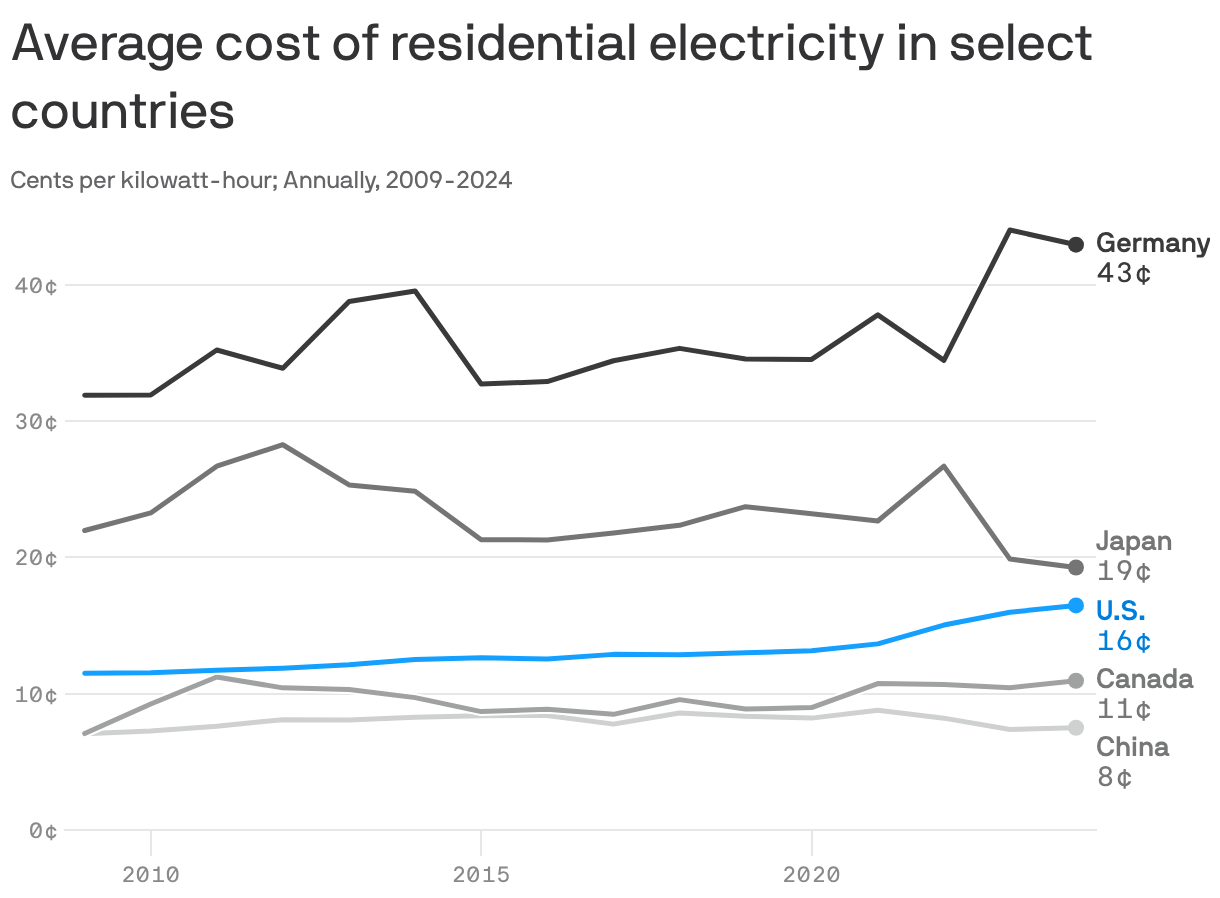
This chart provides a nice comparative picture, even though it's only through 2024.
The latest: The trend of rising U.S. power prices continued last year.
- But while some areas saw large spikes, the BCSE/BloombergNEF report also finds that "as a share of personal consumption ... electricity remained below 1.5%" of consumer spending on average.
The intrigue: "Industrial power prices in the US remained low compared to other G-7 nations. In 2024, the last year for which there is complete data, only China and Canada saw prices lower than the US."
7. 🧮 Number of the day: Over 90%
Microsoft accounted for over 90% of global carbon removal contracting last year on a volume basis, per the new BloombergNEF and Business Council for Sustainable Energy report.
- What we're watching: How that shifts over time — and whether so much reliance on one buyer, even with a massive wallet, creates risks for the young industry.
🙏 Thanks to Chuck McCutcheon and Chris Speckhard for edits to today's newsletter, along with the brilliant Axios Visuals team.
📬 Did a friend send you this newsletter? Welcome, please sign up.
Sign up for Axios Future of Energy