Here's what kind of energy is fueling AI


Add Axios as your preferred source to
see more of our stories on Google.
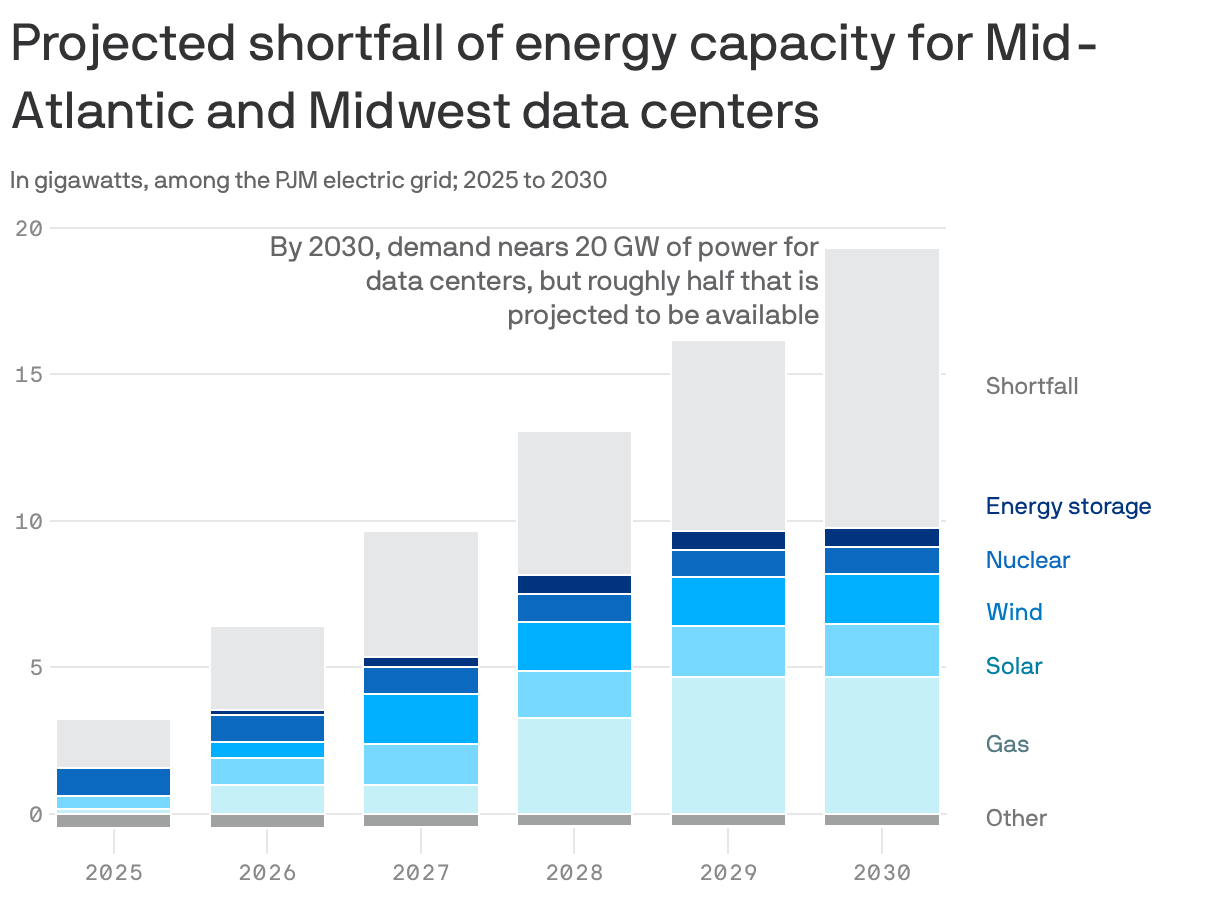
Natural gas is filling the biggest role fueling electricity for data centers in the Mid-Atlantic and Midwest — the country's AI hotbed — but the region is still staring down a huge shortfall in power.
Why it matters: Society faces the risk of spiking power prices or — worse — no power at all if this gap isn't resolved by either adding more power or fewer data centers.
How it works: The chart above illustrates what's known as the effective load carrying capability, or ELCC.
- This is a method that grid operators use to measure how much an energy resource — like renewables or natural gas — can reliably contribute to meeting power demand at times when the grid is most at risk of shortages.
- As wind and solar grow on the grid, ELCC provides a more precise way to assess how much dependable capacity they actually add, accounting for their variability.
- That's unlike traditional resources such as natural gas, which can generally be dispatched on demand, according to a spokesperson for BloombergNEF.
Context: Measured by nameplate capacity — the maximum power a plant is rated to produce under ideal conditions — planned supply additions of variable wind and solar appear far larger.
- But much of that capacity doesn't reliably show up during peak demand. ELCC adjusts for that reality.
- It's the difference between food on grocery store shelves and food on your plate when you're hungry. When demand peaks, the grid needs electricity that can actually be delivered — not just capacity that exists in theory. Timing matters.
Zoom in: The chart is focused on the PJM grid system, which provides power to 67 million people in 13 states. It shows two big things:
- Natural gas currently does the most to narrow the projected power gap, compared with wind, solar and other resources.
- A sizable shortfall remains through the end of the decade.
That picture could change to the degree long-duration energy storage — capable of storing large amounts of electricity for days or longer at affordable cost — scales.
- Google is pursuing this with startup Energy Dome in Europe, for example.
Yes, but: We're talking about electricity connected to a grid system, which may miss other trends:
- On-site diesel generators are growing in use, including for data centers.
- Wild ideas are becoming reality, like floating data centers and aircraft engines and naval ships being repurposed into power plants, per Axios' Ben Geman.
- Peaker plants — typically dirtier fossil fuel plants meant to run only for short periods of time — are running for longer, Reuters found in an investigation.
What we're watching: What other wild ideas bubble to the surface in this race for power.
